

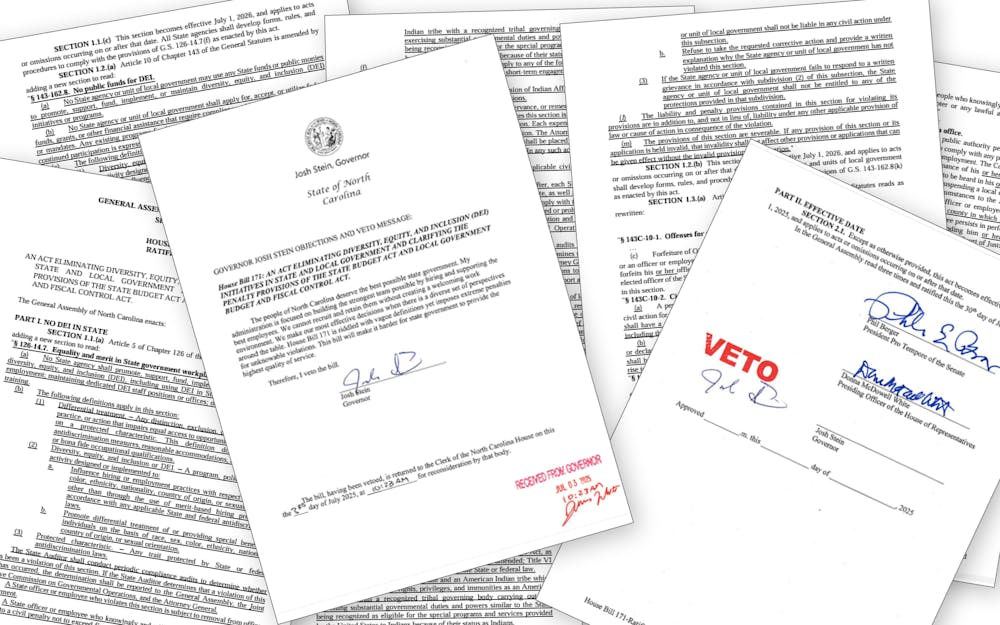
Although North Carolina’s House Bill 171 was vetoed in July 2025, ongoing discussions around the legislation continue to shape how private and nonprofit institutions approach diversity, equity and inclusion efforts.
The bill, which aimed to eliminate DEI initiatives in state and local government, has sparked uncertainty. The broader conversation and potential for similar legislation could have indirect consequences for universities across the state.
North Carolina for Community and Justice is a nonprofit human relations organization, which helps communities get rid of bias, bigotry and racism.
Kelly Dawson, the interim executive director for NCCJ said they don’t have a clear answer, referring to lawmakers’ positions on the bill and its future.
“Not all are operating with the same language,” Dawson said.
Much of the concern, she said, stems from misunderstandings about what DEI actually entails.
“There are some people who don’t know what DEI actually means. It has been reduced to a race issue, and that is not what equity inclusion works for,” Dawson said. “When I think about it, I think of disability issues."
Dawson described DEI as work that "benefits everyone," using accessibility improvements such as ramps, elevators and real-time translators as examples. While private universities like Elon University are not directly governed by the bill, concerns remain about funding sources.
“It’s scary to think about all your funding getting pulled,” Dawson said. “Places have to make these difficult decisions of, are we going to stand on what we believe in?”
Because Elon operates as a nonprofit entity, the impact of such legislation may be less direct but still significant.
Dawson said that some provisions addressed by the bill may already be covered under existing law.
“A lot of these things are already illegal,” Dawson said. “The bill is unnecessary.”
Local officials are also watching the bill closely. Sean Ewing, a member of the Mebane City Council, said while the bill has not passed, it remains a consideration.
“It’s definitely in the back of our minds,” Ewing said. “Until something is actually codified by law, I proceed forward and continue to keep on keeping on.”
Ewing said the city is still working to understand the potential impact, including how funding for DEI-related initiatives could be affected.
“Our understanding is that no resources nor funding would be used for DEI activities,” Ewing said.
Similar to Dawson, Ewing pointed out that interpretation of the bill is unclear.
Ewing said that legislation like House Bill 171 could limit conversations within local government.
“It could really stifle discussions that would be very valuable,” Ewing said. “If we’re unable to say certain words or have certain conversations, it makes it harder to make sure everyone has a seat at the table.”
As conversations continue, both Dawson and Ewing emphasized the importance of public engagement.
"My hope is that people who are directly affected by this will contact their officials,” Dawson said. “It is also up to people in majority groups to do that. We can’t just ignore it, because it affects everyone.”
Ewing echoed that, encouraging young voters such as students at Elon to stay involved. He said the bill continues to appear on the legislative calendar,
meaning it could return in the future.
“This is a real opportunity that students at Elon can make a huge impact in the community that they live in,” Ewing said.