

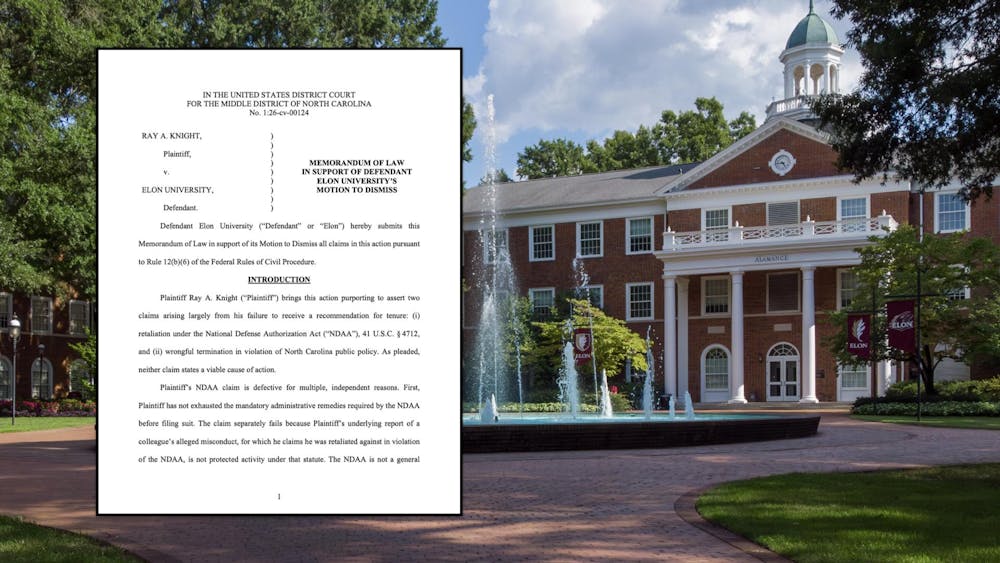
Elon University is seeking dismissal of former Elon professor of accounting Ray Knight’s federal lawsuit, which he filed against the university on Feb. 6. Knight alleges the university retaliated against him for whistleblowing, wrongfully denied him tenure, wrongfully terminated his employment and violated both federal whistleblower protections and North Carolina public policy. The lawsuit was filed in the U.S. District Court for the Middle District of North Carolina.
The university responded on March 17 through its attorney Gerard M. Clodomir, who works for Womble Bond Dickinson, a law firm located in Greensboro. Knight’s claims of retaliation under the National Defense Authorization Act and wrongful termination do not state a practical cause of action, according to the university’s response.
On the federal whistleblower claim — the central piece of the case — the university makes several arguments: Knight did not go through the necessary steps required by the NDAA before filing the lawsuit; Knight’s claim of a colleague’s alleged misconduct does not qualify him as a protected whistleblower.
Knight did not respond to Elon News Network’s request for comment. Elon University spokesperson Eric Townsend said that Elon University does not comment on pending litigation in which it is a party. Elon University’s attorney, Clodomir, did not respond to Elon News Network’s request for comment.
In Knight’s original lawsuit, he claimed he was removed from his role as Internal Revenue Service Volunteer Income Tax Assistance program director a week after making his initial report and was later denied tenure despite receiving a favorable recommendation from his department evaluator. The suit also claims university officials failed to investigate or self-report the alleged misconduct to the IRS or the business school accreditor, the Association to Advance Collegiate Schools of Business.
Second, the university argues that even if everything Knight says is true, it doesn’t qualify for protection under the law. Knight reported that a colleague gave students answers to IRS VITA certification exams, but Elon says the whistleblower statute only applies when the alleged misconduct is tied to a federal contract or grant. According to the university, Knight’s complaint doesn’t establish that connection.
“In that regard, allegations that merely demonstrate a possibility of liability are not enough,” the university wrote in its response.
The university also challenged the timeline. Knight’s disclosures happened in 2021 and early 2022, while his tenure was denied in March 2023. The university argues that the gap — more than a year — is too long to reasonably link the two events as cause and effect.
On Knight’s state-law claim, Elon argues he wasn’t actually fired. The university says being denied tenure isn’t the same as termination, which is required for a wrongful discharge claim under North Carolina law.
The university notes that Knight is a licensed attorney and argues he shouldn’t be given the extra leeway courts sometimes allow people to represent themselves.
Knight seeks reinstatement or front pay, back pay, compensatory and punitive damages, and a favorable letter of reference.
After the university’s motion to dismiss this case, Knight filed to deny this motion and continue with his lawsuit on March 20. Knight had a multi-step argument opposing this dismissal.
Part of this argument claims that the university’s argument against his legal case lawfully failed. These claims include: the university claiming it needs more evidence beyond what the law requires; the court must accept Knight’s allegations as true and cannot credit the university’s competing story; the court must use inferences that are more favorable to Knight.
Knight requested two options of the court — they deny the university’s dismissal of the case or, in the alternative, allow him to amend his complaint..
On April 3, Knight filed a reply that offered new arguments and material.
In one argument, Knight acknowledges that it is materially incomplete. The argument states that the university has not denied any of Knight’s claims that a professor allegedly improperly provided students with answers to the VITA exam — Elon’s VITA program is in a contract with the United States government. Knight argues that the university cannot dismiss the lawsuit by refusing to acknowledge its federal contract.
In another argument, Knight states that the university misstates the NDAA process and role of the Equal Employment Opportunity Commission — a law that sets policies and oversees programs for the Department of Defense. Knight claims that the university attempted to use the Title VII act — a law prohibiting employment discrimination — where it played no role under this argument that the university discriminated against him because of his age, in the original lawsuit.
Knight also argues that the university misstates the ongoing misconduct in their argument of dismissal. Lastly, Knight states that this April 3 reply is necessary to correct new arguments of this case.