

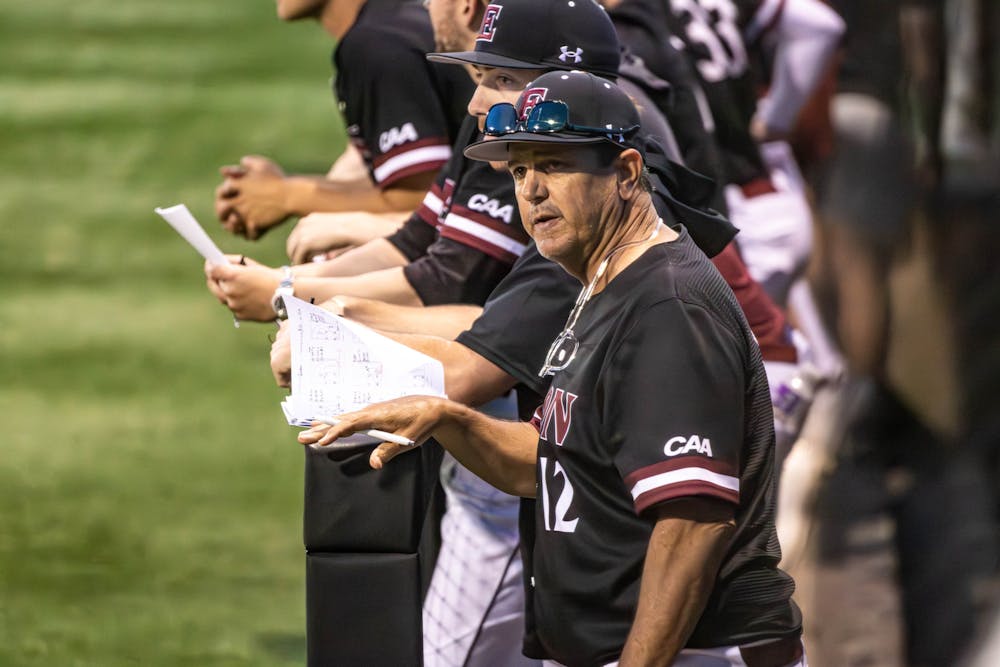
Elon baseball head coach Mike Kennedy has spent most of his adult life at Elon. As a student, he was catcher for the baseball team. Kennedy signed with Oakland Athletics in 1990 then returned to Elon in 1993 as a pitching coach. He’s worked with the team ever since and was named head coach in 1996.
Kennedy said his path to coaching was rooted in a love for the sport and a reluctance to leave it when he finished his Minor League run.
“I wanted to stay in the game somehow,” Kennedy said.
A lot has changed over the last 30 years, but one thing that has stayed the same is Kennedy’s passion for mentoring the players on the team.
“Some of my most meaningful times in coaching have been after practice in the dugout with three or four of them just talking,” Kennedy said. “Just talking about life.”
Those meaningful moments aren’t confined to practice. Kennedy said he’ll go fishing with some of the players and the team often volunteers together.
Kennedy said the rising popularity of the transfer portal has made it harder to develop strong relationships with players who may only be on the team for a season or two. Still, Kennedy values his time with each player and said he hopes they learn from him and from the other players.
Growing up, Kennedy learned these same lessons of trust, service, discipline and teamwork from his coaches and said he wants his team to embody these values.
“They taught me trust,” Kennedy said. “You don’t really want to do something, but they were counting on you to be somewhere, to do something. You had to step up.”
Elon alum Ryan Conroy ’18 was a pitcher on the team and said Kennedy’s life lessons and leadership prepared him for the five years he spent with the Baltimore Orioles.
“He’s one of those guys that is going to push with you,” Conroy said. “He’s not going to ask you to do something that he wouldn’t do. He’s not going to ask you to do something that he thinks is unfair, but he’s going to push you.”
Now, Conroy is back on campus for his first season as Elon’s pitching coach.
“I really didn’t notice how much of my coaching style came from him until I got back here,” Conroy said.
Kennedy said he tries to lead by example and one of the most important aspects of coaching is showing the team how important it is to support one another.
“Baseball, particularly, is a game of failure, so you fail a lot,” Kennedy said. “You can have great joy when you’re failing by being appreciative when somebody else does something well.”
It’s lessons like these — the ones that go beyond the athletic techniques and game strategy — that set Kennedy’s career and impact apart from other coaches, Conroy said.
“This place is more than just a place where he showed up to work for 30 years, it’s home,” Conroy said.