

Brad Hoglund, a parent of a prospective Elon University student, has toured several colleges with his daughter, including Elon. When he is not working or visiting campuses, Hoglund said he frequently writes about artificial intelligence, which he believes is often undersold.
“I don't think people understand the impact. I don't think students understand the impact,” Hoglund said.
While visiting Elon during Scholarship Weekend this year, Hoglund attended a presentation on AI led by Haya Ajjan, dean of the Martha and Spencer Love School of Business. The talk, titled "Artificial Intelligence and the Future: Preparing Students for Elon and Beyond,” was a must-do on his list while visiting campus.
Hoglund said he hadn’t seen anything like Elon’s AI curriculum at any of the other 18 institutions his daughter applied to. After the presentation, he wrote about his experience on LinkedIn and complimented the university on its efforts to acknowledge and incorporate AI.
“Every single college visit I've gone on, it feels like most of the universities, I think I said in the post, are really trying to put the genie back in the bottle,” Hoglund said. “They're pretending like it's not an issue, or they're trying to legislate AI out of the curriculum, or trying to restrict it somehow.”
In Hoglund’s LinkedIn post, he states that kindergarten through 12th-grade education has a glaring gap in foundational AI education.
However, a new opportunity during the summer may bring the AI fluency to Elon’s campus that Hoglund is looking for.
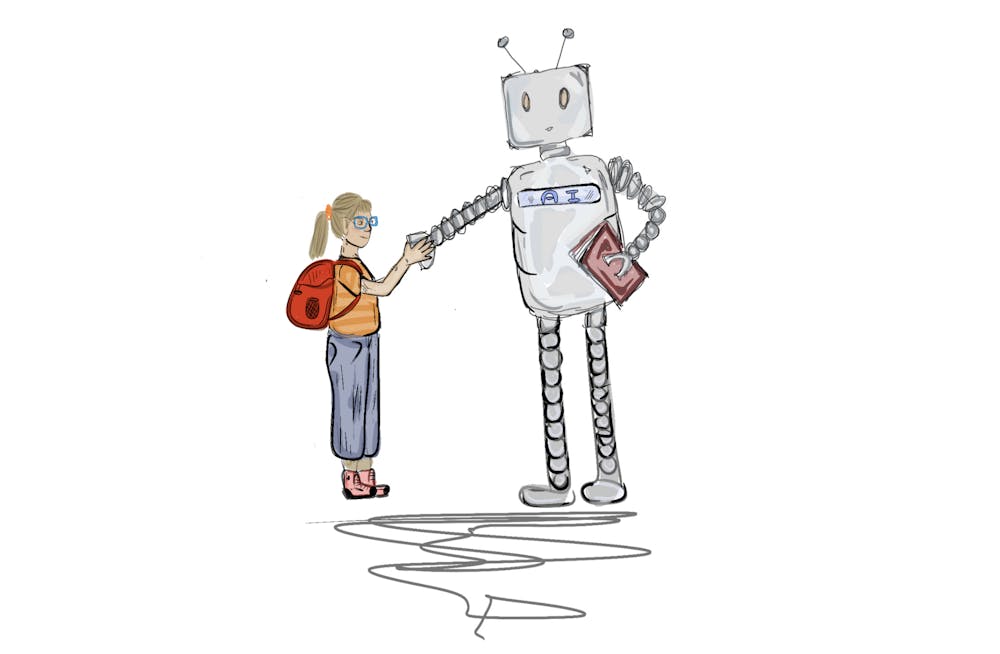
This summer, Elon will offer a new program that aims to introduce middle school students to AI concepts. The university will host a weeklong summer day camp in June for middle school students focused on artificial intelligence through hands-on activities and digital game design.
The camp, called AI Play, will be led by faculty from the Department of Computer Science and is now open for registration. Assistant professor of computer science Alex Goslen said the program will include unplugged activities.
“Typically, you would think of computer science being on a computer the whole time, but students will be very engaged and running around, doing different activities to sort of act out how AI concepts work,” Goslen said.
Goslen said the idea for the camp originally sparked from the dean’s office being interested in summer camps, and she had already done research on the camp during graduate school.
“When we heard there was an opportunity for a summer camp, I kind of leaned in and said, ‘I have this curriculum, would this be something that we're interested in?’” Goslen said. “And then it kind of grew from there.”
Each day of the camp will focus on a major AI concept, referred to by faculty as “the big ideas in AI for K-12,” Goslen said. The first day will focus on perception, with perceiving things through sensors and data collection.
“We have a robot relay that they play, where some students are blindfolded, and they have to race to navigate a maze similar to how a robot would in the real world,” Goslen said.
Students will primarily use Scratch, a visual coding and AI platform, and no prior programming experience is required, according to Goslen.
Hoglund said he thinks it's important for kids to become AI native.
“People can complain about it all they want, but it's not going anywhere, and it's in our reliance, and the innovation is only going to increase,” Hoglund said. So, it is fundamentally important.”
Hoglund said he has been impressed by Elon’s commitment to AI integration.
“I was really impressed by the sort of honesty about the impact it potentially will have on students, the fact that Elon was embracing it full force by installing Gemini and giving access to all students, and that they were building study tools,” Hoglund said.
Goslen also noted the importance of knowing how tools are built.
“I think starting at an age where they're younger and maybe don't have as much experience with programming yet, it helps too, because AI is being put into programming as well,” Goslen said.
The cost of the weeklong camp is $500, which covers lunch, snacks, materials, T-shirts and staff support. Goslen said students should walk away with a good understanding of AI — but won’t necessarily interact with external AI tools.
“If parents are concerned about the confidentiality of data or anything like that, we aren't going to be using AI tools outside of unplugged activities that we have,” Goslen said.