

Right behind the parking lot of the Station at Mill Point, stands a nondescript four-story tower branded by burn marks. That tower helps breed excellence and consistency in the Elon Fire Department’s ranks.
The fire department’s training facility behind Mill Point is a Class A burn building, meaning it is designed for live fire-training using burned organic materials such as wooden pallets, but not fuel. Division Chief Brandon Waddell oversees the department’s training program and said it helps simulate situations that they would face.
“No incident is the same,” Waddell said. “It gives the guys — the scenarios we create, the trainings that are developed amongst the crews — that sense of urgency, that uncontrollable chaos. We create that type of scenario, and then we also add in the elements of the smoke, the heat, zero visibility that we may encounter.”
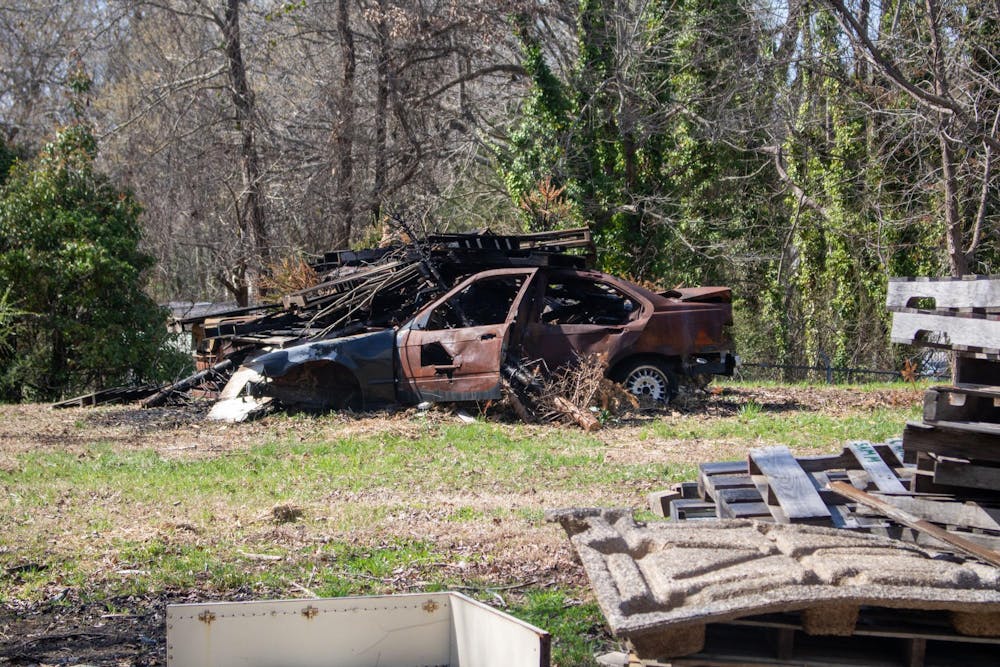
The main attraction of the training facility is the four-story tower which has a variety of access points for rope rescue scenarios. It also has dummies inside for other types of search and rescue scenarios. The department often simulates live burning scenarios through an actual fire going on inside the tower, including some training with fires on the third floor to give firefighters insight into the approach of a high-rise building fire. The facility also has a couple of vehicles to simulate situations where a person is stuck in a burning car.
Waddell said when they stage a live fire, they have a burn instructor inside to oversee the fire, as well as a safety officer. Additionally, all building exits are unlocked for safety. Waddell said a water hydrant is also available 50 feet away from the building during drills.
“They'll have to pull lines off the truck, approach a structure, enter the structure, conduct the drill, isolate any hazards and extinguish the fire,” Waddell said. “They'll have to do so again at live time, at live speed.”
The facility’s presence in a residential area of the town isn’t lost on them, however. Waddell said the department alerts the community when they plan to put on a big training session that might attract a lot of eyes. He said they put out notifications on social media and notify police and the town hall ahead of time. But he said the department has gotten calls before from community members where they need to push out information that they are just training.
Training sessions are a vital part of firefighter’s work at the fire department, Waddell said. Members of the volunteer fire department staff attend training sessions at the facility every Tuesday night for three hours. Ray Pruitt, assistant chief of the volunteer staff, said it helps these volunteers become more efficient.
“We want to practice and make mistakes on the training ground, so we won’t make mistakes on the real scene,” Pruitt said. “That's the whole purpose behind this training.
Pruitt said it helps the volunteers work on their skills and improve. He said since the first training of the year, he’s seen a lot of improvement from some of the new volunteers.
“Since the first of the year, we started at the very beginning with some new candidates, and here we are in March, and we're starting to do some firefighting, search and rescue type stuff,” Pruitt said.
Waddell said full-time firefighters are required to get 240 hours of training each year. But he said they typically do more than that as the 24-full time members in 2025 recorded over 12,000 hours of training. Training sessions are typically focused around the needs of the firefighters. Waddell said these experienced firefighters still learn from these training sessions because of how firefighting is always changing.
“This is one of those professions where you can never stop learning,” Waddell said. “The guys have to be reminded of what can happen and what the potentials are, so we can quickly isolate and mitigate situations.”
Waddell said they use the training facility to test out new equipment and adapt changing aspects of the job like the emergence of electric vehicle fires or different types of buildings. Waddell said training continuously as conditions change is important, along with making sure it’s as realistic to a real situation as they can.
“We get it as close as we can to to have them prepared for what's to come in the real world,” Waddell said.