

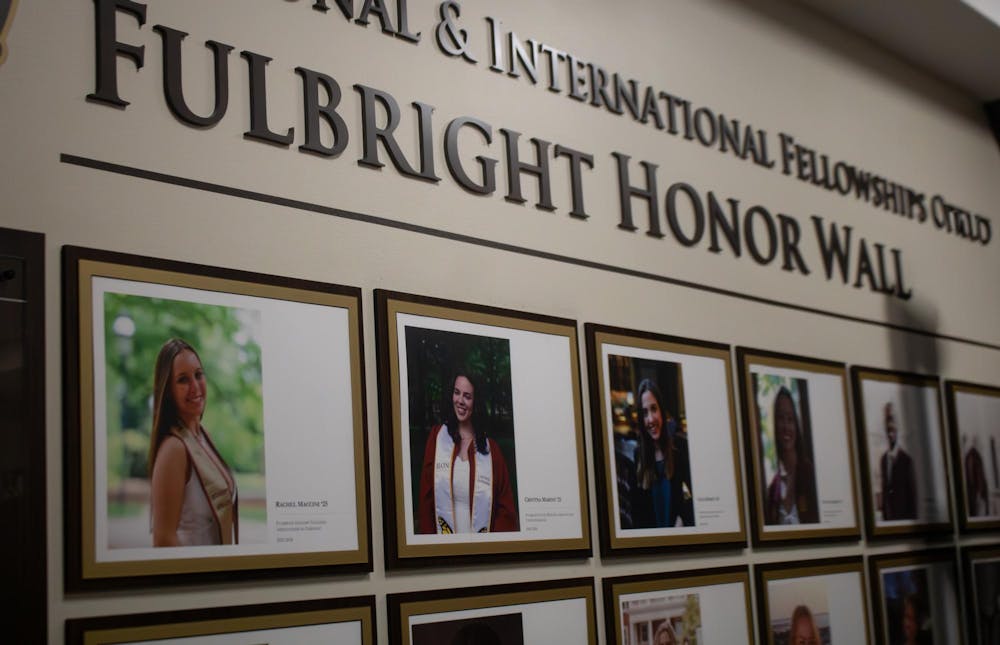
Eleven Elon University seniors and alumni have been named semifinalists for the 2026-2027 Fulbright U.S. Student Program.
Founded in 1946 and sponsored by the U.S. Department of State, the Fulbright Program offers research, study, and English teaching opportunities in more than 140 countries across the world.
As semifinalists, the Elon students and alumni have advanced through the national screening process, and their applications will now be reviewed by host countries for the final round of consideration.
Among this year’s semifinalists is senior psychology major Alex Fleischmann, who applied for an English Teaching Assistantship in South Korea. For this specific ETA program in recent cycles, more than 250 applicants competed for fewer than 90 awards, according to the Fulbright official website.
“At first it was, like, ambitious, a little bit stressful, but really, I just enjoyed the process. And they walked me through it so well,” Fleischmann said.
Fleishmann began working with the fellowships office during his sophomore year after one of his mentors encouraged him to explore grant opportunities. He said that the continuous structured feedback made the application feel manageable.
If selected, Fleischmann would spend 11 months teaching English in South Korea. He said his interest in Korean culture and desire to experience Asia influenced his decision to apply there.
“I figured, while I was applying for this grant, I might as well try a culture I've always been interested in, but haven't really gotten to experience,” Fleischmann said.
Creative Writing and Classical Studies major Jo Bogart is a selected semifinalist for a study and research grant to the United Kingdom, where she hopes to pursue a master of Arts in Creative Writing at the University of Manchester.
“It was hard for me to feel like my scholarly and creative interests in the Arts & Humanities would be competitive in something quite this prestigious,” Bogart wrote in an email to Elon News Network.
Bogart also wrote that she was surprised to make it to the scholarship's semifinals. “Now, I feel excited and anxious to embark on the (potential) next steps of the Fulbright process in the coming months,” Bogart wrote.
Nicole Galante, assistant director of the National and International Fellowships Office, said the process is rigorous and highly competitive, with an overall acceptance rate of about 20%.
“Our ultimate goal, of course, we want students to get awards, but really it still happens through the process of applying,” Galante said.
Galante said students typically begin working with her office the summer after their junior year. Over many weeks, applicants draft and revise their essays, participate in on-campus interviews, and refine their work before officially submitting in October.
“I think oftentimes the most successful fellowship applicants aren't really the ones who have done the most impressive things, but can tell your very cohesive, specific story,” Galante said.
Galante said Fulbright is a reflection of Elon’s emphasis on global engagement in cross-cultural exchange.
“They're sending students abroad to go to graduate school or to teach,” Galante said, “but with the mission of building bridges between communities.”
For underclassmen considering nationally competitive fellowships, Galante encourages students to reach out early.
“It is never too early. We would love to talk to you at any point.” Galante said.
Fleischmann echoed that advice. “The worst they can tell you is no,” Fleischmann said. “There is no downside to doing the application.”
The eleven semifinalists now await final decisions from review committees in their respective host countries, with notifications expected later this spring and summer.