

With the rapid rise of AI and misinformation, the digital world has been altered due to “misleading technology,” according to Elon University alum Bryan Anderson ‘18. He said he believes, however, that the solution starts with a spreadsheet.
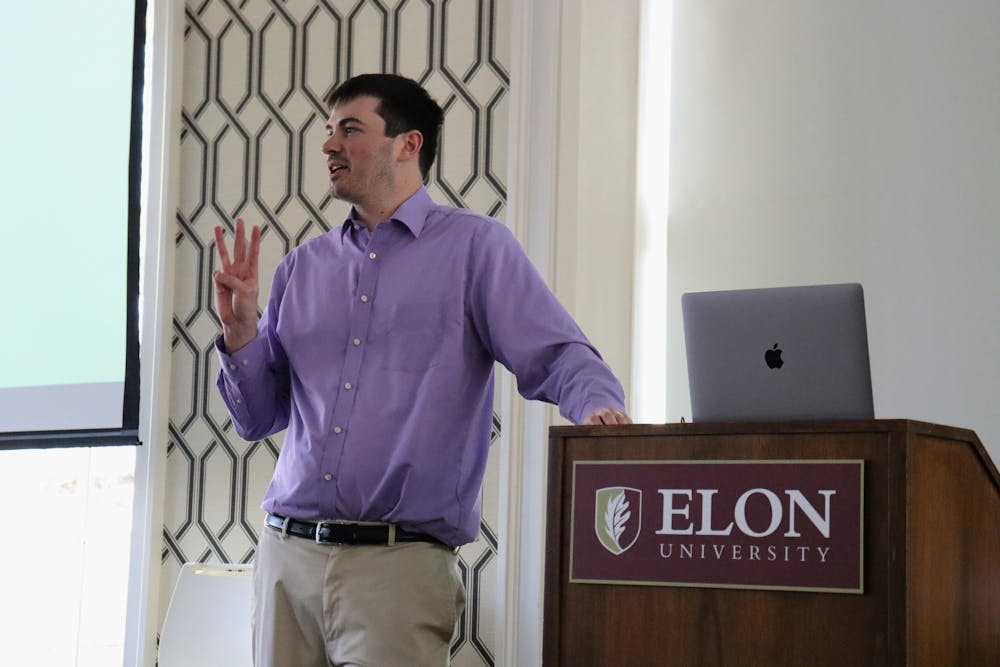
Anderson, a North Carolina politics reporter for The Assembly, returned to campus on Feb. 10t to lead a conversation about “Combating Misinformation.” This event, hosted by Data Nexus in the LaRose Student Commons, aimed to reveal how data can be used to both manipulate and verify the truth of political content.
The talk is a part of Elon’s “Love Data Week,” a national initiative held annually around Valentine’s Day to educate students on data competency. For Crista Arangala, director of Data Nexus, bringing a journalism alum was a deliberate choice to show that data competency isn't just for STEM majors.
"Data shows up in almost every field," Arangala said. "The theme of combating misinformation from the point of view of a journalist would be both interesting to students but also very relevant."
Anderson, who has spent the last decade covering the General Assembly and the Governor’s Office, said that while politicians have always stretched the truth, the tools for "intentional manipulation" have evolved. He also said that AI-generated audio recordings of candidates and TV ads using deepfakes intensify the pervasiveness of misinformation.
During his talk, Anderson recalled an ENN article he wrote at Elon regarding a whiteboard message that read, “Bye Bye Latinos Hasta La Vista.” Though the message was serious, Anderson admitted his original reporting was flawed. He labeled the note as hateful without the necessary evidence or data to support this claim.
Anderson continued by encouraging future journalists to write objective statements backed up by evidence. He claims that social media and online platforms create more potential for sharing misinformation.
"Students are very heavily engaged on social media," Anderson said. "It’s very easy to go down a rabbit hole and feel your views are reinforced. I’m hoping people come away with some strategies and tools for spotting, identifying, and putting good information out there."
Anderson said he believes the solution for students is to break out of the echo chamber and not only engage with content that aligns with their opinions.
"You want to challenge yourself and challenge what you are seeing," Anderson said. "Data is the basis for almost everything we do.
The event highlights the university’s broader commitment to "data competency," a five-year Quality Enhancement Plan currently in its third year. Arangala also said that the school has already approved over 60 "data-intensive" courses, including investigative journalism capstones, to help students across all disciplines navigate a world governed by metrics.