

Updated as of 4:03 p.m. Feb. 9 to include information about confidential support and advocacy resources.
Updated as of 5:58 p.m. Feb. 7 to include a letter to the editor from associate professor of psychology CJ Fleming.
One in five female students at Elon University experienced sexual assault at some point during their college experience, according to newly shared data from a Higher Education Data Sharing Consortium Sexual Assault Campus Climate Survey. The survey did not define “sexual assault.”
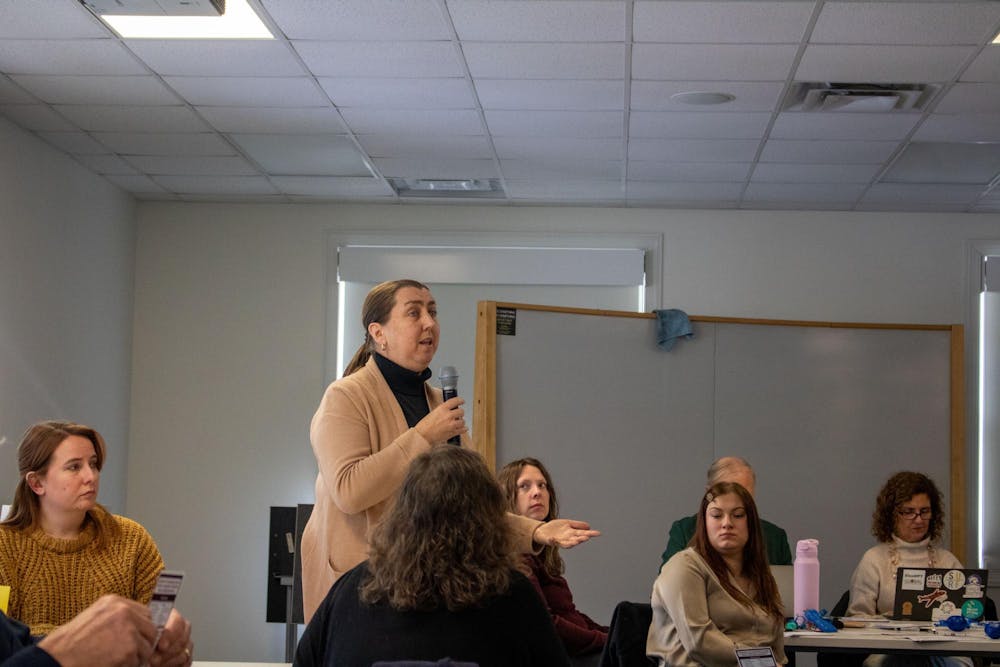
The results of the study, which surveyed Elon students in spring 2024, were presented Feb. 6 at a Campus Conversation in Belk Pavilion that many professors and faculty members attended. Elon News Network’s request for the raw data was declined.
The survey mostly received responses from female students, but of the male respondents, one in 23 students reported that they had experienced sexual assault at Elon. One in three female seniors said they have experienced sexual assault, with one in six non-binary students saying they have experienced it.
These findings contrast with results from 27,000 students from other institutions that took the same survey. Institutions that have taken the survey in the past include Carleton College and St. Olaf College. Other doctoral institutions found that one in eight female students experienced sexual assault, a slight decrease from Elon’s numbers. Elon’s numbers do line up closely with the national rate of 45% of women and 17% of men experiencing sexual assault, according to CJ Fleming, an associate professor of psychology who helped present the results.
“Those numbers are a little bit higher than other doctoral institutions, but not out of line with national norms,” Fleming said during the event. “So it's not great, but it's not terrible either, right? So we're sort of right in the middle there. It's definitely something that we want to continue to pay attention to.”
Fleming emphasized the fact that these numbers might not show a higher number of incidents, but rather a higher rate of reporting and more trust in the system.
The study found that 34% of Elon students reported having a peer in an unhealthy or abusive relationship, and that 33.5% of them have intervened in those relationships. The survey results also indicate that Elon has a much higher rate of alcohol consumption than other institutions.
Fleming said alcohol consumption doesn’t automatically equate to sexual assault, but it's often part of the picture. Professors who attended the event said that alcohol will always be a problem on college campuses, despite the popular idea that Gen-Z drinks less.
The survey found that 88% of students at Elon indicated that they believe faculty and staff are genuinely concerned about students’ welfare, compared to an average of 74% from other universities. Despite this, Megan Karbley, director of compliance and Title IX coordinator at Elon, said formal reporting is rare.
Karbley said there were 163 Title IX referrals at Elon from fall 2021 to spring 2024. The survey found that 10% of women told no one about their sexual assault experience. Karbley said the survey shows that students are experiencing sexual assault at a higher rate than is being reported.
Karbley also said it is important to find ways to help students who don’t want to go through the formal process, like separating them from another student in class.
“We're going to always afford the formal complaint option for folks. That's always an option,” Karbely said. “But is there anything we can do in the interim to help stop, remedy or prevent what's going on?”
Karbley encouraged teachers to attend workshops to learn more about how to support students and suggested that they don’t wait until the first time a student approaches them with a situation. She emphasized the need to reflect when dealing with traumatic experiences that students bring up.
“I also do this work every day, and the weight of sitting with a person who has been affected by sexual violence in some way, I will offer that it never gets easier, but the value and the importance of taking the time for myself to reflect; I sometimes practice in my car,” Karbley said.
Letter to the editor from associate professor of psychology CJ Fleming:
To The Editor
Elon News Network
Dear Editor:
I want to thank Elon News Network for its interest in the significant topic of sexual assault prevention and response. I understand that a topic of this magnitude can be reported in several ways. The recent ENN article about our Campus Conversation addressed the statistical prevalence data that was presented, but it did not fully address the context and purpose of the session and did not draw attention to the incredible amount of hard work being done on our campus in this area.
In response to the article, there have been strong reactions to my quote about how rates of sexual assaults at Elon compare to those nationally. Without the full context of what was presented in the session, I see why this quote raised concerns. Before I offer that context, let me say unequivocally: sexual assault is completely unacceptable, and I wish no member of our community - or any community - ever had to endure it. I apologize for any distress that my words caused, particularly to survivors.
I, and the people and offices at Elon that support sexual assault survivors, are committed to both prevention and compassionate response. My remarks during the Campus Conversation presentation addressed the fact that higher rates of reporting do not always indicate higher rates of incidence, but may well indicate more comfort with reporting and trust in Elon University’s system to support survivors. How I was quoted was not an indication in any way that Elon rates of sexual assault are to be tolerated or accepted — zero is the only acceptable number.
The survey reflects Elon’s attempts to understand and address acts of interpersonal violence on our campus, and the Campus Conversation concluded with a call to action for our community to come together to prevent violence and support survivors to the fullest extent. Although monitoring data and comparing to national norms is a part of that, we recognize that alone it is insufficient, and it was not presented as the only step forward.
To survivors who read ENN’s story and felt like your experience was in any way trivialized or diminished, I am sorry for any pain you experienced. The purpose of this month’s Campus Conversation, and of all of our work, is to educate and empower our community to take action to prevent violence and to support survivors.
I look forward to working with all members of our community to continue strengthening our prevention efforts and our support for survivors.
CJ Fleming
Resources