

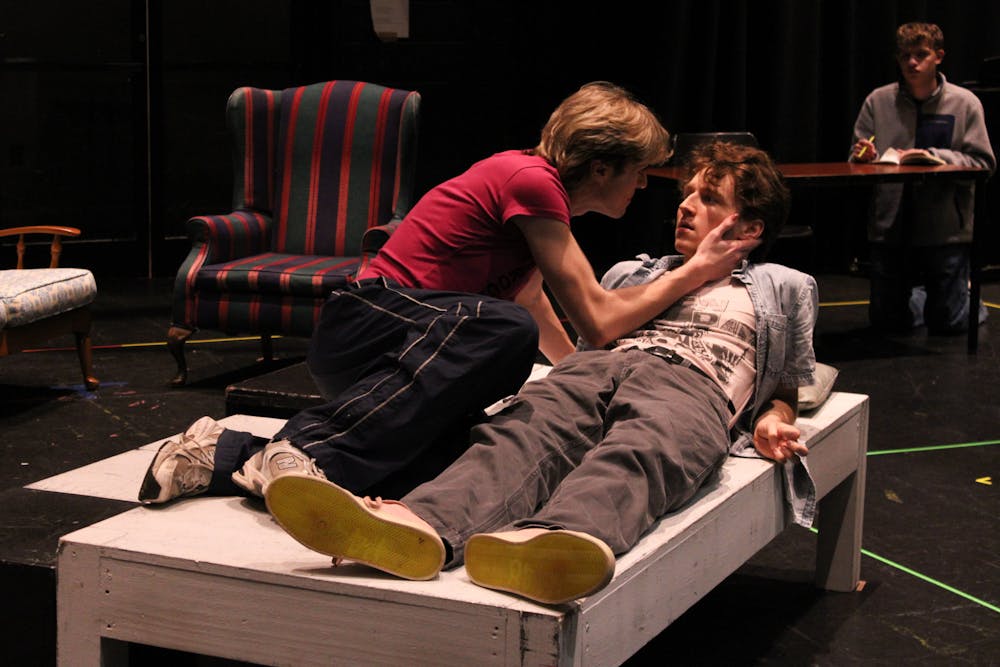
Featuring more than 50 short scenes, Elon University’s winter play explores the concepts of technology and how it impacts human relationships.
The show, titled “Love and Information,” will have 10 performances in Roberts Studio Theatre in Scott Studios from Jan. 17 to Feb. 1.
Director and professor of the performing arts Kirby Wahl said the show holds true to its name, focusing on the connections between love and information across different contexts.
“There's a scene where, I think — and this is our interpretation — but I think the wife is hinting around that she knows he's having an affair, and that's the information in the scene,” Wahl said. “It's subtextual there. The word is never said, but it's there. She wants more information.”
Wahl said that as a winter term show, the cast will spend a total of 11 to 12 days rehearsing throughout the day before opening to audiences. With over 50 scenes and over 110 characters in the show, Wahl said the process is a lot for the show’s 16 actors to do in a short time.
Additionally, Wahl said the cast will be speaking in various English accents in their scenes to match the tone created by playwright Caryl Churchill.
“We will be doing contemporary London accents because it doesn't make sense to say some of the things they say, some of the phraseology,” Wahl said. “In one scene, a husband says to his wife, ‘Don't, let's have this conversation.’ It's like, no American would phrase it that way.”
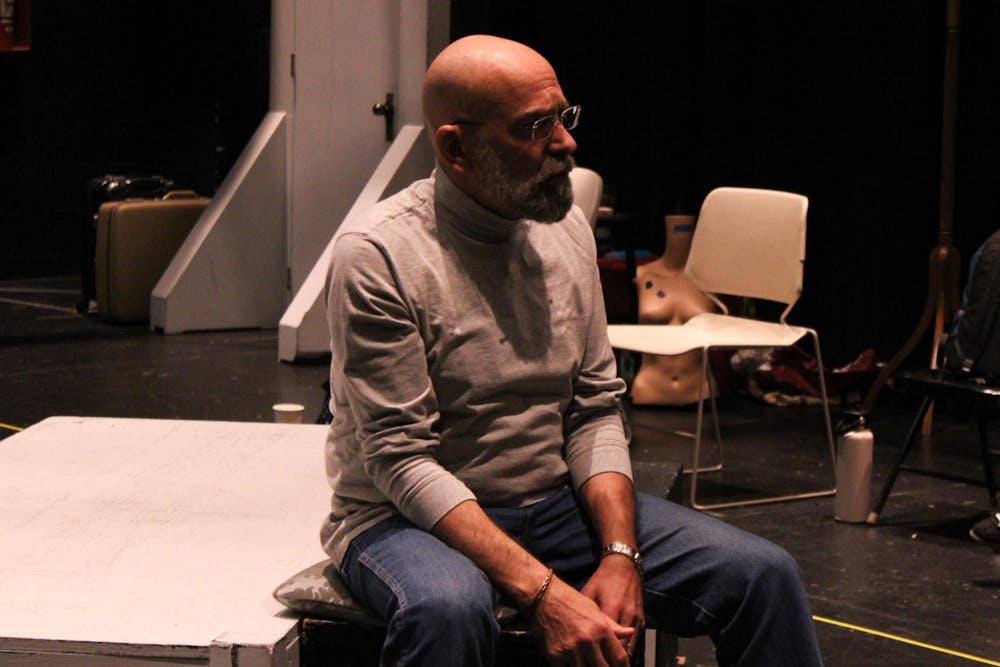
Director of "Love and Information" Kirby Wahl advices actors working on a scene during rehearsal Jan. 9 in the Center for the Arts.
For juniors Parker Bowen and Graham Boggess, this show came right after they returned from spending a semester studying abroad in London. Both said their time abroad has helped them with learning the accents for the show.
Bowen said he has referred back to videos and talked with people he met abroad to help with his accent.
“I feel like sometimes with accent work, it can get a bit intellectual, and for me, I think it works best just to listen and repeat what I'm hearing,” Bowen said. “Having all of that in my mind definitely helps me personally with the accent.”
Boggess said he didn’t expect his study abroad to help with the accent work, but it has proved itself useful.
“When I'm working on a scene, and I don't really know how I would say this word, I try to imagine how my professors would have said it,” Boggess said. “They're all British and it has honestly helped me a lot to think, like, ‘Oh, yeah, how would Johnny say?”
Another obstacle actors face in putting on the show is managing around seven different characters they each play. Wahl said he and the actors created many of the details for each character since the play leaves everything open, including leaving the majority of characters unnamed.
Sophomore Gennie Philpott said each character requires its own specific details to create and remember.
“You have to get yourself organized,” Philpott. “Like, ‘Okay, I'm in these seven scenes, and I play this character in this one, and this character in another one.’ And then you get into the specifics of each one, and so like, ‘Okay, this character's accent leans a little bit this way.’ Or, like, ‘This character's physicality is a little bit more like this.’”
As an understudy, freshman Philip Podhurst said he has to learn from the actors to study the characters in his 17 assigned scenes. He said being an understudy for this show is an interesting challenge, learning from the specifics of each character from the actor creating them rather than doing research about the character in the play.
Philpott said the show fits well with how information is transmitted to people in today’s world.
“We're in an age right now of a high volume of information is coming at us at all times,” Philpott said. “You can look up anything all the time, whenever we're all scrolling on like Instagram or TikTok all the time. So you just get all this quick information is just coming at you constantly, and I think that this show is an exploration of the different ways we try and get and we process information.”
Bowen said the show structure mimics that of short-form content like social media, adding to the themes of technology and information.
“Audiences seeing this show and seeing how rapid things move you have to make a lot of assumptions about these people and these characters, which is what we're doing on a day to day basis on our phones when we're scrolling, scrolling, scrolling,” Bowen said. “The show asks the audience to just reconsider how they engage with the media that is around us and the content that is around us.”
Boggess said he hopes audiences embrace the show and what it has to offer.
“You're not following one character in the plot. It's a bunch of different scenes, a bunch of different vignettes,” Boggess said. “I hope people are hungry for something new, hungry for something that they have not seen before and probably will not see again, because it's really a unique show.”
“Love and Information” will run from Jan. 17 to Feb. 1 with evening performances at 7:30 p.m. Jan. 17, Jan. 20-22, and Jan. 30-31, and matinees at 2 p.m. Jan. 17-18, Jan. 31 and Feb. 1 in Roberts Studio Theatre. Tickets are $15 or free with an Elon ID and can be reserved on the Elon Performing Arts website.