

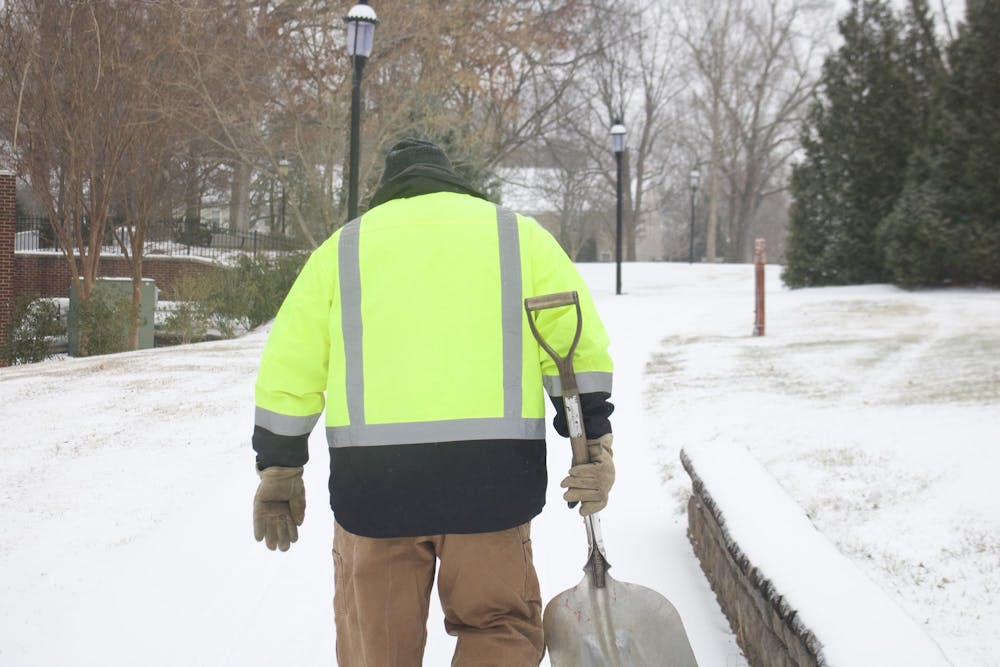
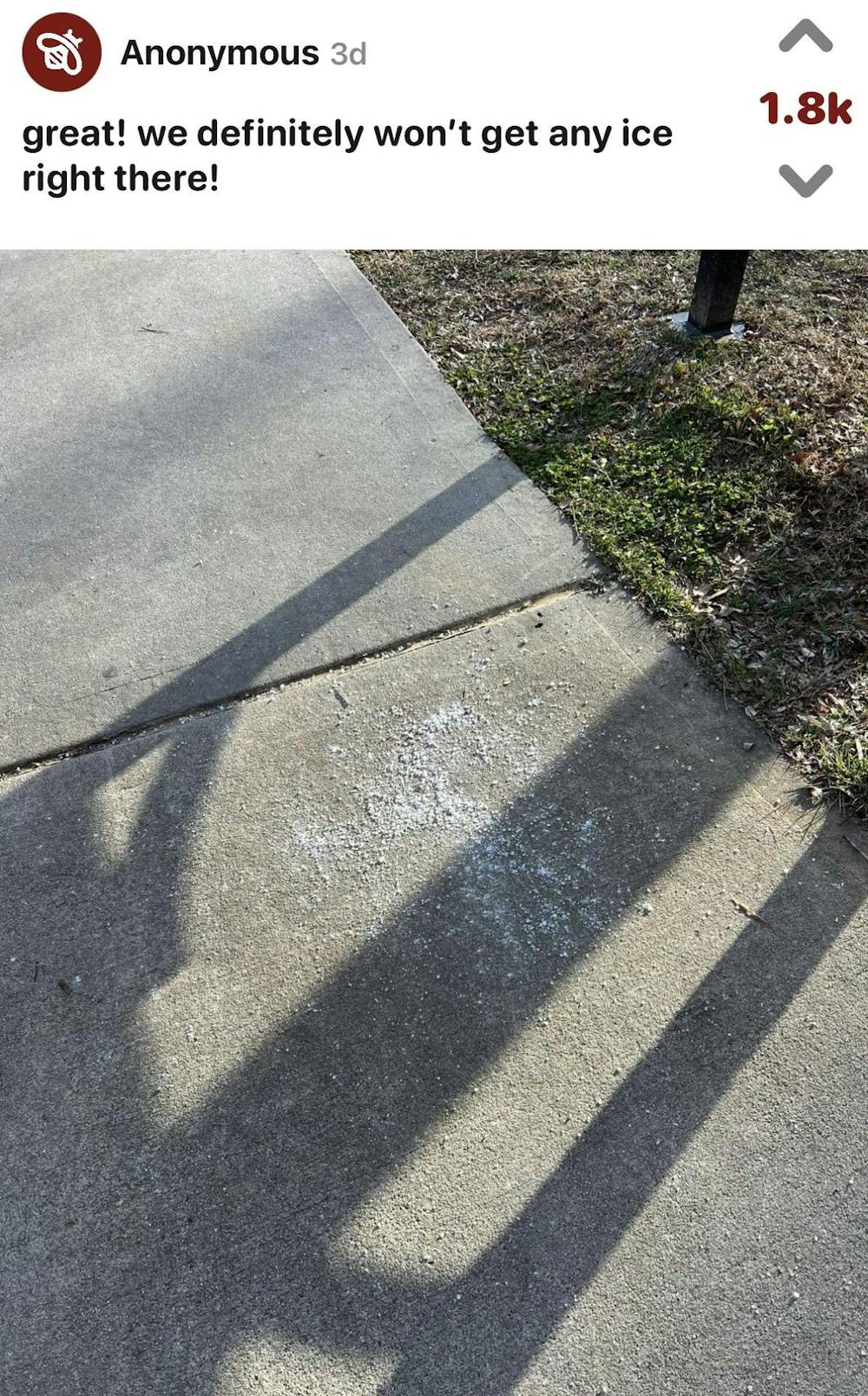
I came across a sarcastic Fizz post while I walked through the snow. It showed a concentrated clump of snow salt on the sidewalk and read, “Great! We definitely won’t get any ice here!” I saw a couple of posts like this on the student social media app.
I started to wonder if people realized the effort Facilities Management makes against the scourge of nature. There is a chance that someone laid that salt on a 6 p.m. to 6 a.m. shift. Social media is full of vicious anonymity. I wanted to show the reality of the work.
There was a point when projections of a snow day with more than 10 inches circulated. Would it turn out that way?
Sunday 8:11 a.m.— I can discern two men in neon workwear spreading salt beside a Cushman buggy. Snow makes anything manmade visible, distinct. It is a difficult, yet manageable, 28 degrees outside. Raymond Fletcher leaned against the pillar outside McEwen Dining Hall, waiting for me. Fletcher is the senior director of Facilities Management at Elon University.
“So far so good,” Fletcher said. “Temperature, that is what concerns me when you think about a storm like this. When you start getting ice on the trees, it starts taking power lines down.”
There were some brief outages on South Church Street; however, the storm passed without any major problems in the Elon area. Many other areas, such as Charlotte, faced trouble with the storm and the state faced 600 car wrecks in the icy conditions. Elon’s freezing rain swept away easily.
The snow fell, pattering diagonally, with faint cackling in the tree line. Ice fell overnight, and now a snow-like layer softened the ground. Fletcher said dry storms like this were easier to brush away. Plowing is reserved for high amounts of fluffy snow.
“Mother Nature is going to throw whatever she has, and we are going to have to deal with it,” Fletcher said. “It’s an age-old tale, a struggle, human and nature.”
Fletcher cut his management teeth in the Navy, and it shows with flecks of subversion, discipline masking droll observation.
“People before us had it worse,” Fletcher said. “You know, it’s not like the Oregon Trail or the Donner Pass or anything like that. You and I aren’t eating each other.”
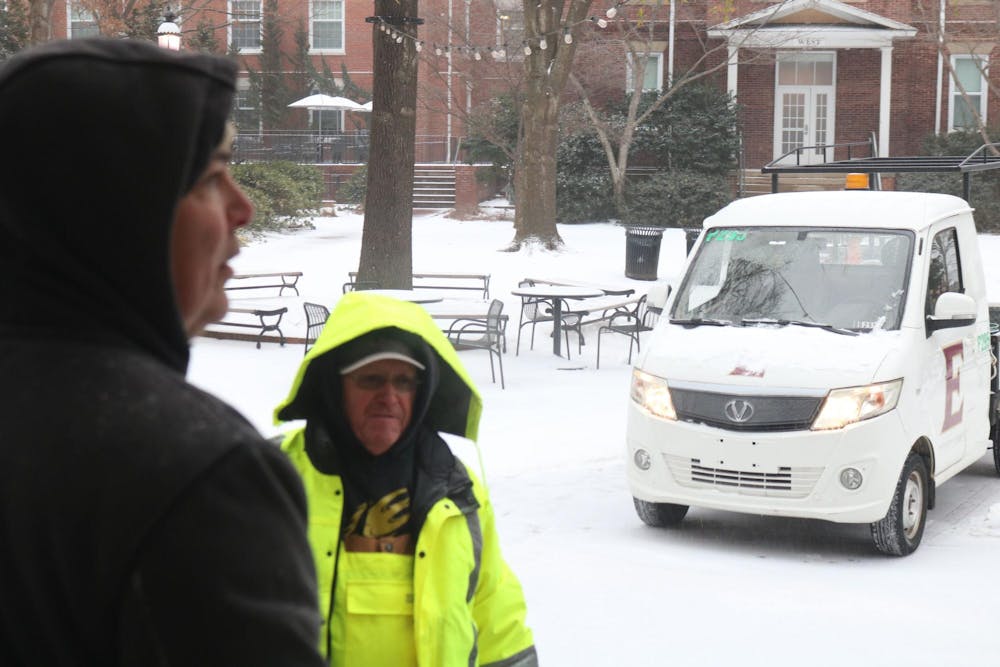
The plan for the day was not anything foreboding. Fletcher was methodical. Facilities Management planned to wait for the snow to quit falling before anything major, but would shovel the openings of buildings and apply salt in the meantime. They had time to stretch out since sorority rush was postponed. They didn’t have to buy any new equipment for the snowfall, according to Fletcher.
There were predictions of up to 12 inches of snow in a winter hell. Power lines can sag after small amounts of snow. Outages could follow. Injury? Death? A Phoenix sorority Donner Pass?
We got a quarter of an inch of mostly ice on Sunday.
Elon prepared for the worst and ended up with something manageable. Those working were a miscellaneous sorting of landscaping and other Facilities Management employees.
I ate lunch alongside Terry Leonard, an assistant women’s track coach who helps facilities management on the weekends. Leonard told me he no longer trusted the weather reports in North Carolina. Air columns tell you the details of when the precipitation freezes in the sky. It shows if the rain will be icy or a snowy buildup, which is vital information.
“The air columns are not the sexy part of the story that people want to see on camera,” Leonard said. “They want to see jackknife trucks on the side of the road.”
Weather reporters tend to underreport the actual details to get clicks, Leonard said. He knew the snow wasn’t going to be unmanageable.
“Have you ever seen a story about I-40 and how nice it was to drive on it?” Leonard said.
I guess I came close with an article about people who are supposed to be shoveling snow who are, consequently, shoveling snow.
11:30 a.m. — The snow quit pattering in the trees. With the sleetless silence and the first round of snow down, labor is now in the picture. Teams disperse across the campus to clear up some crucial walkways. I rode in Laura Miller’s Cushman buggy. We talked about audiobooks, snow shovelling and funeral rites as she gave me a lift to the other side of campus.
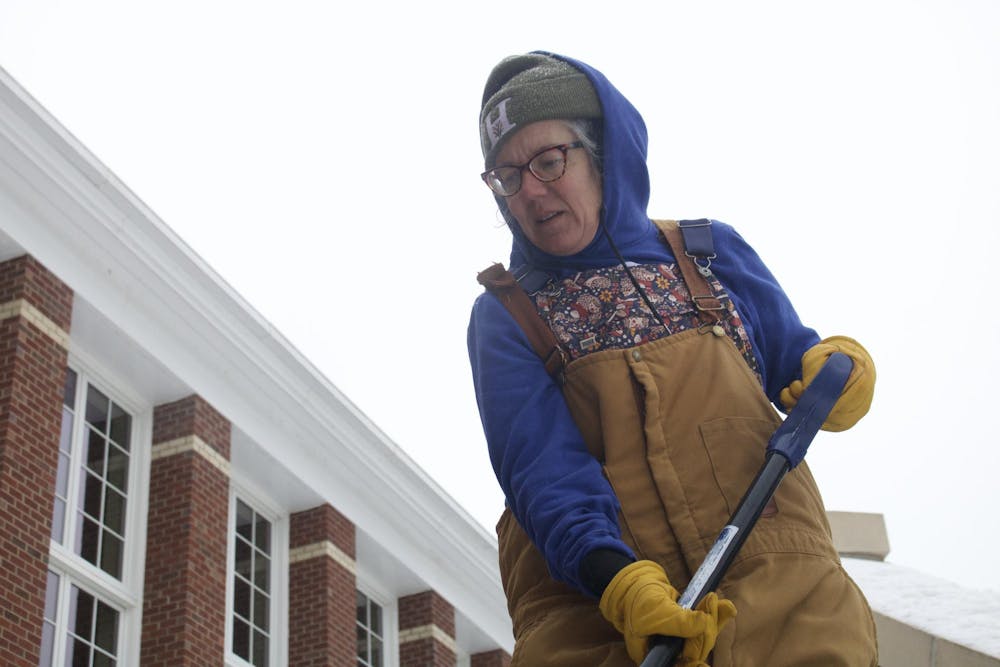
I started walking by myself. A thick coat of snow reminds the walking man of the passage of time in layers, the inflections and works of humanity, striving against a gentle gale. There is a strange forensic grace. You can tell when the fresh leaves have fallen by the marks above the coat, and when the teams have applied the salt — the marks of man. Snow preserves nature and effort for a brief moment. A lack of effort becomes visible. That is what is so difficult about this kind of work.
Stoplights change colors without cars. I remember riding with Fletcher in his car as he scanned the area for excess snow. He paused a podcast on military maneuvers as I sat down. Teams would work throughout the night.
“We were expecting much worse, but we will take this,” Fletcher said.
If you see someone shoveling snow, don’t say anything corny like, “Thank you for your service,” just look around at the ground and say without irony, “This is great! We definitely won’t get any ice here!” That would probably never happen, but it isn’t wrong to aspire to it.