

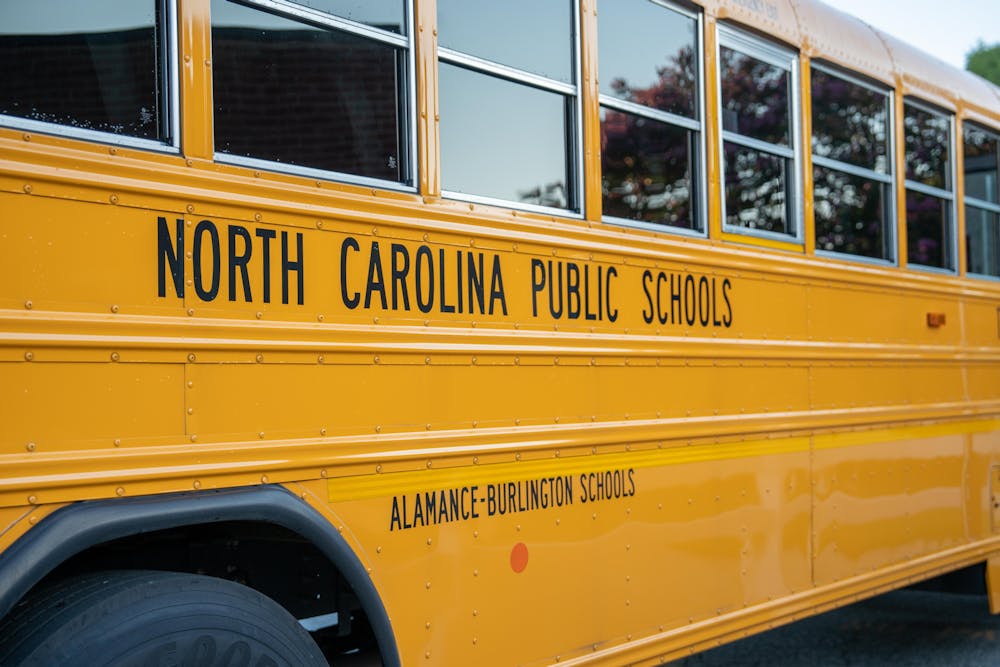
As K-12 students across North Carolina prepare for their winter break, the Elon University Poll released poll data on Dec. 17 finding that most North Carolinians gave mediocre or poor grades to public schools across the state.
Elon Poll, who partnered with the Dr. Jo Watts Williams School of Education, found that among the participants they surveyed, 50% gave public schools a C, D or F letter grade. Public schools received the highest percentage of mediocre or poor grades, with private schools receiving 20%, charter schools receiving 28% and home schools receiving 27%.
Director of the Elon University Poll, Jason Husser said the Elon Poll and the School of Education wanted to conduct this poll following changes in K-12 education policy.
“There's been some emphasis on shifting education authority towards the states,” Husser said. “The states have always had deep authority on education, but there has been more federal involvement in various years. So we thought, well, this is the time for us to really look in depth about what do people think about North Carolina schools.”
In March 2025, President Donald Trump signed an executive order to close the Department of Education and “return authority over education to the States and local communities while ensuring the effective and uninterrupted delivery of services, programs, and benefits on which Americans rely.”
Elon Poll found 46% of respondents indicated that they believed the state government deserves a lot of the blame if a school performs poorly.
Forty-four percent of respondents also believed local schools deserve a lot of blame if a school performed poorly.
When it comes to schools underperforming, 60% of respondents said insufficient funding and resources are one of the most common issues. The second most common answer was 52% of respondents said lack of parental involvement.
Dean of the School of Education Ann Bullock said she hopes these results will help inform state government officials for the future.
“Sixty percent felt like the one of the reasons schools underperform is due to under-resourcing or insufficient funding,” Bullock said. “I do think the public is clear on that message, which is a clear message that needs to be told.”
Husser said results indicated that most respondents were unaware or had limited knowledge of how schools function and can be improved.
“When it came down to what are the mechanisms by which schools can be improved, the governance structures, there was a great deal of confusion in that regard, with relatively low knowledge about how schools actually function,” Husser said.
Part of the poll asked respondents how local school board members acquire their positions. The majority of North Carolina local school board members are elected to their positions by the people, 48% of respondents either answered the question incorrectly or were unsure.
“North Carolina has a pretty complex educational bureaucracy, and the result of that is relatively low civic knowledge among residents of North Carolina about how decisions are actually made regarding schools,” Husser said.
For the Superintendent of Public Instruction, 59% of respondents said the position was appointed by state officials or were unsure. The position is elected by voters.
The current Superintendent of Public Instruction, Mo Green, released a strategic plan to make North Carolina schools the best in the nation by 2030.
Husser said he hopes to continue to collaborate with other academic entities across Elon University.