

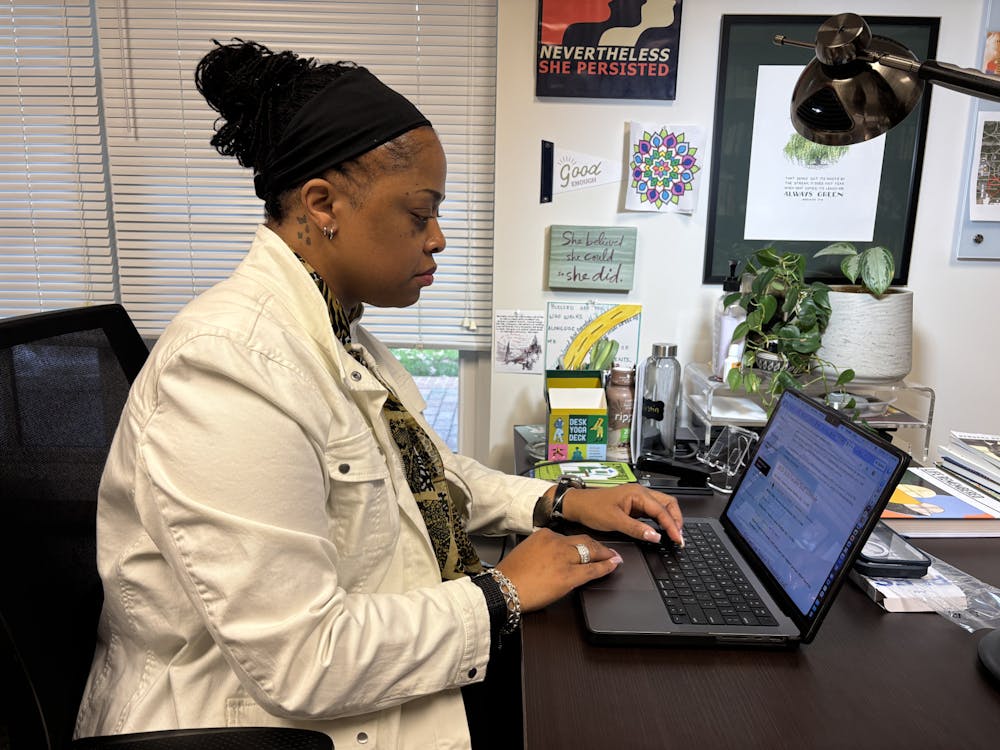
Elon University associate chaplain Rev. Julie Tonnesen said loss and grief are universal emotions, but found that they can be difficult for faculty and staff to process while continuing their usual routines.
“Even when we show up to work, that doesn’t mean that we get to put the rest of our lives on the back burner,” Tonnesen said. “Our grief comes with us. It’s not something we can just keep on a shelf at home.”
In collaboration with Counseling Services, the Truitt Center for Religious and Spiritual Life, began offering a monthly group for faculty and staff to support those affected by loss. Tonnesen started the group in the fall of 2022 and currently runs it with Elon chaplain and Dean of Multifaith Engagement Rev. Kirstin Boswell, and Associate Chaplain for Muslim Life Shane Atkinson.
Boswell said the groups help people feel less alone in processing an event many relate to. According to the American Psychological Association, group therapy is as effective as individual therapy, and may be more effective in some cases by providing stigma reduction and solidarity.
“My team and colleagues that I connect with across campus are constantly sharing stories about people that are impacted by loss within our community, and it’s a part of the human condition, but we don’t always know how to navigate it,” Boswell said. “Part of the care that we want to provide to our community is to help people that are dealing with this thing that is very common, but yet so very difficult.”
Pathologization is the characterization of a trait as medically or psychologically abnormal. Boswell said that grief is sometimes approached in this way — as a mental or psychological problem requiring treatment rather than a normal reaction to loss.
While Elon’s loss support group is run directly by chaplains from the Truitt Center, Counseling Services assists by consulting about planned activities and providing referrals for patients who need more help. Boswell said that running the groups through the Truitt Center allows for a more holistic approach to processing grief.
“We never want to pathologize grief,” Boswell said. “Grieving is a natural thing — it’s part of the natural human process. That could be a reason why we tend to put more of a focus on these things coming through the Truitt Center, as opposed to Counseling Services.”
Boswell also mentioned that Counseling Services only serves students, while the Truitt Center is a resource for students, faculty, staff and alumni.
According to Tonnesen, meetings generally involve open discussion time for attendees to share what brought them to the group, followed by an activity. This may include reflecting on a particular prompt or reading, drawing or another visual reflection activity, writing letters, or journaling. Lunch is also often provided.
“So many traditions and cultures around the world gather around a meal, or gather around some kind of food at some point in the bereavement process,” Tonnesen said. “There are so many particulars from different religious and cultural traditions about how long grieving periods should last, what different types of services and remembrances look like, but food seems to be one thing that’s pretty universal.”
The Truitt Center is also in the process of reinstating a similar group for students. Boswell worked with Counseling Services to run a student loss support group shortly after she arrived at Elon in 2021, but she felt they weren’t reaching all the students who needed help.
“We see a lot of students that are impacted by loss because they’ll reach out to someone, a professor will be in touch with them — however it is that they get on our radar — but they don’t necessarily make it to the group,” Boswell said. “After a while, we decided to stop to regroup and figure out what makes the most sense in terms of format.”
According to Boswell, the student loss support group is still in its early planning stage, but more information could be available as soon as next semester.
Tonnesen said the loss support group is open to all staff and faculty regardless of religious or spiritual affiliation because loss is universal.
“Even for people who don’t ascribe to particular religious or spiritual traditions, grief and loss can bring up questions that are more universal,” Tonnesen said. “What happens after we die? What’s happened to my loved ones who have passed on? Why do bad things happen to good people? Those are questions that humans wrestle with regardless of our religious or spiritual traditions. Sometimes those religious and spiritual traditions can give us tools or wisdom to help us wrestle with those questions, but those questions are not exclusive to a particular tradition.”
Tonnesen emphasized that chaplains and counselors are available to support staff, faculty and students if they need individual support for loss.
“Grief is like a club that you never wanted to be in, but now that you’re in it, you kind of have to figure out what to do with it, because you’re stuck,” Tonnesen said. “You don’t really just get to get out. For some people, that sense of community, the sense of a monthly gathering, gives them a prescriptive way to enter into that grief.”
For resources, students, faculty and staff can contact the Truitt Center for Religious and Spiritual Life at 336-278-7729, staff with Student Care and Outreach in the Office of the Dean of Students at 336-278-7200, or counselors from Counseling Services at 336-278-7280. Faculty and staff may also utilize Elon Work-Life Resources for support. The Suicide Prevention Lifeline is 988.