

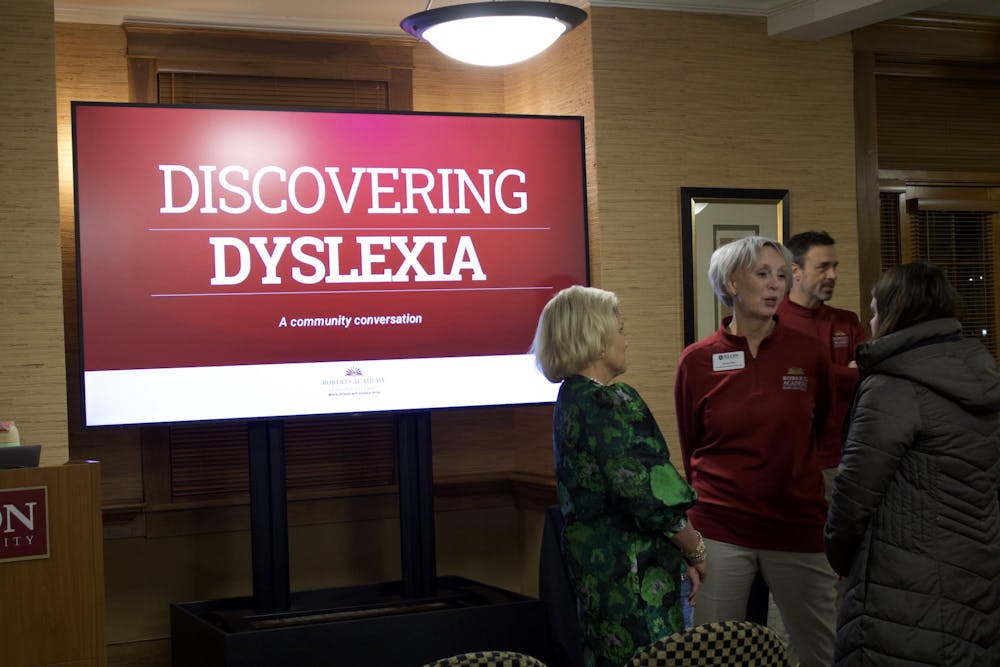
Interested parents and community members had the chance to attend Elon University’s first “Discovering Dyslexia” session, held Dec. 10 in Johnston Hall. The session aimed to provide general information about dyslexia and the Roberts Academy at Elon University.
The Roberts Academy at Elon University will be a private school for children with dyslexia and is set to open in fall 2026.
Alicia Tate, acting director of the Roberts Academy at Elon University, led the session by introducing members of the Elon community including the academy’s implementation team, faculty and staff from the Dr. Jo Watts School of Education, and Elon Teaching Fellows. She also thanked the room for coming.
“I know this will give us all a shared foundation for understanding the experiences of students with dyslexia and the ways we can best support them,” Tate said during the session.
According to Tate, dyslexia is broadly defined by a difference in the child's potential and performance in the areas of reading, spelling and writing.
The Mayo Clinic defines dyslexia as a learning disorder that causes difficulty reading due to problems relating speech sounds to letters.
“Dyslexia affects how a child learns, but not what they can achieve,” Tate said.
Elon senior and teaching fellow Bella Martino led attendees in a dyslexia simulation activity. Other teaching fellows passed out slips of paper with jumbled passages. Martino said frustration often accompanies the reading process for someone with dyslexia.
“The goal is not to perfectly replicate dyslexia, but to rather invite empathy and to help us begin thinking differently about what reading demands of students with dyslexia,” Martino said to attendees.
After a few minutes of attendees decoding and writing out what the passage read, Martino asked a question.
“With just a quick show of hands, how many of you were feeling frustrated when you were attempting to decode what we gave you?” Martino asked the group.
Almost everyone in the room raised their hand.
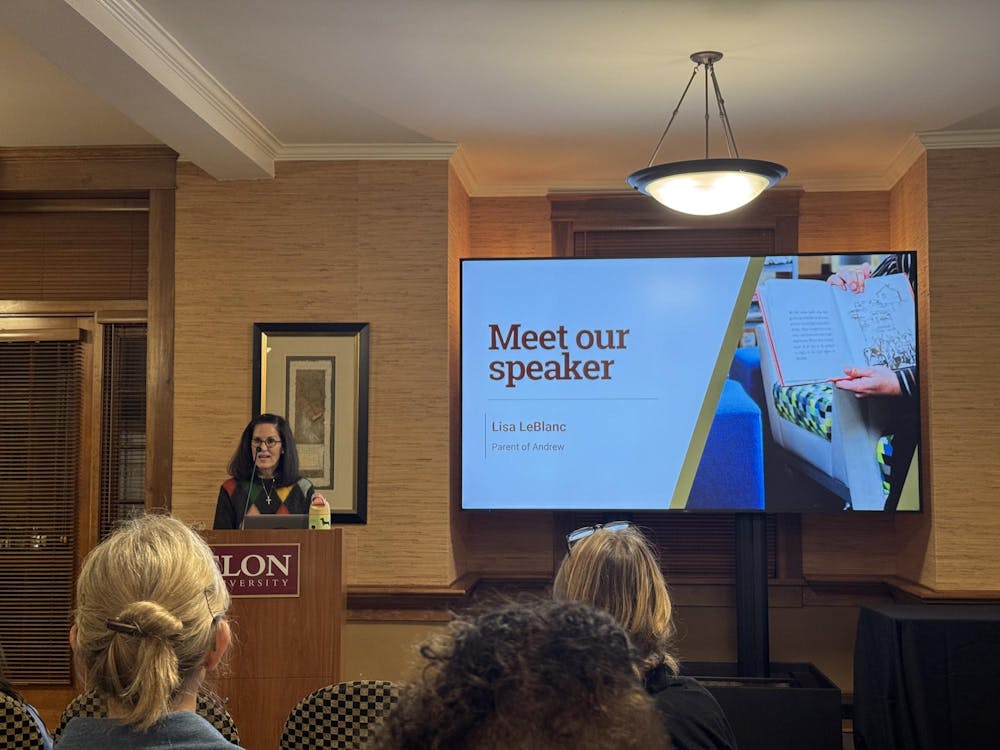
The session’s guest speaker, Lisa LeBlanc, raised two sons in Guilford County. She said her youngest son, Andrew, struggled to match sounds to letters when he was in kindergarten.
“He just couldn't automatically retrieve the sounds each letter made, and by the time he was in the second grade, it was just pitiful, the amount of effort that he would put into memorizing 10 words on the spelling list each week, every day after school,” LeBlanc said during the session.
Attendees received a Roberts Academy folder containing a child’s reading skills checklist, informational handouts, a Roberts Academy bookmark, and a feedback and questions form that people could fill out and give to the staff.
In an interview with Elon News Network, Tate said she was excited about the session’s turnout and is looking forward to continuing the series to receive more community feedback.
“There was a lot of excitement and interest in what's going on here at Elon University for the Roberts Academy,” Tate said. “A lot of great questions and a lot of participation.”
Emily Hinesley, an interested parent from Asheboro, said her daughter was diagnosed with dyslexia last year in the second grade.
“She has a good support system,” Hinesley said. “She's got teachers that love her and pour into her, but we still feel like it's just a struggle for her, and this year with third grade, it's one of those grades. Third grade is hard anyway, because that's when testing gets involved.”
Hinesley said this is the first year that she has seen her daughter’s diagnosis begin to affect her.
“For her, it was, ‘I'm not smart anymore,’ and so we had to really overcome that a little bit,” Hinesley said. “And I just thought, maybe we need to look at doing something different with her.”
Although Roberts Academy will be a one-hour drive from Asheboro, Hinesley said if it all works out, it may be the right place for her daughter, Stella. She even asked Stella if she’d like to attend.
“She said to me, ‘I would like to go to a school with other people that have brains that think like mine,’” Hinesley said. “And for me, that was telling for an eight-year-old.”
Another interested parent, Tora Taylor-Glover, said her son was diagnosed with dyslexia at six years old.
“We've seen some struggles that he was having, and he has been receiving tutoring, but we feel like just kind of continuing that and making sure that he has a curriculum that helps him learn in a way that he wants to learn,” Taylor-Glover said.
She said the “Discovering Dyslexia” session went well and that she connected with LeBlanc’s story.
“Having a personal story really helps connect with, like, ‘Hey, you're not the only one that's going through this,’” Taylor-Glover said. “And just to be reminded, though our children have this learning disability, that they are still unique. They're still creative. It's not, you know, not a dig at their intelligence or anything like that.”
The Roberts Academy at Elon University will offer small class sizes, with 12 students each in third and fourth grade — a total of 24 students in its first year. The academy plans to add the fifth grade in 2027 and another 12 students. The application portal will open in January. The tuition details have not yet been finalized.
The academy will not offer transportation, but Hinesley said that may not be an issue for her family.
“If it's a short-term commitment and it's the right fit for her, then that's something we want to definitely look into,” Hinesley said.
According to Tate, the next session will be held Jan. 27.