

The total cost of lunch debt across public schools nationwide is $194 millions, according to a 2025 report from the Education Data Initiative. North Carolina accumulates $243,639,200 a year.
However, the lunch debt from the Alamance-Burlington School System will not be a part of that number anymore — because as of right now, it has none.
The lunch debt in ABSS has been paid off, according to Shereá Burnett, President of United Way of Alamance County.
ABSS has 28 Community Eligibility Provision schools, which is a program that allows low-income area schools to offer free breakfast and lunch to all students without requiring applications for free and reduced-price meals. Eight ABSS schools are not part of CEP, but still provide breakfast to students for $2 and lunch for $3.10.
In those schools, students can rack up lunch debt — the unpaid balance from school meals owed by families to a district.
In a previous interview with Elon News Network, Amanda Gantt, school nutrition manager for Western Alamance Middle School, said that students with lunch debt over $30 do not get to participate in extracurricular activities, such as school dances.
Burnett said while learning more about school lunch debt from a previous Elon News Network article about ABSS lunch debt, the United Way partnered with Southern Alamance Family Empowerment, a local nonprofit that supports food insecurity, and found a way to get involved.
“Both of us, within minutes of each other, emailed the school nutrition staff to try to get an estimate of what the amount was that was owed to cover school lunch debt,” Burnett said. “And we did that because we were trying to figure out how big of a number it was.”
The overall outstanding ABSS lunch debt was $21,400 as of Jan. 31, 2026.
Much of the existing debt has been paid by a $15,000 donation from McKAY’s used bookstore and record store in Mebane, and a Georgia-based nonprofit, All for Lunch, has committed to paying the rest.
“It became just us having the conversation and then going back to our networks, working within those groups and then coming back to the table and seeing what we could do to not only close the loop with the school system and pay off the debt, but to also better educate the community about what resources are available,” Burnett said.
Promotions and advertising director for McKAY’s, Rachel Poe, said the store is always looking for ways to support the local community and give back. She said McKAY’s tries to evaluate where the need is at the greatest time, and there are many people struggling to put food on the table.
“When we made the donation to United Way, we asked that they use it for food-based assistance, because we know a lot of people are struggling to put meals on the table right now,” Poe said. “United Way applied that towards school lunch debt, which we were so happy to hear because it's a good cause.”
Executive Director of SAFE, Tiffanie Jackson, said she knew about school lunch debt, but was unaware of how much it impacted students.
“It's not just a local or regional issue; it's a national issue,” Jackson said.
Jackson said lunch debt is an issue because kids aren't getting the nutrition they need — and kids who live in households with financial stress understand it better than anyone.
“They hear their guardians and mom and dad talking about these issues in the house, and they take that in, especially younger kids,” Jackson said. “Rather than go through the line, they may feel like, ‘Maybe I shouldn't do that, because mom and dad are stressed out.’”
According to the School Nutrition Association, nearly one in five children in America live in households without consistent access to adequate food.
SAFE has continued raising donations even after the full debt was paid, because lunch debt accumulates at about $3,500 a month in Alamance County, according to SAFE.
“We're going to have an ongoing fundraising campaign throughout the school year and next year and on and on,” Jackson said. “All for Lunch is partnering with us for that to continue making sure that lunch debt gets paid.”
Burnett said what the United Way and SAFE realized was that many people would likely qualify for free and reduced breakfast and lunch, but they have not filled out the paperwork to get it because of concerns about their immigration statuses.
Jackson said SAFE wants to get to the root issues of school lunch debt as well, and knows that there is a misunderstanding about what it means to apply for free and reduced lunch — it won’t compromise citizenship or put a family in front of the Department of Social Services, according to Jackson.
“Here at SAFE, because we have a proper intake process to help connect people to the resources to get them past the barriers that brought them to us in the first place, we're going to start including the applications for free and reduced lunch,” Jackson said.
Burnett said she feels like the decisions of adults should not affect children in a way that limits access to human rights, such as food and the ability to eat.
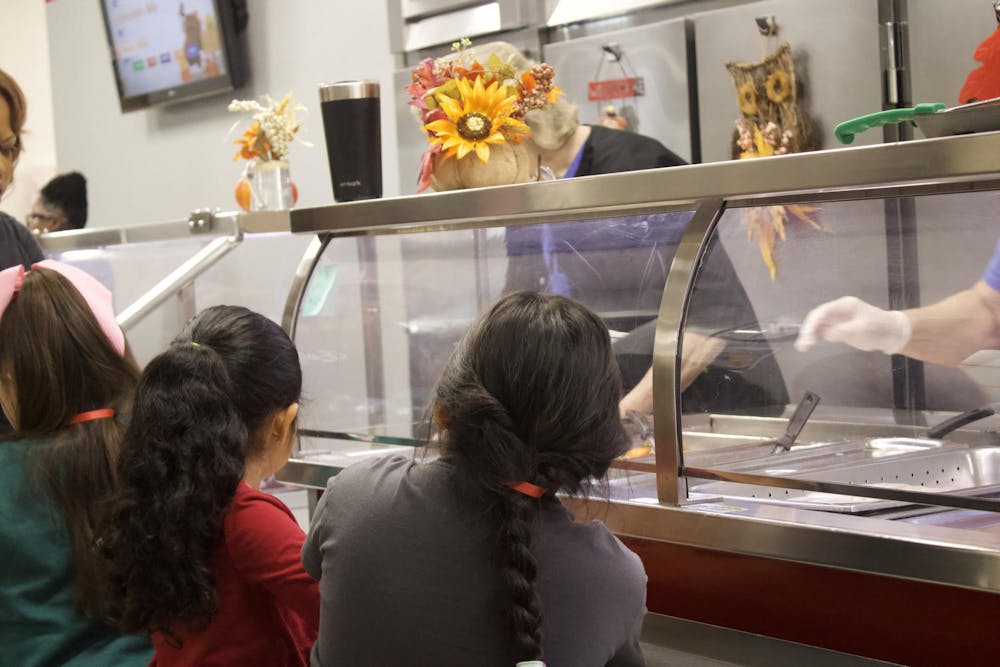
Harvey R. Newlin Elementary School students stand in the lunch line and watch cafeteria workers prepare lunch wraps and nachos on Nov. 14.
“The fact that we are in a country where there are people that have so much — they have so much in excess and then we have kids who may be making the decision not to eat simply because they don't want to be embarrassed by the fact that their family doesn't have a few dollars to cover the cost of their school lunch, that to me is heartbreaking,” Burnett said.
Burnett said she and Jackson spoke about how people should think about the ramifications of the decisions they’re making. Burnett also said children can develop issues with food, such as not focusing in school, developing eating disorders and receiving falling grades — all because of school lunch debt.
“I don't want any child to be hungry. I don't want any child to struggle in school because they are hungry, but I also don't want them to be punished because of the decisions of adults and those adults might be their parents or guardians, or it might be elected officials,” Burnett said. “But either way, I don't want children or suffer because of that.”
To learn more about or donate towards accumulating ABSS school lunch debt, click here.