

Updated as of Dec. 12 at 3:40 p.m. to include video.
Paige Davis and her husband Clayton thought they wouldn’t have a baby to bring home when six-month-old Harper Davis was first born, but she's defied the odds since then.
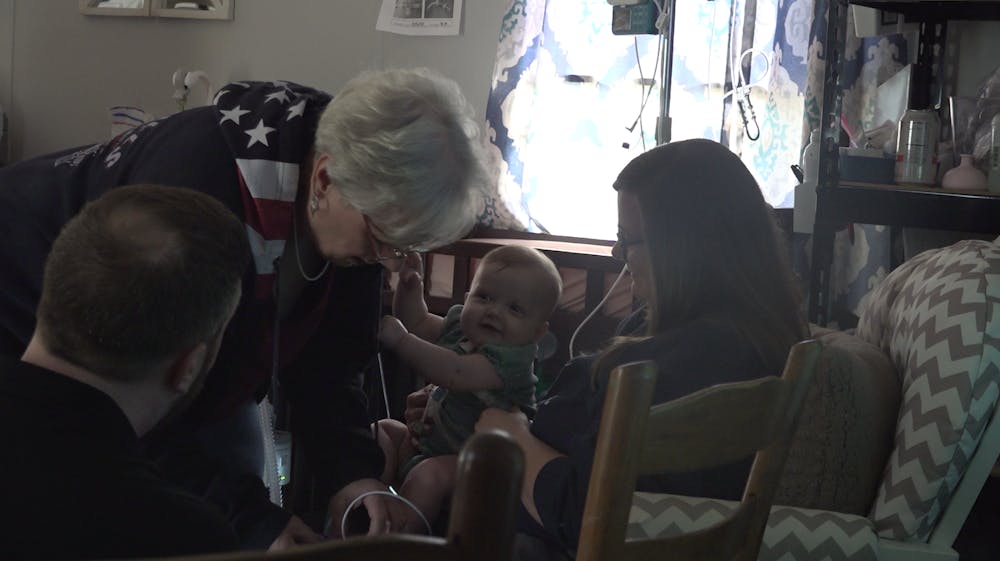
North Carolina Senator Amy Galey visited Harper’s home in Burlington on Nov. 17 to learn more about Medicaid cuts that are impacting the family’s access to receiving in-home services for their daughter.
Harper was born with a narrowed aorta, restricting blood flow to her heart. While her aorta has been able to increase blood flow and some of her heart issues have subsided, she also has an underdeveloped airway, which collapses when she breathes in. Harper had to undergo a tracheostomy, which is a surgical procedure that creates an opening in the windpipe to help with breathing when the airway is obstructed. She has had to use an intubator to this day for every breath she takes.
The state has been in a deadlock on what the state budget will be for the next two-year cycle in 2025-27. The General Assembly typically passes new budgets for the state. The state is currently operating and using funds from the previous budget that expired on June 30, 2025, until a new one is passed.
Both the House of Representatives and General Assembly are GOP-controlled chambers who have seen disagreements on medical funding for both healthcare programs and hospitals. Because of the lack of a new budget, Medicaid and Medicare services are currently underfunded, which led to Medicaid cuts.
On Oct. 1, the North Carolina Department of Health and Human Services implemented Medicaid rate reductions. According to NCDHHS Medicaid Division of Health Benefits, home health services and private duty nursing received a 3% reduction, both are services that the Davis family relies on.
Democratic members of the North Carolina House of Representatives hosted a town hall with the Elon community on Nov. 12 to talk over concerns and their perspectives on the state budget. Rep. Sarah Crawford said she was concerned about Medicaid not being fully funded as many patients cannot see their medical providers anymore, according to a previous Elon News Network report.
“There are people across the state that are losing services, losing access to health care, losing their therapeutic services, losing pharmacy benefits, because these Medicaid cuts have gone into effect, and that's all because the Republican controlled General Assembly cannot come to a deal,” Crawford said in a previous interview with Elon News Network.
Galey represents Alamance and Rudolph counties and is sponsoring bills like Senate Bill 316 Lower Healthcare Costs, which looks to lower healthcare costs and increase price transparency. She said she blames Gov. Josh Stein for the Medicaid cuts, saying he and the health department are the only ones who have executive power to end state-specific Medicaid cuts.
“In the opinion of the General Assembly and the leadership and myself, there’s enough money to get Medicaid through until next spring without having to do any cuts,” Galey said. "Governor Stein can solve this whole issue before supper time tonight.”
Galey, a Republican, and the GOP-controlled General Assembly have disagreed over Medicaid funding, scheduled tax cuts and state employee raises in the state budget negotiations. No major votes on the budget are expected until sometime in 2026.
Harper needs to be monitored constantly, which is where their in-home nurse Nancy Haplin steps in to help the Davises. She’s been with the family since the day Harper and her parents came home from the hospital, working at least three days a week from 7 a.m. to 5 p.m.
Haplin said she has had multiple patients in the past, but has been devoted to only the Davises since starting to work for them this year. For six months, Harper’s parents went back and forth with the state’s health department to receive Medicaid benefits for their daughter as their incomes were too high to qualify for care.
“This is my family,” Haplin said. “I’m not going to leave them without coverage.”
The Davises receive in-home care from BAYADA Home Health Care, a nonprofit group that accepts Medicaid for patients needing their services. They also receive support from the Community Alternatives Program for Children, which provides a cost-effective alternative and waiver to hospitalization for “medically fragile or complex children” who may otherwise be at risk for hospitalization if the waiver was not available.
Both Paige and Clayton receive state-insured coverage, which their children are covered under Paige’s insurance. However, Aetna insurance only covered three weeks worth of in-home services before the couple had to find new financial sources to take care of their daughter.
While the medical cuts have raised some questions for them on what Harper’s care will be like for the future, they’re glad of the progress she has made.
“We’ve been able to get weighed up, get her to her milestones and just keep her healthy,” Paige said. “We just hope she continues to grow and progress, to meet her milestones even though we are still behind.”
A Medicaid rebase, or the process of adjusting the state’s Medicaid budget to account for changing costs and enrollment, was discussed by the General Assembly for $600 million toward these services, a shortfall of $300 million, according to Galey.
NC Health News reported on Oct. 22 that over 200 people with disabilities, advocates and their healthcare support agencies traveled to Raleigh in an attempt to have the Medicaid cuts reversed. Gov. Stein called politicians in North Carolina’s legislature to return to Raleigh in a special session on Nov. 17 at 2 p.m.
GOP leaders rejected his order, with State Senate leader Phil Berger and House speaker Destin Hall writing to Stein that the state Constitution allows the governor to call special sessions in “extraordinary cases,” Republicans believed that the lack of Medicaid funds did not fit this criteria.
Galey was at the Davis’ home from 2 p.m. to 2:45 p.m. on Monday, missing the session to be with the Davis family.
The governor’s office has said that they cannot pledge full provider payments as long as full funding is not guaranteed, according to a NC Newsline article. However, a North Carolina judge ruled that services provided to children with autism will not be impacted by the Medicaid cuts, something Galey criticized in her talk with the family as that she believed was unfair.
“It’s not going to the community college system, it’s not going to the UNC system or patients,” Galey said. “That’s kind of the frustration that I feel. It seems like this whole provider cut was bait. It doesn’t seem to be grounded in the reality of what’s actually needed to help the program.”
Along with taking care of Harper, the Davises have a 6-year-old son that is trying to understand his sister’s medical needs, with Paige asking him what he should do if Harper’s intubator were to fall out. Paige joked that having a “hospital” at home has captured his curiosity.
“He just loves her. He tells everyone how to take care of her, knows the processes – we’ve actually been starting to work with him,” Paige said. “It’s not something you want your kids to have to learn, but he’s in that situation where he’s learning it. This is just our new norm.”
Clayton works at the University of North Carolina, Chapel Hill’s cogeneration facility, while Paige is an instructor in medical assistance at Alamance Community College. When Paige isn’t working, she’s not just taking care of her immediate family, but also her 92-year-old grandfather who lives just around the corner of their gravel driveway.
Paige said that if the family doesn’t have nursing care for Harper, then either her or her husband would have to take time off of work.
“We have great jobs, we want to keep these jobs," Paige said. “If one of us quits, that’s one less income coming in to support our family, to pay our taxes, for me to take care of my grandpa – to keep things afloat.”
Haplin noted how significantly different pay is for in-home nurses and the training is, as many nursing students are not taught how to provide care at home. Healthcare workforce management solutions company ShiftMed reported an hourly median wage of $19.61 per hour or a salary of $40,789, a -30% difference to the national average. Texas is set as the standard example for in-home nursing at a 0% national comparison, with the average hourly wage being $28.11 and annual salary being $58,462.
Republican lawmakers have said that Stein is playing a “political gambit” since the NCDHHS had to cut funding for doctors during the funding shortfall. While Galey claimed that Gov. Stein was the only one to reverse cuts, in actuality it’s both the governor and the General Assembly who make that decision. However, the General Assembly has no plans to make any more votes in 2025.
“It’s a political issue that feels like innocent families are being caught in the crossfire and that breaks my heart,” Galey said.
In due time, Harper should be able to have her trach removed in a year and a half to two years as her upper airway develops, allowing her to breathe and eat normally as she currently eats through a tube inserted into her abdomen. Galey believes bettering the national nursing shortage and finding a better solution for the Medicaid cuts can help North Carolina families on Medicaid plans.