

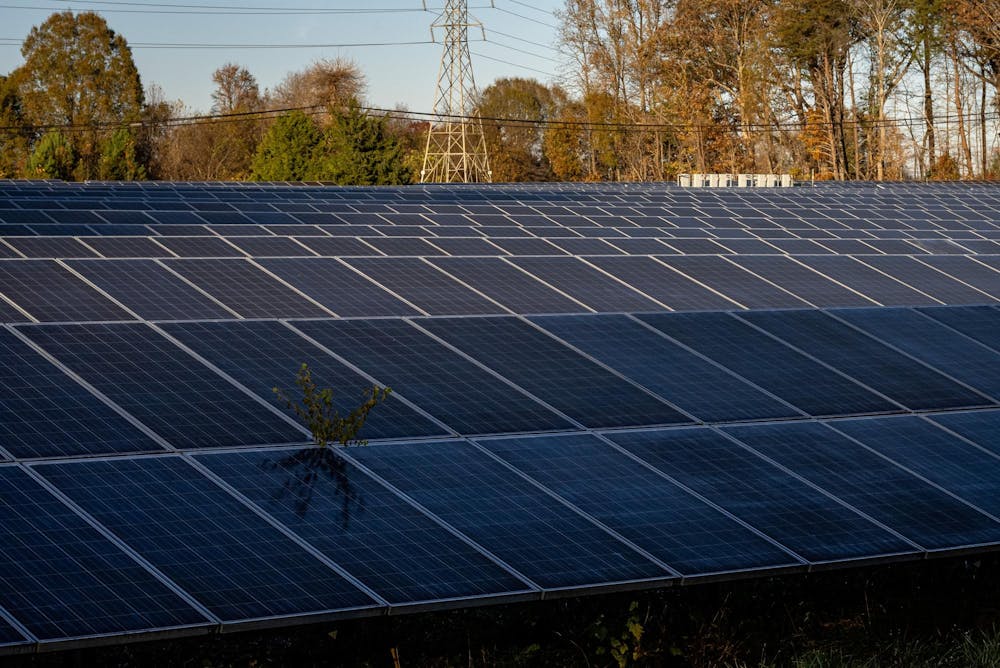
When $156 million in federal solar funding was rescinded from North Carolina this August, it wasn’t just money that was lost, according to Elon University associate professor of geography and environmental studies Ryan Kirk.
“This is stimulus and jobs and economic activity in these communities,” Kirk said. “Which is just one step not being placed for trying to help these communities.”
Back in April of 2024, former Gov. Roy Cooper announced in a press release that the U.S. Environmental Protection Agency selected EnergizeNC, to award the “Solar for All” grant, which was just over $156 million worth of funding to put towards solar energy initiatives.
The coalition was a collaborative effort between the NC Clean Energy Center, the NC Clean Energy Fund, Advanced Energy, and its leader, the NC Department of Environmental Quality’s State Energy Office, with one clear goal; make clean and affordable energy accessible to all.
EnergizeNC aimed to emphasize the introduction of solar energy in “low-income and disadvantaged communities.” This was a part of a larger scale environmental initiative by the Biden administration, allocating $7 billion in solar power grants to 60 national recipients.
In August 2025 the Trump administration rescinded the funding as part of its reconsideration of former EPA regulations. The Trump administration claimed that by removing the restrictions placed on industries, they would restimulate the U.S. economy.
This action was met with attorney generals of 23 states, filing a $7 billion lawsuit against the EPA. Amongst them was North Carolina’s Jeff Jackson, who called for $150 million of this large sum. If won, it would be reallocated to North Carolina to refund the state’s solar panel initiative.
Jackson argued that the EPA illegally canceled these funds.
“These funds were going to help low-income and rural North Carolinians save money on their energy bills,” Jackson said in a press release. “Thousands of families were going to have the option to install solar power, save money, and have another energy option after a major storm.
Kirk described solar energy as a beneficial alternative to fossil fuels, which have large environmental implications and consequences. Unlike wind and hydro farming, which Kirk noted are heavily constrained by the geography and weather of an area, solar energy can be applicable in a broader range of spaces.
“It’s a boundless resource on geological timescales, and it’s a renewable resource every day the sun comes up,” Kirk said.
The Pew Research Center said that between 2020 to 2021, there was a 34% increase in residential solar panel installations.
According to the North Carolina Department of Environmental Quality, the grant would have removed the financial burden of installing the expensive solar panels and provided an accompanying storage infrastructure. It was projected to reach over 12,000 households statewide. According to Tesla, installing solar panels at a home can cost between $21-26,000.
Kirk recognized its alternative advantages.
“It’s also an entrepreneurial opportunity,” Kirk said. “This is a way to create jobs and investments and new types of opportunities as more of a forward looking entrepreneurial initiative.”
Kirk said the program had real potential to help underprivileged communities but remained marginal in public discourse. It was after the funding cuts and lawsuits that this shifted to a politically charged conversation.
He added that the funding’s removal reflected a pattern of economic inequity.
“Environmental justice is the term we use in this field, where you have unequal access to environmental benefits or unequal burden to the harms of environmental change,” Kirk said.
The ongoing lawsuit will determine whether North Carolina can restore the investments meant to address those inequities. As of now, there is no timeline announced for a decision.