

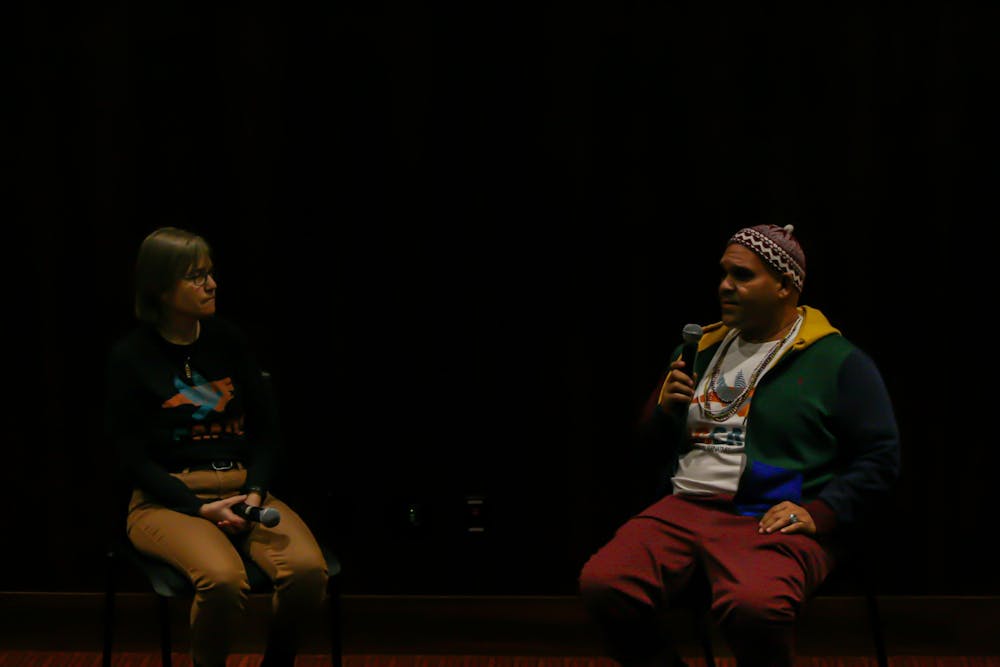
The North Carolina Coalition for Alternatives to the Death Penalty screened a 25-minute documentary in Turner Theater on Nov. 17. The film showed the racial history of North Carolina death penalty cases in the past and present. After the film screening there was a panel with death row exoneree Alfred Rivera and Noel Nickle.
Noel Nickle, who serves as executive director of the NCCADP, expressed how important sharing this history is now after HB 307 passed in October. The bill enacts stricter pretrial release conditions for violent offenders by limiting cashless bail, mandates mental health evaluations for certain defendants and directs the state to find alternative methods of execution if the current method of execution — which is lethal injection — is not available or found to be unconstitutional.
“The newly passed law adds execution methods that we have not used in North Carolina previously,” Nickel said. “So it's really important for people to understand that reality.”
Nickel said awareness is more important since it’s been almost 20 years since the death penalty was carried out in North Carolina. Executions have been halted in North Carolina since 2006 over legal challenges to the use of lethal injections and issues of racial bias in death sentences.
“A lot of people don't even know that we still have the death penalty, but we actually have the fifth largest death row in the country, with 122 people,” Nickle said. “With a recent passage of HB 307 into law, it is quite likely that executions will resume.”
In an interview with Elon News Network, Alfred Rivera, who is a death row exoneree and spoke on the panel, said after being released from prison advocating for racial prejudices when it comes to the death penalty and has been something that he has been passionate about. Rivera was wrongfully convicted in 1996 and spent two years on death row before being exonerated.
“I still try to stay connected to the work that's being done because it means that much to me,” Rivera said. “I look at my ordeal as something that now has basically given me more of a push to have to say something or do something or be somewhere and to share the fact that these type of situations and mistakes are going down, not only in North Carolina, but of course, America.”
During the panel Rivera talked about the resources for inmates and their families and how this would’ve made a difference in his life.
“The state or government used to always take into consideration the overall predicament that a family is in,” Rivera said. “Instead of just, let's say, for instance, more times the state or the government tends to want to simply just prosecute and have the other family believe that justice is being served. And now you can close this out, and everything is good, but in actuality, it’s not like that.”