

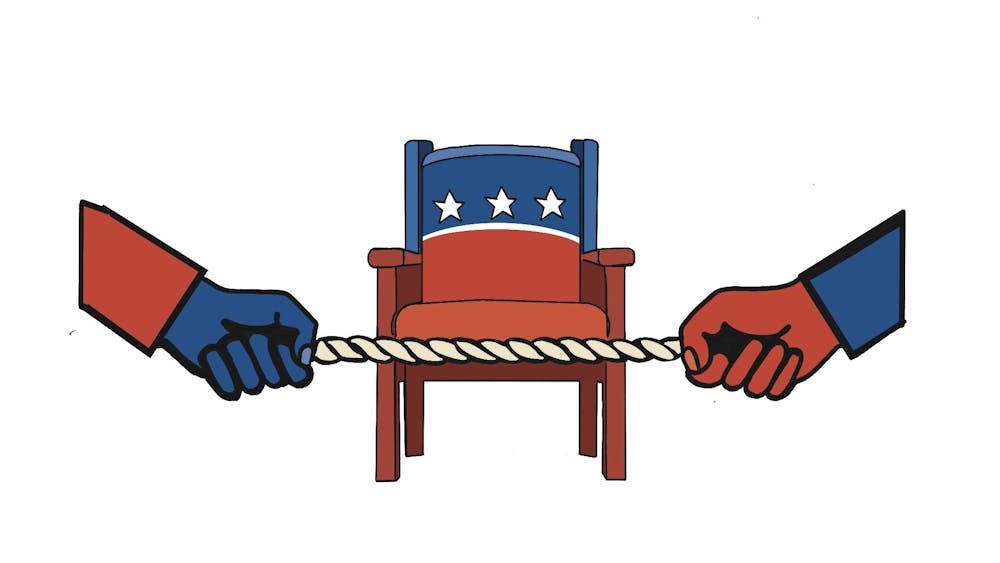
The Republican National Committee endorsed Michael Whatley as senator for North Carolina ahead of the midterm primary elections, sparking ethical concerns about early endorsements. The position opened in June, when current senator Thom Tillis announced he would not be running for reelection in the 2026 midterms, and Democrats now have the chance to flip the seat.
The RNC serves as the formal governing body and operational organization of the Republican Party. Their endorsement of Whatley is unusual because both the RNC and the GOP typically refrain from endorsing candidates until they have been confirmed as the party nominee or are running unopposed, according to Christopher Cooper, professor of political science at Western Carolina University. The Republican Party officially allows endorsements of non-incumbents before primaries only when all three members of a state’s RNC agree to the move, which did occur in this case.
When the RNC backed Whatley, businessman Andy Nilsson and former military lawyer Don Brown were still in the race. Nilsson later dropped out, and Brown openly criticized the RNC’s choice to endorse Whatley before the primary.
“The traditional way of thinking is the party should stay out of primaries,” Cooper said. “It is the job of the party to facilitate the primary process, but not to favor one candidate over the other.”
The decision to endorse a candidate also drew backlash because Whatley was serving as chairman of the RNC when he announced his campaign for Senate.
“Certainly, people who have been head of the RNC and the DNC have run for office before, so that part is not that unusual,” Cooper said. “What’s interesting is, it isn’t like Whatley was the head of the RNC six years ago, this was, like, six days ago when they made the endorsement.”
For example, Cooper explained that former President H.W. Bush briefly served as RNC chairman between 1973 and 1974, but did not become president until 1989.
Whatley was selected by President Trump and officially appointed chairman in March 2024. He served as co-chair with Trump’s daughter-in-law, Lara Trump. The move was significant at the time because Trump was able to ensure all his picks for RNC leadership were chosen, essentially linking the RNC with Trump’s presidential campaign.
Trump also played a major role in the RNC’s decision to endorse Whatley. Trump posted in support of Whatley on Truth Social on July 24, the same day Whatley announced his campaign.
“That is more normal, for President Trump to sort of askew norms and get in there early and endorse,” Cooper said. “In a world where Donald Trump is — not the literal head of the Republican Party, but certainly is the symbolic head — I have no doubt that Trump getting in early for Whatley played a role.”
North Carolina GOP Communications Director Matt Mercer also acknowledged the president’s influence in Whatley’s endorsement by the RNC.
“The decision to engage on their part was made when President Trump endorsed Mr. Whatley in the race,” Mercer said in an email statement to Elon News Network. “The NCGOP is neutral in primaries but will work with any candidate who wishes to engage in joint fundraising to benefit the party’s General Election campaign activities.”
The 2026 Senate race in North Carolina is projected to set funding records, potentially becoming the first billion-dollar Senate race. Whatley’s campaign has largely been funded by small dollar donations to PACs such as the Whatley Victory Committee and Whatley for Senate, and recently received a $4.5 million donation from the Susan B. Anthony Pro-Life America group.
Mercer also emphasized the GOP’s need for early action in this race because the seat could flip to a Democrat. Roy Cooper, who served as Governor of North Carolina from 2017 to 2025, is currently the only Democratic candidate for the Senate seat. Recent polls show Whatley trailing Roy, but by a small margin.
“Ensuring Republicans maintain this U.S. Senate seat is critical, especially going against Radical Roy Cooper and the out-of-state billionaire donors funding his campaign,” Mercer said in a statement.
In the first 24 hours of his campaign, Roy set a fundraising record by raising $3.4 million. The majority of donations were collected directly from his campaign account, and 95% of donations totaled $100 or less.
Going forward, Christopher said the RNC’s move to endorse a candidate before the primary election may set a new precedent for the role parties play in future elections.
“It’s very possible we’re going to see parties be more aggressive in choosing primary candidates, almost like they did before the party primary reforms of the early 1970s,” he said. “It’s almost the party re-exerting the muscle that it used to have.”