

Since 2021, the number of large-scale artificial intelligence systems has increased in the United States by 3,775%.
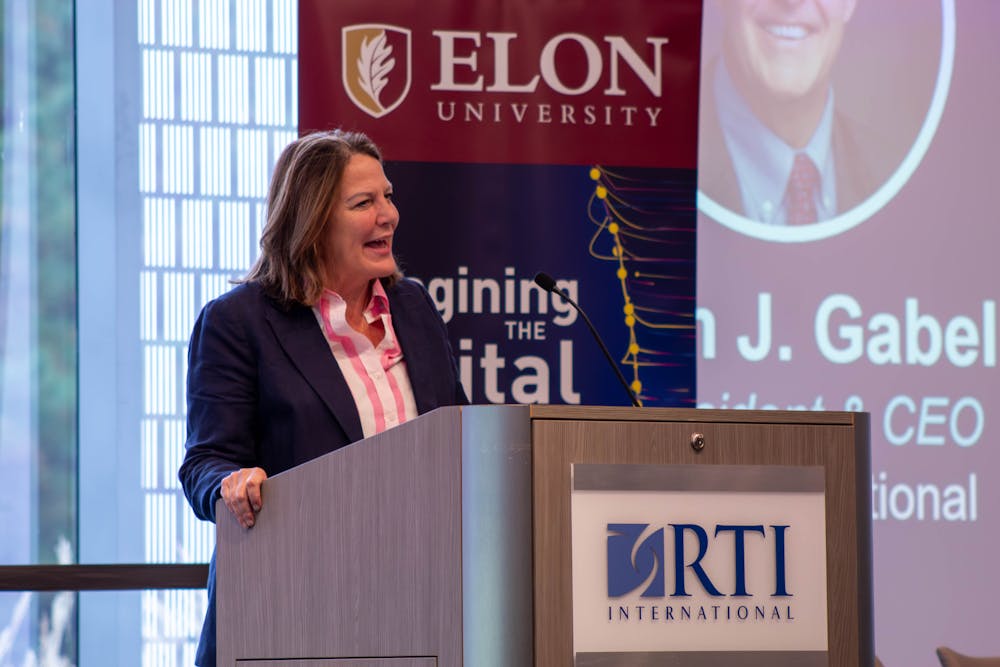
With AI becoming more prevalent, Elon University’s Imagining the Digital Future Center and RTI International, a research institute based in the Research Triangle, hosted a conference Sept. 17 reflecting on what it means to be human in the age of AI.
Elon University President Connie Book addressed attendees, saying that schools need to begin to focus on how humans will grow with AI.
“All institutions must seriously address the coevolution of humans and digital systems and work to reimagine the animating human spirit of organizations, workflows, communication, teaching, learning and research activities,” Book said.
Lee Rainie, director of the Imagining the Digital Future Center, said in an interview with Elon News Network that this conference is a follow-up to the data the center released in April 2025 predicting 12 key human capacities and behaviors that will likely change through the growth of AI and what people consider “human.”
“If the definition of what's been on one side of the line or what's on the other side of the line rests on some essential human characteristics, like empathy, like social intelligence, like creativity, like curiosity,” Rainie said. “Were they going to help or hurt?”
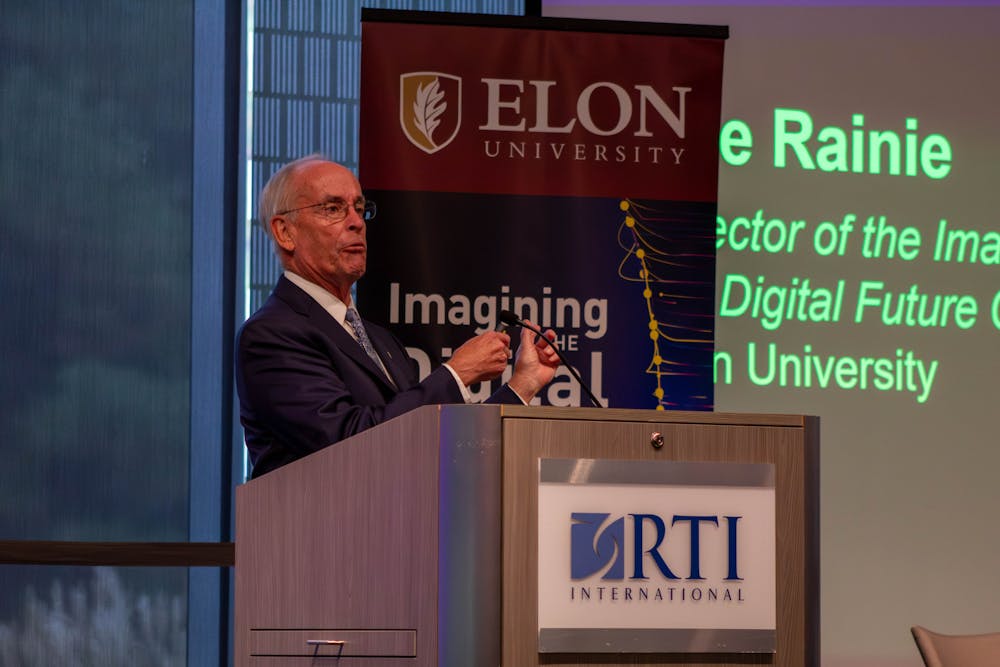
Director of the Imagining the Digital Future Lee Rainie presents recent research from the center at the "The Human Edge: Our Future with Artificial Intelligences" conference Sept. 17 between Elon University and RTI International at RTI International Headquarters in Durham, North Carolina.
The center also released a survey Sept. 17 indicating that most Americans expect that AI will have a significant negative impact on human capacities over the next 10 years.
Rainie later addressed the attendees and presented the survey. During his address, he said the piece of data that surprised him the most was that people who have pursued higher education feel more negatively about the impact of AI on human capacities compared to people who haven’t pursued higher education.
“I want someone to grab me by the lapels and tell me their theory about why this is,” Rainie said to the attendees.
In addition to remarks from Book, the conference also featured speakers from legal and medical fields. This included Duke law professor James Boyle, who spoke about how the growth of AI is affecting human consciousness, and Dr. Eric Huang, who spoke about the use of AI in the medical field.
Huang said that despite AI becoming more popular, nothing can replace human work.
“I would argue again that the care we provide to our patients is not artificial,” Huang said. “I trained as a breast cancer surgeon. I don't know if people will yet be comfortable with having a really tough discussion about the possibility of having metastatic breast cancer with a ChatGPT-like interface. I think that's a conversation that people want with human beings.”
The conference also included a panel of representatives from institutions across North Carolina, who shared the work they had been doing to educate and use AI within their universities, which included Fayetteville State University, University of North Carolina at Chapel Hill, North Carolina Central University, North Carolina State University, University of North Carolina Greensboro, Duke University School of Medicine and the National Humanities Center, a private nonprofit organization that studies humanities.
According to Rainie, the Imagining the Digital Future Center will release its next survey results in March 2026.