

This interview was edited for clarity.
Kelly Oten is a professor of forestry and environmental resources at NC State. She specializes in forest health and posts content on NC State’s Extension Forestry website about bugs impact on trees.
How would you explain what an orange-striped oakworm month is to someone who might not be familiar with critters?
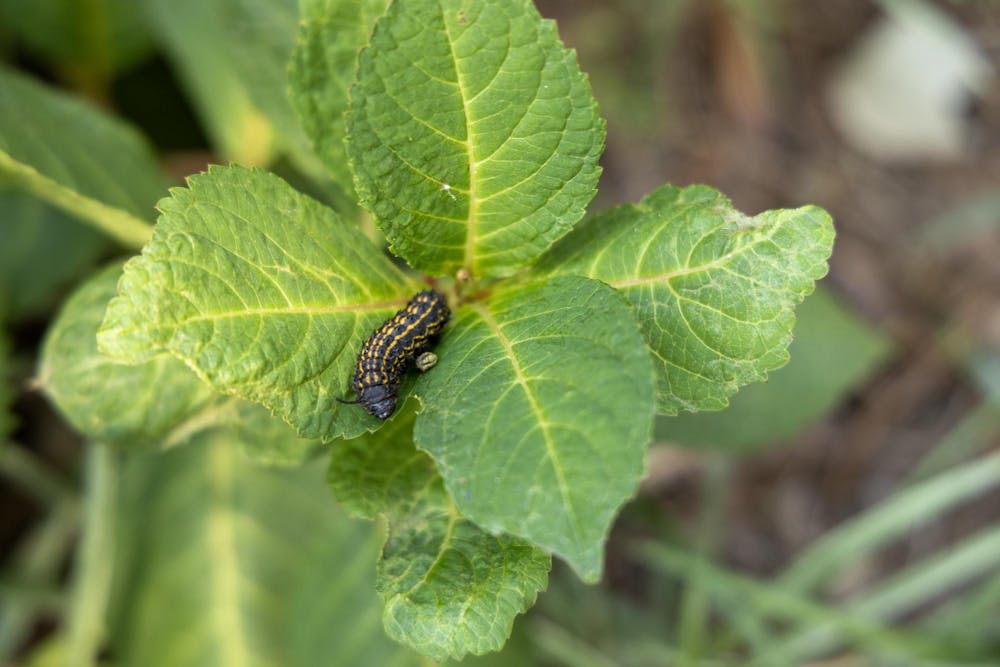
A lot of people are very alarmed when they first see damage by the orange-striped oak worm. It feeds on leaves of trees which can surprise people, but they feed in clusters. They’ll defoliate an entire branch or multiple branches on a tree. We like trees for the shade they provide and all these other ecosystem services, but they generally don’t impact the long term tree health. We have someone calling and they have orange-striped oakworm on their tree, we usually tell them not to worry about it, that it’s not going to impact their tree health, that usually the outbreak subsides in a year or two.
Why are there so many caterpillars during this time of the year and why should people be conscientious about where they walk to avoid stepping on them?
Outbreaks happen periodically. It’s just something we see with this caterpillar. Usually they subside. There’s not going to be an outbreak that lasts years and years, that would be shocking. Insects where they go through an outbreak period — predators and parasitoids, which are parasites that kill insects, all the natural enemies that already exist in our environment actually help take them down. So if we have enough predators feeding on them, then the populations will decrease and that’s what happens with the orange-striped oak worm.
As far as stepping on them — they’re not endangered, they’re not beneficial. I would not tell people not to not step on them, because, I mean that’s one of the things that might bring their populations down too.
How long would you say an outbreak typically lasts? How many caterpillars constitutes an outbreak?
I don’t know if there’s actually a number on what entomologists would consider an outbreak, and part of that is because an outbreak is a human definition, right? What we’re willing to accept. An outbreak in a forest, probably not a big deal, but if they’re on campus, bothering people, stripping leaves off, it’s all a situation.
We expect outbreaks to happen periodically. For some pests, every 10 to 15 years we expect an outbreak to happen. We don’t have that for orange-striped oakworms. We generally just see it when environmental conditions are great.
When are they typically active?
We call them late season defoliators, which means the end of summer. Fall webworm is another one. So you could probably expect to see it in mid to late July at the earliest. But typically we see the impacts in August.
How do orange-striped oakworms contribute to the environment/ecosystem? Could they be harmful to the environment?
They’re harmful if they actually damage trees. Usually they don’t damage trees, so it’s not a big deal. If there’s an outbreak year after year, if a tree gets defoliated — which means all of its leaves get eaten — multiple years in a row, then you have a problem.
How common are they to North Carolina? Are they an invasive species?
No, it’s not an invasive species. It is native to North Carolina and it is extremely common.
Is there anything else you would like to add?
I always try to leave by making sure if someone has a pest problem, they know what to do with it. There are chemicals out there that can be used to control them. Because they feed in clusters, you can also beat the branch and the caterpillars will fall off. Birds will eat them. So lots of options, but generally not a huge thing to worry about because they’ll probably disappear in the next year or two.