

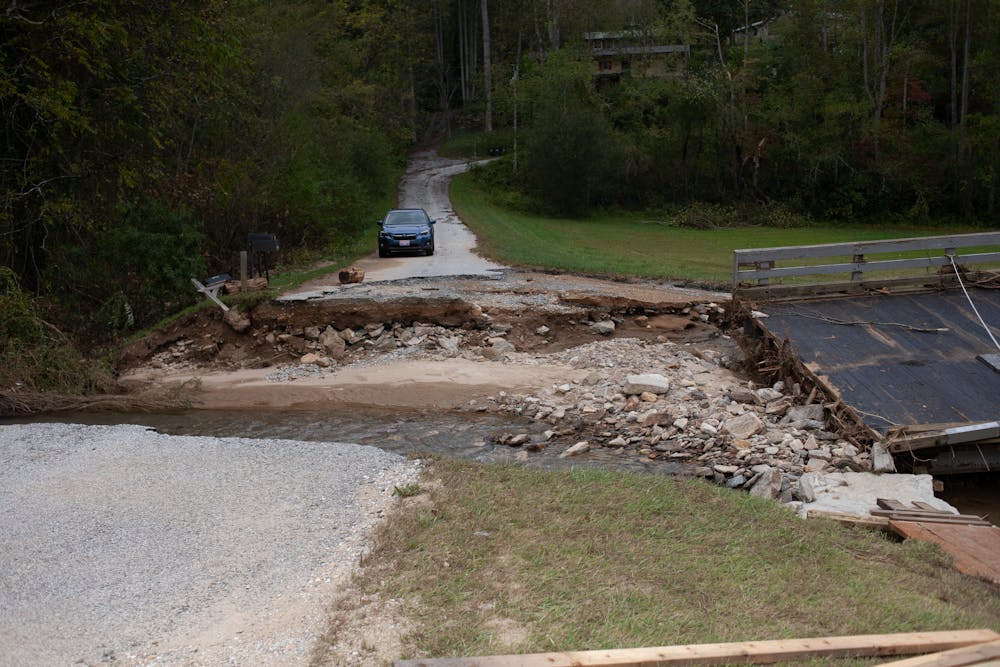
Throughout the summer months, Elon students received more than 40 e alerts warning of power outages, severe weather and flood watches. North Carolina’s typical wet season was made even more tempestuous by storms such as Tropical Storm Chantal, which swept across the state in July.
The storm raised concerns among North Carolina residents not only about damage but also about the freeze of federal disaster relief funds promised by the Federal Emergency Management Agency.
On July 16, North Carolina Attorney General Jeff Jackson filed a lawsuit against FEMA over its decision to cancel a program that provides more than $200 million to protect the state’s infrastructure, including water and sewer systems heavily damaged by storms. The suit places North Carolina among 19 other states that have filed similar legal challenges against FEMA. “FEMA was wrong to break the law and cancel this money, which will save lives. I’m taking it to court to win these funds back for our state,” Jackson wrote in an article posted on his official website.
The withheld funds were intended to support the Building Resilient Infrastructure and Communities, or BRIC, initiative. BRIC allows for the relocation and development of water treatment plants across North Carolina. Jackson said the project aimed to move these critical facilities to higher ground and better equip them to withstand future weather-related damage to the public water supply. North Carolina residents like Alex Arrasmith, an Elon sophomore and Chapel Hill local, have ongoing concerns about local flooding. “It floods here at least twice a year,” Arrasmith said. “I don’t think it’s a good idea to mess with the safety of our drinking water.”
The urgency of the project became clear after Tropical Storm Chantal, when nearly 7 million gallons of untreated sewage spilled into the Eno River following flooding in the area. The spill severely damaged Hillsborough’s river pump station—a system that transfers water from the river to treatment plants— affecting nearly half of the town’s water supply. The city was able to repair the site in five days with initial repair costs estimated at nearly $300,000.
In addition to repairs, Hillsborough received a million-dollar grant to upgrade its connection to the neighboring Orange Water and Sewer Authority, which serves Carrboro and Chapel Hill. Such connections enable water systems to draw supply from nearby counties when storms compromise essential infrastructure, according to reports from Blue Ridge Public Radio.
Jackson compared this project to several other reconstructions across the state, saying, “Dozens of these projects will end up getting canceled if this particular fund goes away.”
The lawsuit is based on three main arguments. First, Congress has long funded pre-disaster mitigation and required FEMA to prioritize it, making programs like BRIC a key part of FEMA’s mission.
Second, the lawsuit claims that President Trump’s appointment of Cameron Hamilton as FEMA administrator—who no longer holds the role as of May 2025—was unlawful because it lacked proper authority and congressional approval. Therefore, the states argue that any decisions made under Hamilton’s leadership are invalid.
Third, the states argue that FEMA overstepped its authority when it shut down BRIC, disregarding Congress’s instructions. They argue FEMA cannot unilaterally cancel or change programs funded by Congress, so the shutdown was unconstitutional. Although there has yet to be a ruling on the case, a judge ruled on Aug. 5 that the government cannot offer any of the $200 million elsewhere until the freeze is resolved.
FEMA has not made a public statement regarding the lawsuit; however, the organization argued BRIC was "wasteful and ineffective” in its official cancellation statement.
For now, the injunction means North Carolina’s $200 million in stalled projects won’t be erased, but communities are still waiting to see if the funds will be released in time to make a difference before the next storm season.