

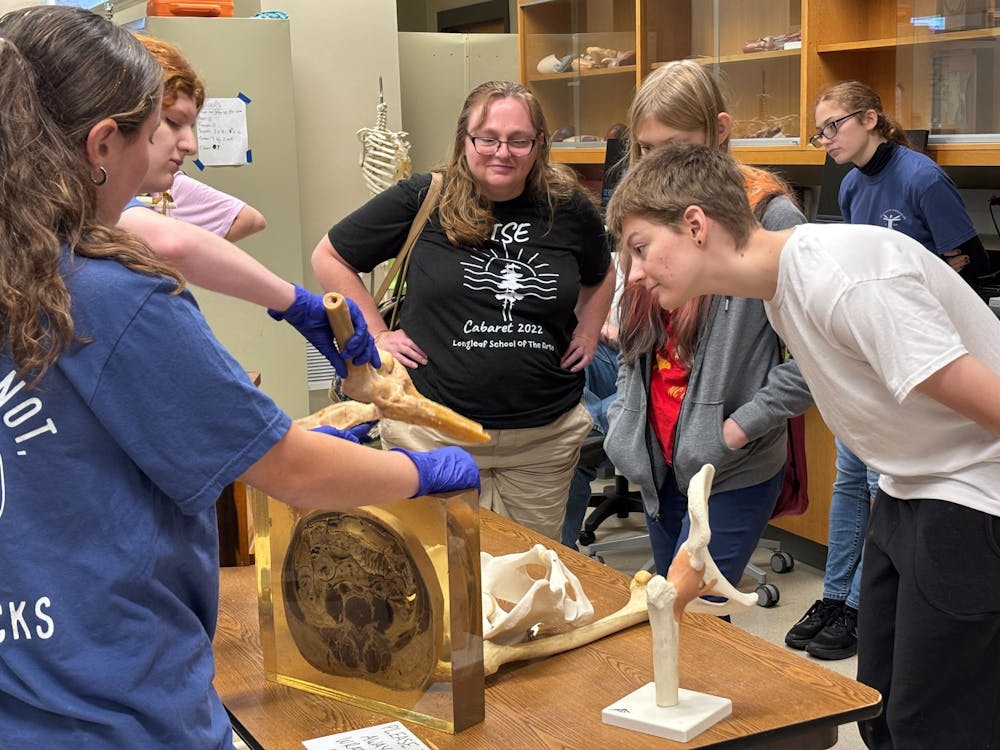
The Edler family came to Elon University’s open anatomy lab to see what their child, Julia, was learning in anatomy class.
“I was impressed that my daughter actually knew the anatomy for the sections that she’s already learned,” Michelle Edler said.
By contrast, Elon biology professor Matthew Clark was shocked that more people don’t know their own anatomy.
“It’s amazing to me how so many people don’t really understand what’s inside the human body,” Clark said. “It’s almost like a mechanic who, when you go to take your car to the auto shop, you really don’t know what’s under the hood.”
The Edlers went around to five different tables, learning different anatomy facts as they went.
“Their tip jars have formaldehyde or some liquid in them,” Darin Edler joked.
The Elon Anatomy Teaching Assistant Program Students — otherwise known as TEATAPS — ran the event. TEATAPS lead Abby Monsanto said she was excited to share the anatomy lab with interested families.
“I just want people to come in and see how passionate we are and how excited we are to share this subject, and how cool it is to learn off of real human donors,” Monsanto said.
The open lab included displays of preserved human organs, including a heart and brain. These organs came from donations through Elon’s Anatomical Gift Program, which allows people to donate their bodies to the university for scientific and educational purposes.
Clark is among those who call these people “silent teachers.”
“They are individuals who never say one word to us, but teach us so much about science that there is no way for you to learn that if you didn’t have the opportunity to work with these silent teachers,” Clark said.
Undergraduate student lab manager Joey Rudnicki said there is a balancing act between being respectful and staying lighthearted in regard to silent teachers.
“We have a very no-nonsense policy for anything that could be making fun of donors or our silent teachers. We just don’t accept that,” Rudnicki said. “But there are ways that we can keep it light.”
As an example of a way to keep moods lighter, Rudnicki recalled acronyms and sayings to remember the branches of the brachial plexus, the section of the nervous system that sends signals to the shoulder, arm and hand.
Elon University holds memorials for the silent teachers twice each year: once in December and once in May.