

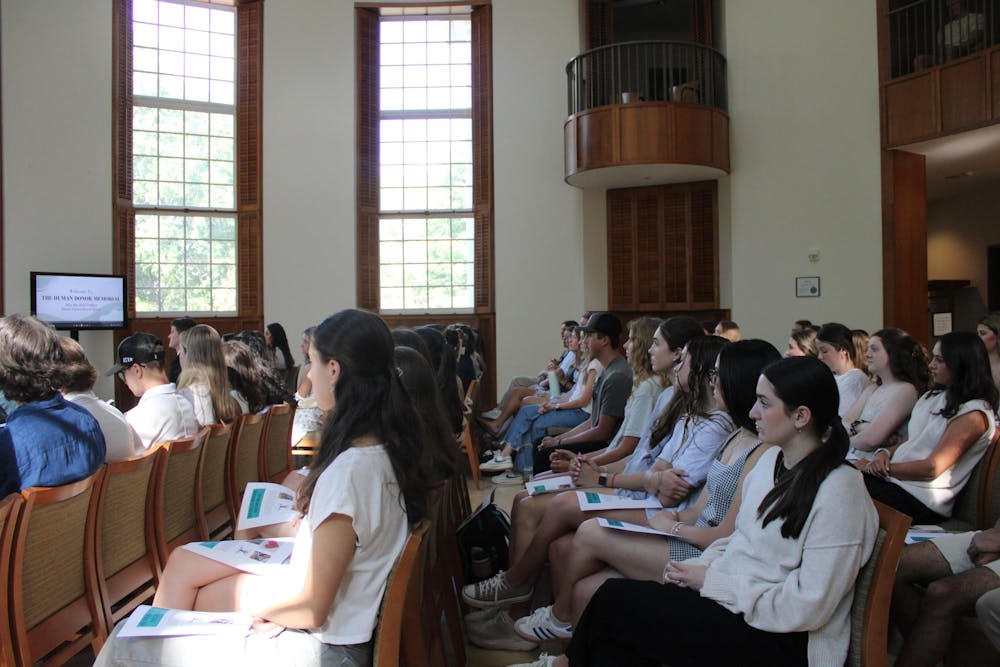
The Numen Lumen Sacred Space was filled with memories, stories and remembrance to honor the individuals who donated their bodies to science — referred to as “silent teachers” — as part of the undergraduate human anatomy program. The event also recognized the contributions of the Elon Anatomy Teaching Assistant Program Students, known as TEATAPS, and faculty who support the program throughout the academic year.
Both the undergraduate human anatomy program and TEATAPS were established in 1999. The Anatomical Gift Program allows individuals to donate their bodies to science and undergraduate teaching.
The memorial service is a tradition held once a year, designed to reflect on the invaluable role body donors play in medical and anatomical education. Students and faculty gathered to express gratitude and reflect on the lessons learned from those who donated their bodies for anatomical study.
Dr. Matthew Clark, coordinator of the undergraduate human anatomy program, said creating the program has been exciting.
“The process here at Elon is pretty unique,” Clark said.
An individual can willfully fill out the proper documentation and at the end of their life Elon will send officials to prepare their body for studies in human anatomy. The human anatomy program has two areas of study: one in the Francis Center and the other in McMichael Science Center.
“We have two programs, a graduate program, which is at the Francis Center, and we appreciate having the opportunity to get those from the Francis Center, but also go to the second program, which is the one we're part of, the undergraduate human anatomy program in the McMichael Science Center.”
Letters and reflections from donor families were read aloud — gathered by Dianne Person, director of the Anatomical Gift Program at Elon.
More than 75 students attended the memorial service, including more than 20 TEATAPS, to share the stories and findings of the two pro-sected donors, which are donors who were previously dissected before coming to Elon, Richard and George, and the two dissection donors, Carrie and Mike.

Junior Zach Heath, TEATAPS foreman, began the donor remembrance part of the ceremony and ended it with a moment of silence.
“This is a time to reflect on our donors and remember that our donors have families, friends, feelings, thoughts and hardships, just like all of us, and we want to thank them for their incredible gift,” Heath said to the crowd.
Sophomore Sylvie Swerdlow reflected on their time spent with the silent teachers and what their gift of donation has meant to them academically and personally.
“To be face to face with the entire human body, and the end of life is something that most people in our society cannot experience, and is powerful,” Swerdlow said. “We are beyond grateful.”
Sophomore Alydia Wheeler said silent teachers have made a major impact on her education, especially helping with her dance career.
“Being a dancer comes with a lot of injuries, and being able to learn about the muscles and the nerves, and the bones that contribute to these injuries has been very beneficial, and I'm very grateful for this opportunity,” Wheeler said.
TEATAPS student lab manager and senior Rebecca Derengowski said the experience of working with the donors is something that she will cherish forever.
“We have the privilege of utilizing our donors as a means of learning, and it's a tool that we get to use, that not a lot of undergraduate students get to experience,” Derengowski said. “We get to see the donors firsthand.”
Clark shared that being the coordinator of undergraduate human anatomy is truly his passion.
“There is nothing else I would want to do as a professional now than to be the coordinator.”