

Ira Poston begins his day on his farm at 8 a.m. He turns on his green John Deere truck and drives from his house to his farm property. In the back of his vehicle is a paint bucket filled to the brim with wood scraps and wilted leaves. Next to it is a battered and soot-stained bee smoker.
He has three horses and 20 chickens.
But what keeps him outside for so long are the over 70 bee colonies on his property, which includes Smith Farms in Gibsonville.
“This is the only hobby that people will need,” Poston said. “It’ll take their time.”
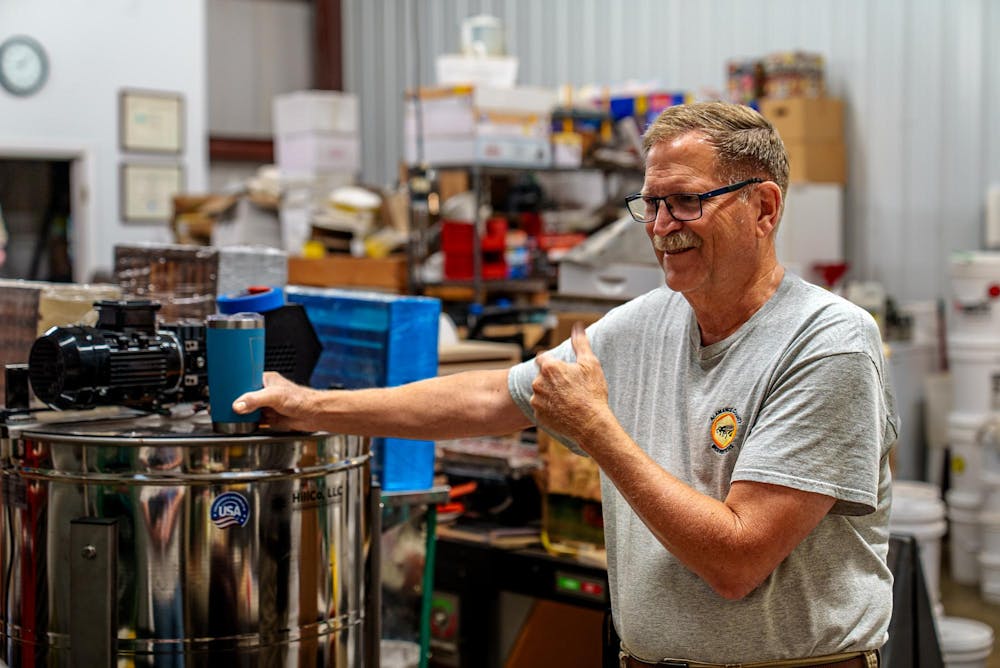
Alamance Beekeepers Club President, Ira Poston, talks about his plans for building an additional shed for woodworking on Aug 4 in rural Elon.
Poston is the Regional Director of the North Carolina State Beekeepers Association, but before that he was President of the Alamance County Beekeepers for 10 years.
The Alamance County Beekeepers is a chapter of the state’s beekeepers associations. It is a nonprofit club focused on educating the community about honeybees by visiting schools, local clubs and even teaching a bee school for aspiring beekeepers in January.
“Anybody that reaches out and says ‘Hey can we have a speaker?’” President of the Alamance Beekeepers Sarah Stevens said. “We will happily go and show up,”
Sugar water
According to Poston, start up costs for beekeeping can cost $800 to $1,000. Usually a novice beekeeper will start off with two hives, but the bees have to construct the honeycomb from scratch, which takes a lot of energy. Poston said the bees get their energy their food source:s sugar water.
Poston said beekeeping is not an easy hobby either. That’s why the Alamance County Beekeepers host a 10-week class for beginners.
“We help those people get through the first year, hoping that they keep their bees alive,” Poston said. “Then the next year, we're still mentors to anybody that asks, and then we get a new crop of new beekeepers.”
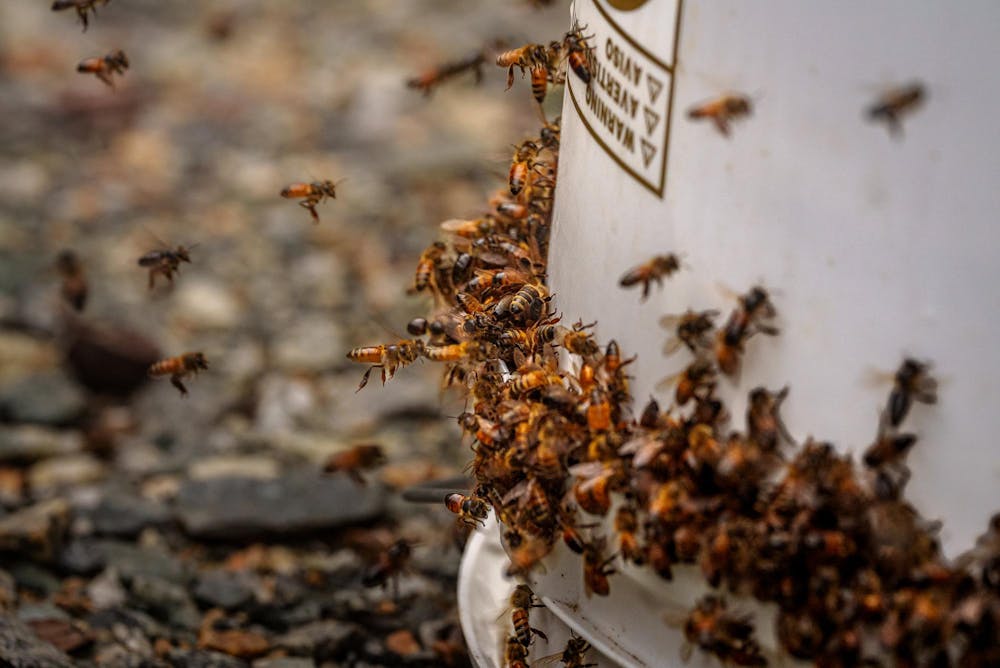
Hundreds of bees from the area gather at a neighborhood feeder filled with sugar water on Aug 4 in rural Elon. Multiple bucket feeders are scattered around the area to ensure local bees have enough food regardless of the availability of local plants.
With over 3.5 million bees to his name, Poston has over 15 years of beekeeping experience.
However, unlike Poston and Stevens, not everyone is cut out for the hive life according to Jay Rimmer, Assistant Director of Operations for Jewish Life.
“The average person who starts beekeeping gives it up within two years,” Rimmer said.
According to Stevens, most beekeepers won’t see honey within their first two years which can be discouraging.
Then there are the mites.
Smoke
For Stevens, having only three hives is practical for her and the space in her backyard. Three might seem like a small number, but that’s about 150,000 bees under Stevens' care. However just last week she had lost over 40,000 bees due to a tiny parasitic mite called the varroa destructor.
“It's a mite, and it attaches itself to the bees,” Stevens said. “It it lays its eggs inside of the open larva of those bees. They have no defenses against this varroa.”
The parasite is an invasive species from Asia. While honey bees during the summer are preparing for fall and winter, the mites are preparing to strike.
“This time of year right now, this is when the varroa populations are rising,” she said. “The bee populations are decreasing, because we're going into fall.”
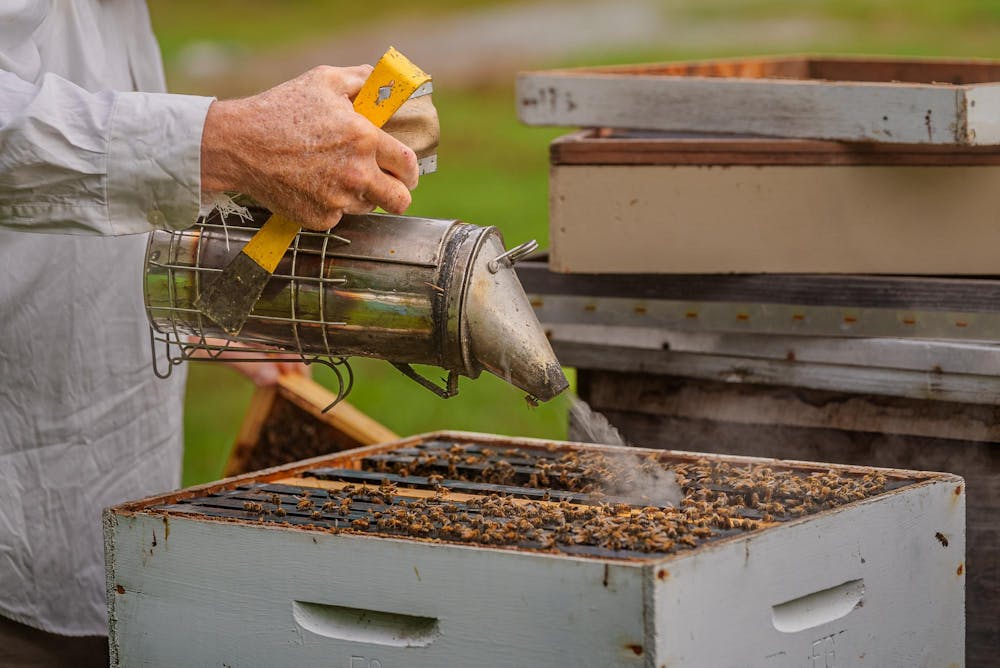
Alamance Beekeepers Club President, Ira Poston, uses a bee smoker when inspecting a hive on Aug 4 in rural Elon. Beekeepers can use smoke to calm the bees by disrupting their communication, making inspections and care much easier.
However, as a beekeeper there are different ways to minimize the impact of varroa mites.
“When you treat, I thought it was on schedule, but sometimes you just can't get ahead of it,” Stevens said.
For Poston he uses Apiguard, which is a mite treatment that he changes out once every two weeks. He places a white tray paper-like substance over his frames that contains a gel-like miticide which is completely harmless to bees.
“It's very important to us to make sure that we keep the bees alive, and find out how we can extend their life and possibly find a mite treatment that will work,” Poston said. There's always mites in the hive, what we're trying to do is just control the level of the mites.”
According to the United Nations Food and Agriculture Organization, bees are directly related to people's food security.
“One out of three pieces of food that we put in our mouths has been pollinated by a bee or other pollinators,” Poston said.
Just like the varroa, honeybees are not native to the Americas, and instead are from Europe. Stevens said that within the beekeeping community there is some controversy between honeybees and native bees. Some people believe that honeybees are overcrowding the native bee populations from being able to collect their pollen quota.
In order for native bee populations to collect their pollen quota, the Alamance County Beekeepers established a pollinator garden located in Snow Camp on the Pine Hill Trailhead. Every plant in the garden is local to the county and as Stevens likes to put it, “somewhat deer resistant.”
“This is planted mainly for the native pollinators, so butterflies, hummingbirds, any of the bumblebees, wasps, whatever,” she said. “This is actually here more for them.”
Honey
A worker honeybee will produce an average of 1/12 of a teaspoon of honey in its lifetime.
“I produce honeys, make soap out of the waxes, and lip balm salves,” Rimmer said. “There's a million different areas you can take the hobby and it sort of interrelates.”
It wasn’t until Rimmer got to Elon that he could finally delve into his interest in beekeeping. Currently he has 15 colonies and cares for 750,000 bees.
“The more beekeepers, the better,” Rimmer said.
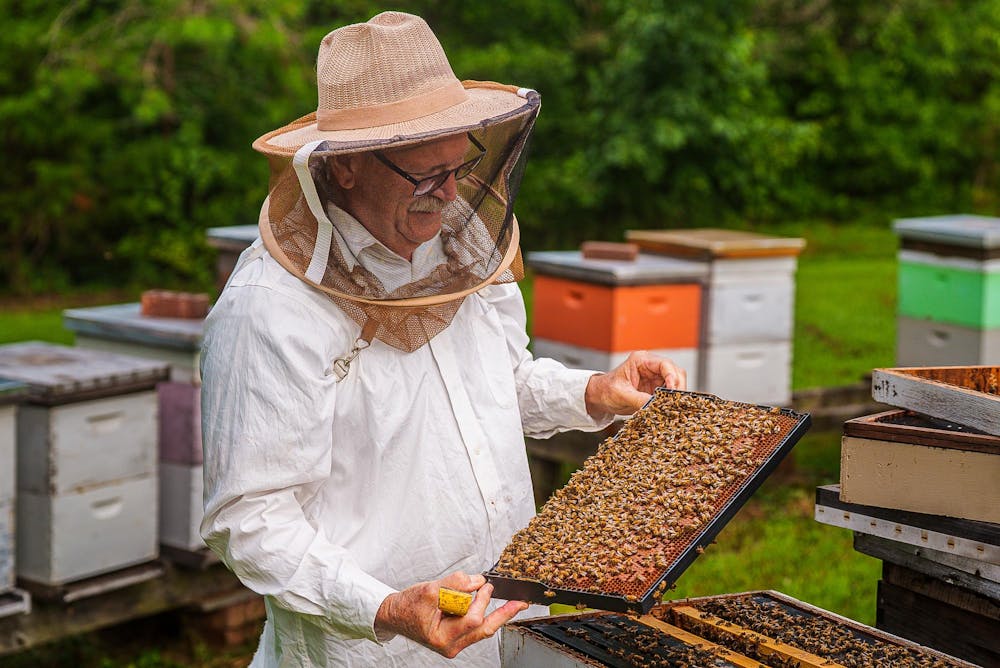
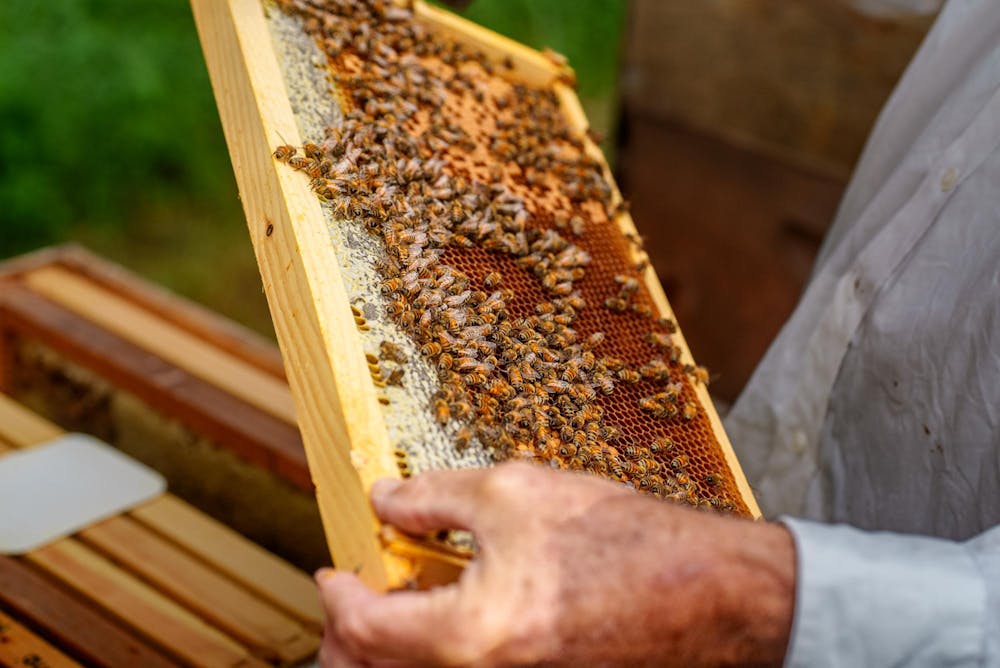
Alamance Beekeepers Club President, Ira Poston, inspects a frame filled with larvae being taken care of by worker bees on Aug 4 in rural Elon.
Maybe at first the cost upfront for this hobby is an investment, but Poston said that it can turn profitable. Poston also sells his own honey.
But Poston, Rimmer and Steven don’t do it to make a profit.
“The bees themselves are fascinating because there's always something to learn,” Rimmer said. “And just the way they are a superorganism.”
Rimmer said anyone is welcome to join the Alamance County Beekeepers and can attend their monthly meetings on the third Thursday of every month.