


Abigail Kerr left behind the foam weapons of Dagorhir — a live-action combat game — in search of a new challenge. They found it on the roller derby flat track, where the hits are real, the pace is relentless and they don’t have to hold anything back.
The track was also the first time Kerr asked people to refer to them with she/they pronouns. Kerr isn’t the only one in the league who has benefited from its welcome environment.
“It has done wonders for our retention in the league — feeling welcomed, feeling not just tolerated, but truly accepted for who we are,” Kerr said.
Kerr joined the Greensboro Roller Derby, or GSORD, New Skater Academy in August 2024. They climbed up the ranks to play at a competitive level as a blocker. A blocker’s goal is to stop the lead player, otherwise known as a jammer, from getting past them to score points. They wanted to find a sport that was less male-dominated than Dagorhir. Even with no prior experience, roller derby provided a more female-centered and nonbinary community.
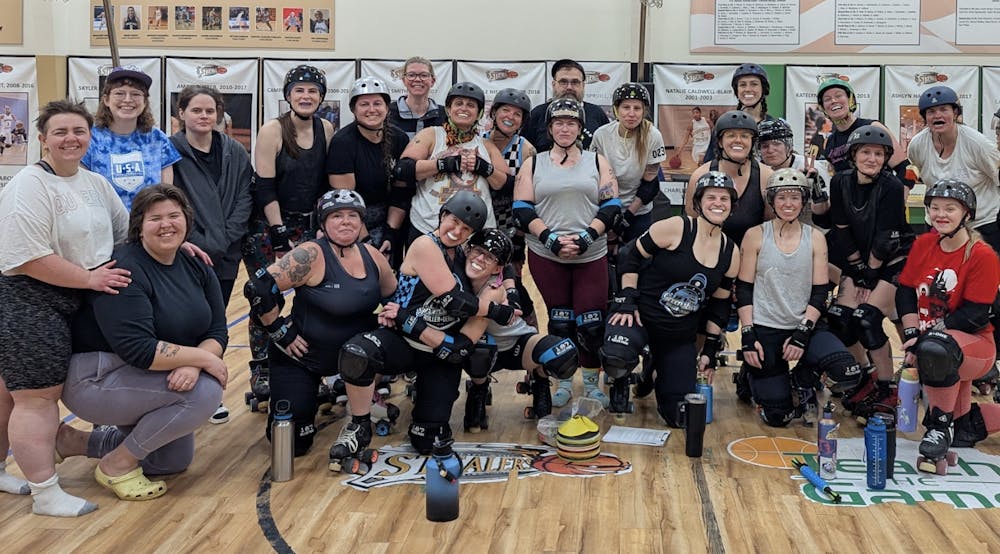
Abigail Kerr (left) stands with the Greensboro Roller Derby Team at Brown Recreation Center in Greensboro. Photo Courtesy of Katie Bardou.
The Women’s Flat-Track Derby Association, the governing body of all WFTDA league members, states those who describe themselves within a marginalized gender, including women, nonbinary and those under the trans umbrella, are encouraged and welcomed to join the sport if the player believes it aligns with their identities.
In 2011, WFTDA changed their eligibility standards. One of the new guidelines on eligibility included “language stating that the athlete’s sex hormones are within the medically acceptable range for a female” based on the healthcare provider’s judgment on what the range for “medically acceptable’” is for a female.
After growing conversations on gender identity worldwide, they rewrote the statement in 2015 to remove “potential exclusion and discrimination,” making gender-based eligibility broader.
Eastern Illinois University kinesiology, sport and recreation professor Andrew Kerins researches non-mainstream sports, including roller derby. From his work, he found that these sports usually have a strong social component.
“That's one of the interesting things with derby, there's this phenomenal community that is primarily female identifying, although that's definitely changed a lot in the last ten years as people become more open to different sexualities,” Kerins said.
Roller derby is played in two 30-minute games, with teams consisting of four blockers and a jammer. A full game is also called a bout. Jammers are distinguished with a star on their helmet, starting each jam behind the group.
As the lead player for the team during the game, they must make it through the group of blockers and back around the track to start scoring points. After the initial pass, jammers score one point for each opposing team’s blocker they pass. Each period lasts two minutes or until the lead jammer calls off the jam.
“Combat Wombat,” Kerr’s derby name, made their GSORD travel tournament debut on April 24 in Richmond, Virginia, battling other roller derby teams. In the past, Kerr said places like the gym were not a fun way to be active. Now, the accepting nature of GSORD gives them the opportunity to be active in a way they enjoy.
“I have always been discouraged from being in sports,” Kerr said. “I don't really have what's considered an ‘athletic body,’ but my body is a derby body. I am so very built for blocking. I can stop anyone in their tracks. It is so affirming to have your teammates be like, ‘Yes, you're doing well because of how you are built.’”
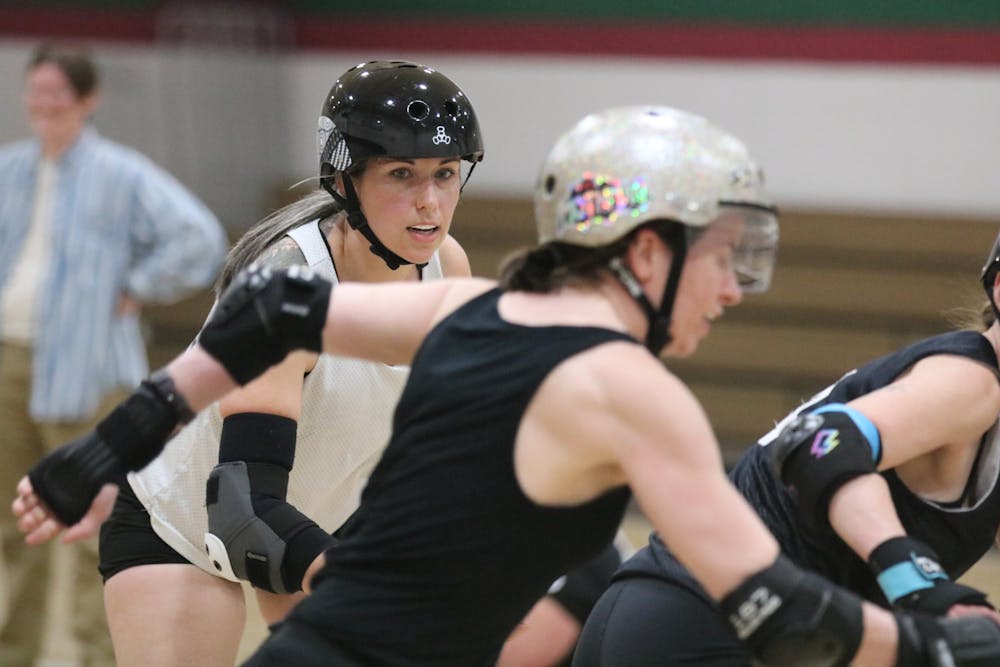
Cruella De Wheels skates after other GSORD players during a practice on May 1 at Brown Recreation Center in Greensboro.
Roller derby dates back to the Great Depression, when roller skating was a popular hobby among Americans, but not a competitive sport. Originally, derby tracks were banked or curved, but due to construction and insurance costs, many leagues have now strayed away from that design.
Roller derby made its flat-track revival during the early 2000s in Austin, Texas — bringing popularity back to the sport. According to the WFTDA, there are 413 registered league members across six continents. Flat Track Stats, which gathers bout stats from WFTDA, lists 543 leagues in their rankings. Bout stats include points scored, penalties, jam length and individual skater performance.
“When derby took off, people said, ‘Hey, we want to do something different, and here's this kind of edgy thing that used to be cool back in the day. We're going to bring it back,’” Kerins said. “When we think about involvement with an activity, it's about some kind of physical thing, game or sport.”
Emily Price, or “Sunny D’Lightning,” plays as a pivot for GSORD. Price emphasized how important it is to see the sportsmanship between different teams and the opportunities they get to compete nationally as a travel league.
Pivots in roller derby have special abilities in the game, beginning as a blocker and then being able to switch to a jammer during the game when the lead jammer decides to eject themselves from the bout. These players are marked with a single, wide stripe going across their helmet.
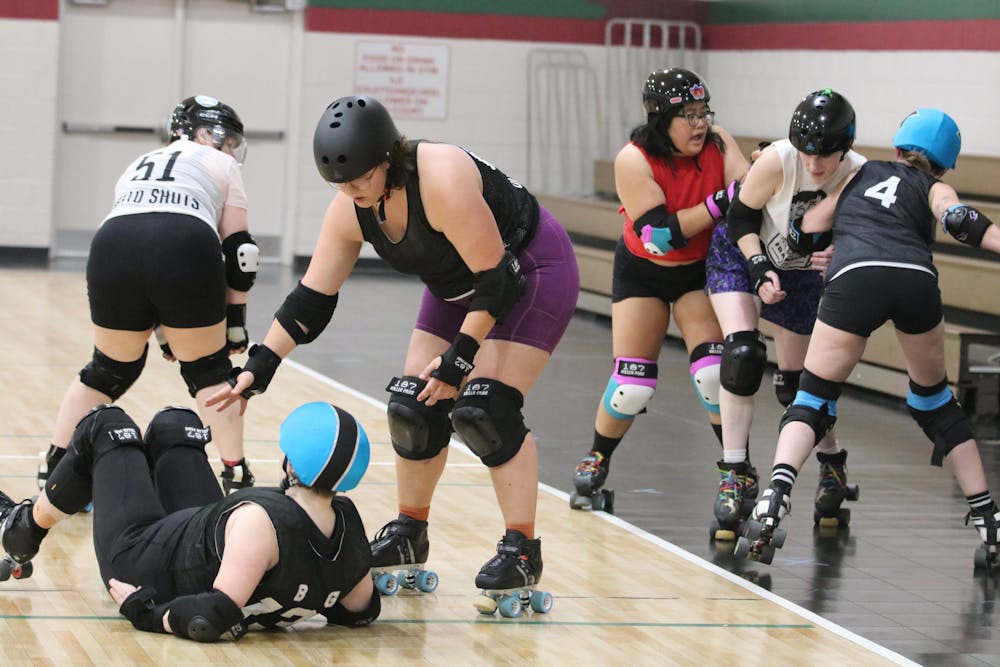
A GSORD pivot player, marked by the line going across their helmet, falls onto the ground on May 1 at Brown Recreation Center in Greensboro.
“It really does help rally our team together. It strengthens our bonds more when we have a common goal to defeat somebody that maybe last year they beat us really bad,” Price said. “That's a motivating factor for us to all kind of come together and do better the second time around.”
Ranked at #490 internationally according to FlatTrack Stats on June 8, Price says there is still a lot of growing to do when competing with other leagues who defeated them before.
GSORD was founded February 3, 2010. In July 2012 they joined the WFTDA Apprentice Association, becoming a full WFTDA member in June 2013. The organization is run entirely by volunteers, from the players to the referees to support staff.
As a nonprofit, all of GSORD’s profits go back to the league or, at select competitions, they choose to donate the money to charity. Katie Bardou, who plays as Skatie Long Stockings, leads the public relations and marketing team for the league. She believes that without social media, the team would not have the same breadth and participation as it has gathered.
“It’s incredible how word gets passed around,” Bardou said. “Our goal for social media is not just to promote our games, but show people that they can find us and find a team from all backgrounds and cultures.”
During the day, Bardou is a freelance photographer who started roller derby to set an example for her son. While Bardou says that it creates a greater drive for players to donate time as they promote or work on the behind-the-scenes of the league, Kerins said that it’s one of the many challenges for the future of the sport.
“Derby has DIY ethos ingrained in its DNA,” Kerins said. “Some of those amazing founders that rebirthed it, the way they took it on is awesome, but they still had day jobs. If you can't get to the point where people are being paid, then it's going to be hard to break in a sport significantly because there's just not the time and energy there.”
Many leagues, like GSORD, have to rethink what they do as academic calendars come to a close. Kasey “KCDC” Miller works as the Assistant Director for Communications and Engagement at Elon University Catholic Life, but outside of office hours she’s a blocker for GSORD. She said the summer is especially tough for the league as many of their college athletes return home during the competition season.
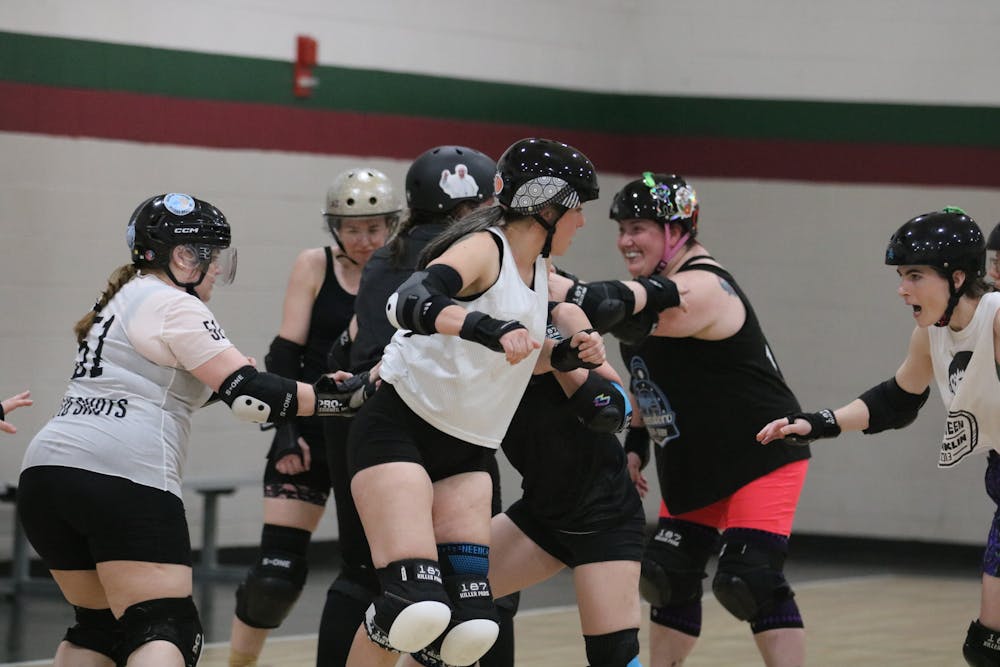
GSORD players scrimmage during a practice on May 1 of Brown Recreation Center in Greensboro.
“There are a few college leagues, but it is very difficult because it is a year-round sport,” Miller said. “We've had a number of college students play and then they have to leave for the summer. I think if they can find a way to join something like this – whether it's roller derby or rugby at Elon – finding a sense of community, that puts you outside of what's expected.”
When she was younger, Miller competitively figure skated and then started roller derby when she lived in Little Rock, Arkansas. She said she believes awareness of opportunities in female-dominated contact sports will break standards and encourage more diverse perceptions of what an athlete looks like.
“Women are kind of made to feel like they need to be perfect,” Miller said. “They need to be a certain body size, shape, level of aggression. This is the opposite of everything I've done. I'm encouraged to be bigger. I'm encouraged to take up space. I'm encouraged to hit hard and be super competitive.”
From the doctor to the dentist, Price joked she’ll show off her bruises and encourage them to join roller derby. According to GSORD players and Kerins, any sport is hard to get into, but they both point out that it's more about self-exploration than anything.
“It doesn't matter if you’ve never played a sport,” Price said. “We really welcome everybody — every body type, every gender, every shape. We meet you where you are. There's a spot for everybody on the track. We all have the common goal to better the sport and make it bigger and more accessible to everybody. At the end of the day, we all share the same love of roller derby.”