

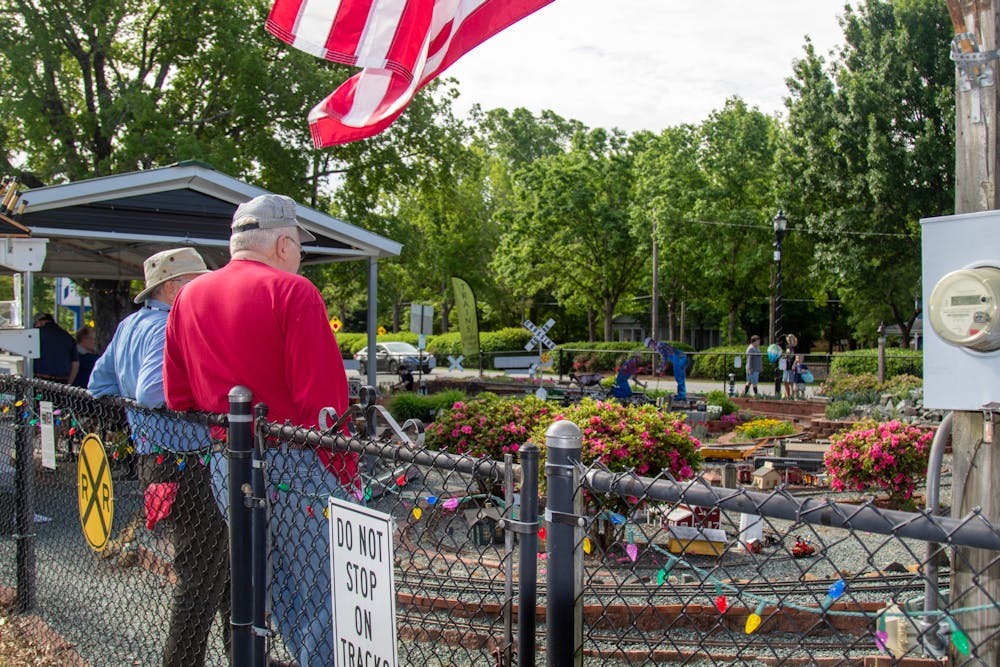
When Neil Bromilow moved to Gibsonville in 1995, one early morning his wife and he drove through downtown Gibsonville and thought it looked “sketchy” and “tired.”
“It looks like a place you wouldn't want to go,” Bromilow said.
It wasn’t until 2005, when he got appointed onto the Board of Aldermen and then chairman of Downtown Gibsonville Revitalization Commission, that a downtown makeover went into effect. For the next six months, he and fourteen other board members and volunteers, six being current or former Elon professors, put together a report detailing 83 initiatives that could be implemented to enhance downtown based on survey responses. The town approved $60,000 for the effort, and it’s only grown since.
One of the initiatives was establishing a farmer’s market to occur every Saturday morning. Bromilow said the idea was met with laughs and lack of faith. Despite this, he started the farmer’s market with one farmer who sold potatoes, and now the market has grown to over dozens of vendors.
“It's certainly bigger than that,” Bromilow said. "But you get the idea that it had to start somewhere.”
Exactly, it has to start somewhere... about two centuries ago.
Gibsonville was founded in 1871 and, like most other towns within North Carolina, their economy was heavily intertwined within the textile industry. Running through the town was a railroad where they would ship out textiles made at the Minneola Cotton Mill located just beyond the tracks. However, the main star of the show was the rose bushes that could be seen outside a traveler's window, garnering the nickname of “The City of Roses.”
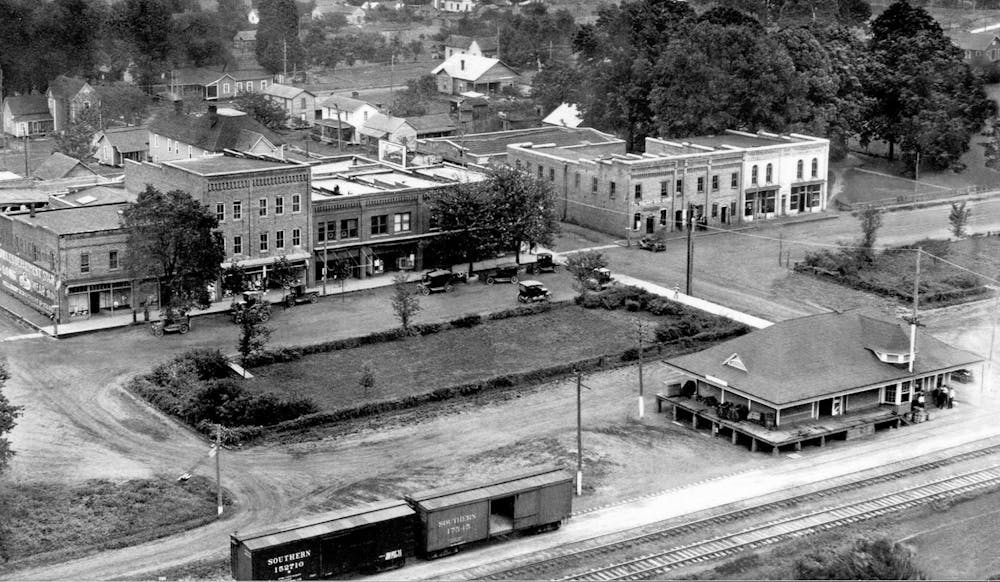
With business being drawn into downtown, Main Street was a lively place until the mills closed in the 1980s.
Owner of Just For You, a vintage shop, Wanda Small is from McLeansville, North Carolina, and grew up shopping within downtown Gibsonville. Her father and brother had worked at their local mill.
“When it shut down, it lost the economy to the town,” Small said. “I mean, it pretty much devastated the town.”
Small has owned Just For You for twenty one years and saw the downtown transition from boarded up windows to a bustling area. She said within the past five years she has seen more businesses move and rent out previously vacant spaces.
She also noticed an increase in greenery. When Bromilow started the initial makeover, he said the place looked like a cemetery with random monuments scattered around, so one of the initiatives Bromilow made was to move all the monuments onto one spot and then plant more trees.
“So we went with ‘do a little of this and little more of that,'” Bromilow said. “It wasn’t a million dollar funding.”
According to the North Carolina Department of Commerce, investments in Main Streets across the state reached $4.5 billion dollars in 2022.
Chelsea Dickey, a community development consultant, took on the project of tackling the revitalization of downtown back in 2018. Dickey’s company, Motley Local, has worked on projects all over Alamance County including Haw River. Her goal: businesses.
“When I first came here, our goal was to get a lot more businesses downtown,” Dickey said. “We had a lot of vacancies on our main street, so it was all about business recruitment.”
She said that it took years of emailing and advertising downtown to get businesses to move to Main Street. Despite this, Dickey said she has been able to double the amount of boutiques and is continuing to drive businesses to Gibsonville. With that comes an increase in the job market. According to the NC Department of Commerce, there were about 32,000 new jobs made in downtown districts across the state.
Dickey said she didn’t want downtown Gibsonville to be defined as a pit stop destination before getting onto the highway. Dickey also didn’t want to define Main Street by the Alamance and Guilford county line which separates the downtown. Though the line is invisible, Alderman Bryant Crisp says that it affects the amount of funding they get for projects.
“Funding is always – when you're trying to do things – an issue, because we want to find ways that we can get as much of this done as possible without passing that deal on to the taxpayers,” Crisp said.
Crisp said they have applied for grants in order to receive funding on projects the town has without raising taxes, but in general the board has tried to be as responsible as they can with the budget.
Dickey and Crisp said their overall goal is to create a downtown that can keep up with its growing population. According to the U.S. Census Bureau, Gibsonville’s population has grown by 48% since 2010.
Crisp said long term, the Aldermen, which are the members of the Board of Aldermen, has dreams of expanding downtown across the train tracks. They recently purchased the Minneola Mill for a little over $1.2 million dollars in 2024 and hope to renovate it to become apartments for people to live in. However, for now they have been focusing on more basic tasks like increasing accessibility and walkability among main streets.
“That means a lot of the things on my plate right now are parking and trying to figure out how to get a tunnel underneath the tracks,” Dickey said.
Just like Bromilow, Dickey is creating basic structures like sidewalks so people can have an enjoyable experience downtown. However, on a bigger scale the job title also includes event planning.
Even if there were only five businesses to participate, Dickey said they would still do it. After the first “Girls Night,” when around two thousand women came out, almost every downtown business wanted their share of participation.
Small said that before the event all the owners come together, pray over the event and grab the distinct, pink-labelled Gibsonville Girls Night bag that they pass out to visitors.
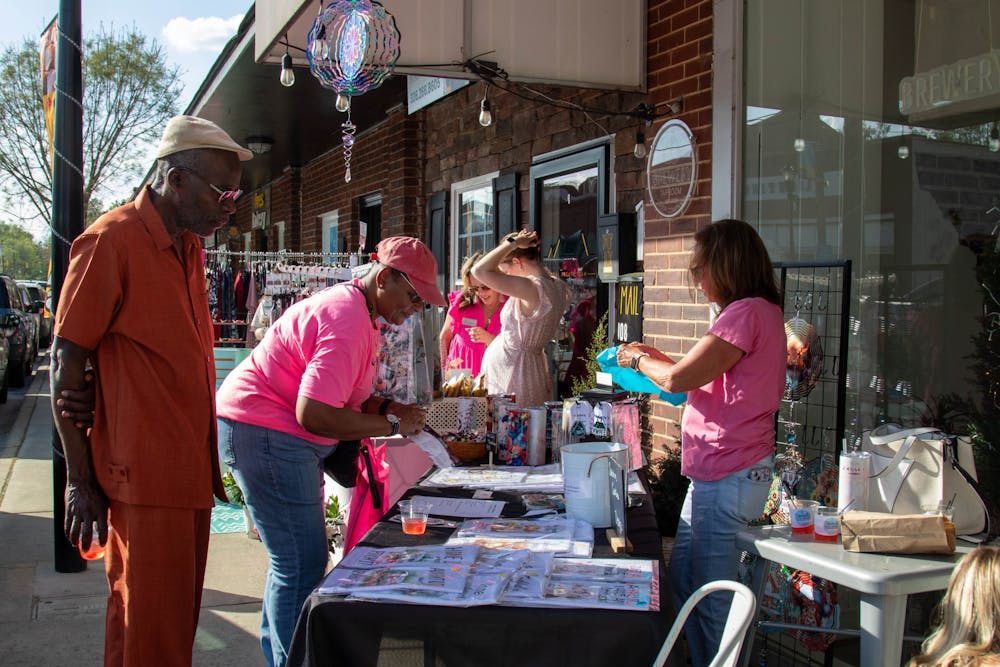
“It’s just the comradery, that has really… it’s a blessing,” Small said.
Dickey said her goal is to not only uplift female voices within downtown, but also people of color.
“Gibsonville is literally built on the backs of African American people who were enslaved,” said Dickey.
Dickey said she does outreach to black and other minority businesses and makes sure those voices are uplifted within downtown.
As a black man, Crisp knows what his identity entails in a small town like Gibsonville. When he was running for Alderman, he had people urge him not to add his face to campaign signs because people might not vote for him just because of his skin color. He did so anyway and ended up winning the seat.
“We want Gibsonville to be inclusive and welcoming for everyone of any race, creed, sexual orientation. At the end of the day, we’re all residents of Gibsonville,” Crisp said.
Crisp said when it comes to modernizing downtown, there has been pushback. Some locals want to preserve the historical aspect of downtown and keep its small town feel. Crisp says that as an elected official he is used to not making everyone happy, but he and the rest of the board try to do what’s best for Gibsonvillians.

“What's also true is that growth is inevitable, and people are moving here because they've seen what a great place it is to live,” said Crisp.
However, Dickey is contracted by the town. She has many ideas, but said that due to funding and pushback it’s hard to make them a reality.
“You’ve got to take direction and give the decision to the community and to the towns,” said Dickey. “Because at the end of the day, it’s theirs and it’s not mine.”
Dickey said this is always on her mind, and that she hopes her work makes Gibsonvillians feel empowered by their downtown and its future.
For Small, she hopes that there is a grocery store within downtown and that it becomes a more walkable place.
For Bromilow, he hopes that there is more housing within the next few years and that Gibsonville becomes the next “place to be.”
For Crisp, he hopes that there is room for everybody and that everyone feels welcomed by the City of Roses.
“Just having a point person like this is the work that needs to be done,” Dickey said when it comes to her job. “Somebody’s gotta shoulder it.”