

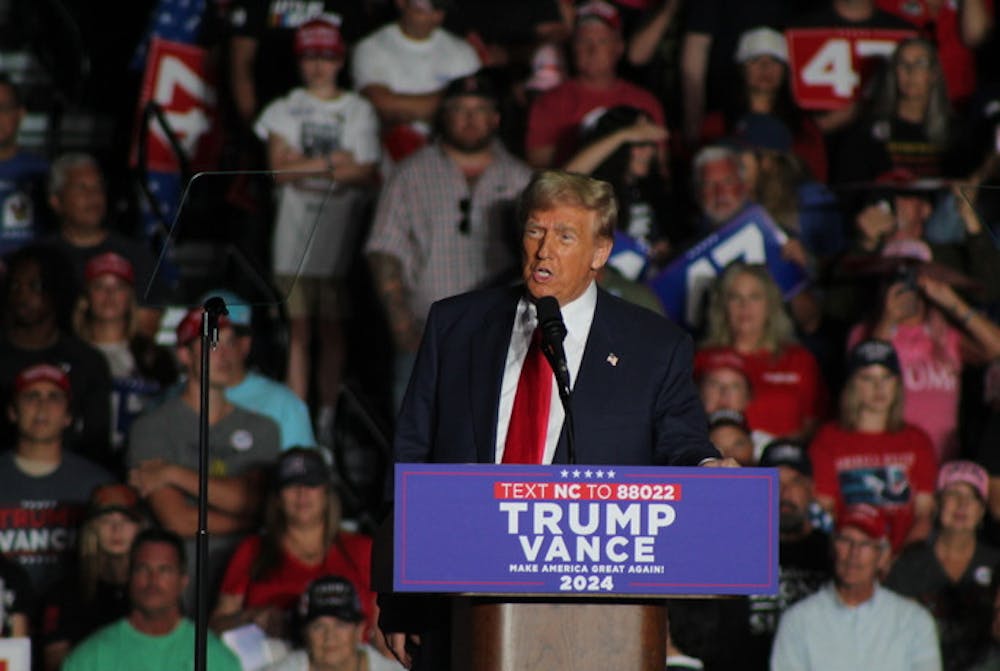
Since President Donald Trump returned to office in January, at least 130,000 federal employees have been laid off or accepted buyouts, and there are currently plans to cut at least 149,000 more positions.
Trump appointed billionaire and tech mogul Elon Musk and GOP primary candidate Vivek Ramaswamy to lead a new agency called the Department of Government Efficiency. DOGE aims to cut trillions of dollars from the federal budget, eliminate or consolidate hundreds of federal agencies, and decrease the federal payroll by as much as 75%.
Federal job cuts came almost immediately after DOGE was established through an executive order titled “Establishing and Implementing the President’s ‘Department of Government Efficiency’” on Jan. 20.
The federal government is the single largest employer in the U.S., with over 3 million workers, or 1.87% of the entire civilian workforce, according to an analysis by Pew Research Center in November 2024.
Fewer than one-fifth of government employees live in the Washington, D.C., area — North Carolina alone is home to nearly 85,000 federal employees.
However, these statistics do not account for people employed by companies contracted by the government or that rely on government funding. Elon University sophomore Audrey Luben’s mother worked for a company contracted through the U.S. Agency for International Development on vaccine rollout in developing countries but was laid off in April after USAID was dismantled by the Trump administration.
Luben’s father works as an epidemiologist in Durham for the Environmental Protection Agency, and while he has not been fired, he is one of thousands of federal employees who waits in limbo.
“It's just probably a really stressful environment to be in, not knowing,” Luben said. “They keep getting told, ‘We're gonna have this big meeting this week or next week,’ and then it never happens.”
Ryan Kirk, chair of Elon University’s environmental studies department, has seen this play out in his own life.
“I talked to friends in the Bureau of Land Management that said every day they go in and they don't know what that day's going to turn out to be right now,” Kirk said. “Just that uncertainty and the weight of that stress, I'm sure that affects families as well as those that are actually employed.”
With many layoffs and budget cuts targeted at environmental and scientific agencies, Kirk has also noticed a shift in students' confidence in their ability to be successful after college.
“A lot of students are doing soul searching — is this a viable career path anymore?” Kirk said. “You're committed to this and you're in the middle of your education, and I think students are thinking, should they look at other things? Should they broaden their skill set?”
Luben, who is an environmental science major and hopes to work in environmental law and regulation, sustainable urban planning, or corporate sustainability feels this defeat when seeing the scale of layoffs.
“I think it’s really hard because everyone who’s getting laid off is looking for a new job, and that field just kind of doesn't really exist at the moment,” Luben said. “I think unemployment will be a thing for a long time.”
According to the Bureau of Labor Statistics, the unemployment rate in April was 4.2%, but federal employees on paid leave or receiving severance packages — pay and benefits employees may be entitled to upon dismissal — are counted as employed. There is no requirement in the Fair Labor Standards Act for severance pay, so many recently laid off federal employees must find new health care providers and insurance.
Luben also has minors in public policy, political science and geographic information systems, and while she credits those classes for helping her gain a deeper understanding of the federal government and its changes, she attributes her initial political interest to her parents.
“I've always grown up hearing about their jobs,” Luben said. “My parents are super politically active people and I grew up in a really politically active town, so I think it's kind of always been a big part of my life.”
But Luben noticed that environment wasn’t necessarily reflected at Elon.
“I was kind of in shock when I first came to Elon because it feels really politically disengaged to me, at least as to where I came from,” Luben said. “Having these uncomfortable conversations that I don't necessarily find uncomfortable, I would bring up freshman year and not realize that people didn't like talking about that stuff.”
Both on campus and off, Kirk advised people to keep an open mind toward the work government employees do and the role agencies play in setting laws and regulations.
“I'm a bit worried about changing perceptions about the value of government work,” Kirk said. “This federal workforce has been continually criticized, and I believe extremely unfairly. These are important jobs that bring value to our society, and I hope we can always keep that part in mind.”