

CORRECTION: A pervious version of this story stated that Marquette did not release a statement on ICE. Marquette did release a statement on Jan. 24, 2025. Elon News Network regrets this error.
With President Donald Trump back in office for his second term, one of his first of many executive orders shortly after he was sworn into office was called “Protecting the American people against invasion,” which is intended to limit the number of people entering the U.S. through the southern border.
According to the executive order, the Department of Homeland Security can now set new enforcement policies, expand the use of expedited removal and authorize state and local law enforcement to investigate, detain and apprehend people who are in the country illegally.
While Elon University is a private university and is not as reliant on federal funding as a public institution, university administration is not planning to send out an official statement regarding ICE to the entire student body. According to Elon spokesperson Eric Townsend, a memorandum was sent out from President Connie Book to Elon University vice presidents, deans and senior staff Feb. 17 regarding university protocol after the signing of Trump’s executive orders.
According to the memorandum, university leadership is monitoring the implications of the executive orders on higher education as well as how other higher education institutions are reacting to the executive orders through injunctions and amicus briefs.
“The leadership team, with guidance from legal counsel, examines each unique situation to understand the legal and regulatory requirements as they are proposed, changed or litigated,” Book wrote in the memorandum. “In each case, the university keeps at the forefront its commitment to fully support the educational priorities and goals of its mission. Elon is monitoring the progress of these cases and, as appropriate, will join amicus briefs in the coming months as these cases progress through the courts.”
In addition to the DHS, Secretary of State Marco Rubio and Attorney General Pamela Bondi are limiting humanitarian parole, the designations of temporary protected status and employment authorization. This also includes denying federal funding to any sanctuary cities that interfere with the enforcement of these operations.
The executive order also states that any person who is in the country illegally must register their presence and failure to do so will be treated as a civil and criminal enforcement priority.
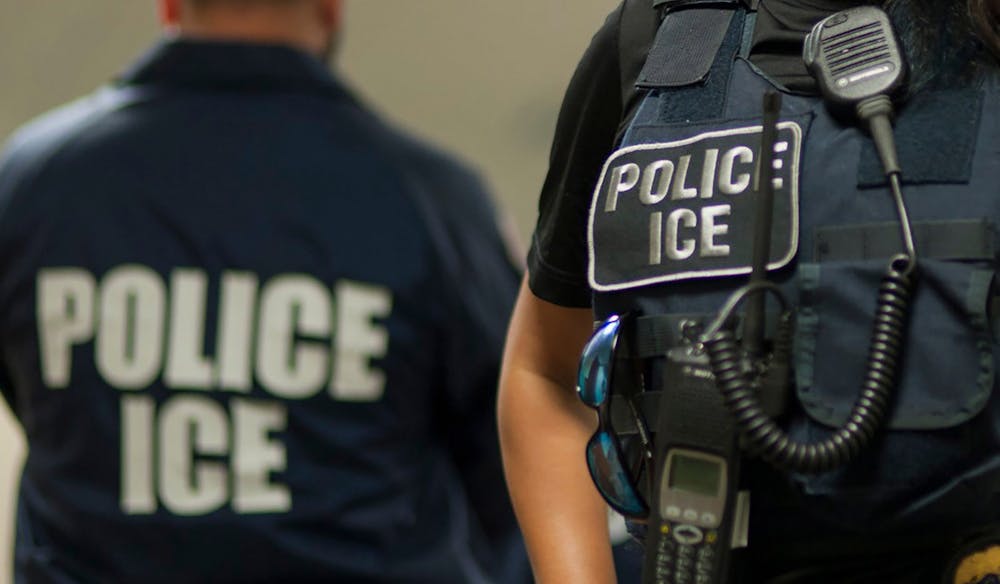
The implementation of this executive order has led to Immigration and Customs Enforcement entering churches and public schools until a Maryland federal judge blocked ICE agents from entering places of worship in February.
In addition to monitoring other cases and other institutions, the memorandum stated that regarding the recent executive orders, Elon University will only respond to judicial warrants and subpoenas.
Immigration lawyer and graduate of Elon Law ’22, Dara Arroyo-Longoria said she was not surprised at Elon’s lack of a public statement to the student body.
“As a Latina at Elon Law School, I didn’t feel supported,” Arroyo-Longoria said. “I can only imagine what an immigrant can feel, what an undocumented immigrant can feel on campus because it is something that I think Elon needs to just continuously work on, is to create a more safe environment for all students.”
Since Elon University is a private institution, ICE cannot enter classrooms, buildings and dorms without a warrant, however in public spaces such as outdoor portions of campus, ICE can make an arrest.
According to Elon Campus Safety and Police classrooms, labs, residence halls and faculty/staff offices are closed to the public at all times and any visitor seeking information about students or employees, or asking for access to private areas of campus, should be directed to Campus Safety & Police.
“If they have a federal warrant, they can very much go into those spaces,” ArroyoLongoria said. “If I want to directly come outside, then it avoids them coming into the dorm and potentially encountering other students.”
The Trump administration is currently in the process of deporting a student visaholder, Mahmoud Khalil, a former student at Columbia University, for his involvement in the campus protests against Israel.
“It’s very much like it is, it is a visa.” Arroyo-Longoria said. “So they could, in theory, revoke those at some point or in the future.”
While ICE has not published arrest numbers after September 2024, ICE has been active in North Carolina. On March 18, ICE published a report regarding an arrest operation conducted in Charlotte from March 1 to 8 where 24 people who were in the country illegally were arrested.
Arroyo-Longoria said while Elon is a private university, giving federal agencies like ICE access to public spaces on campus could still put students who are here illegally at risk.
“This conversation about a public versus private space will matter a lot,” Arroyo-Longoria said. “Let’s say Elon says, ‘Sure, yes, you can come wherever, whatever you need, we will help you.’ That would be concerning because then that is the university giving them access to these private spaces that students would otherwise be protected in.”
She also said Elon can take steps to protect their students by training their staff on what to do in this situation.
“Training staff in every building,” Arroyo-Longoria said. “Any building that you need to be a student to enter, whether that’s RA’s, whether that’s your front desk staff as well, you need staff to be able to feel safe enough to tell I say, ‘Hey, you don’t have permission to be here without a warrant.’”
Elon University is not the only university to not address the current executive orders from the Trump administration.
When compared to Elon’s 15 peer institutions, six of them — three private and three public — have not released any sort of statement to their student body. These universities are Chapman University, Furman University, James Madison University, Miami University, Oxford, Santa Clara University and William & Mary.
While Elon University is not planning on releasing a statement regarding ICE, according to Townsend, Arroyo-Longoria said the university should do as much as it can to keep its students safe, even if that information doesn’t come from Book.
“I do think that there’s things that anyone could be doing to help protect students,” Arroyo-Longoria said. “It’s important for students to feel safe, and I do think that means professors knowing what would happen if ICE comes in the middle of class. Those are all things that I would be advocating for before I send an email to all students, I would want to be able to legitimately say, ‘Hey, these are the resources, and this is what you can do.’”