

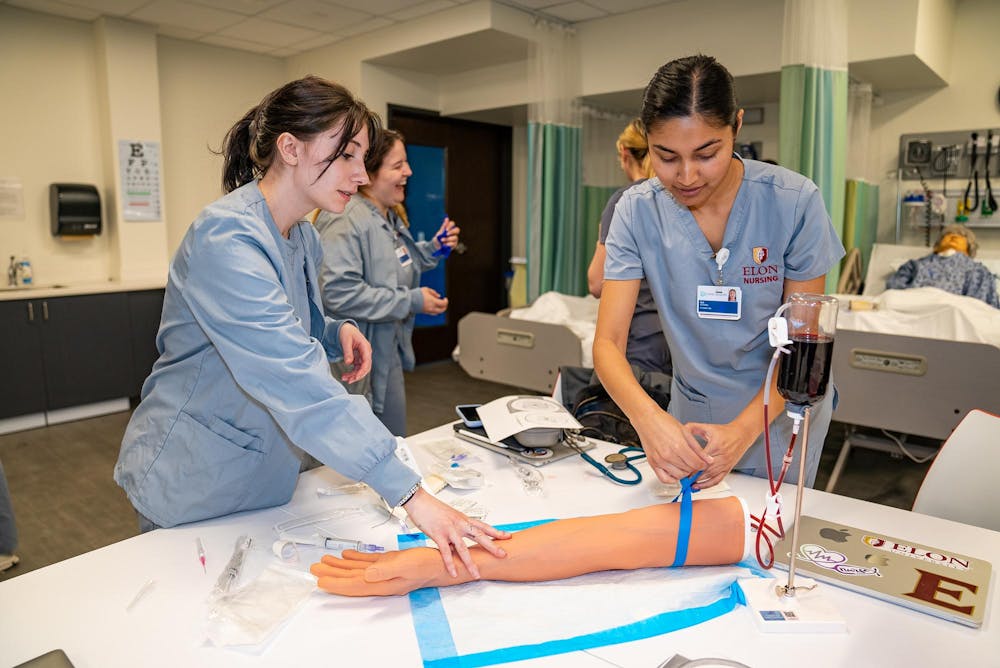
Elon junior Eva Korn came to Elon University to study nursing, even though she knew the program wasn’t accredited.
“I knew that by the time I was in the spot where I was graduating, and I needed to be worried about the accreditation, that it would be there and that I would be able to do everything I wanted to do with this degree,” Korn said.
Over the past two to three years, Elon’s nursing department has been preparing a self-study to send to the National League for Nursing Commission for Nursing Education Accreditation. After the program’s launch in fall 2021, Elon’s nursing program received accreditation from the NLN CNEA in February 2025.
There are five standards the NLN CNEA sets for nursing programs seeking accreditation — a culture of excellence, a culture of integrity and accountability, a culture of excellence and caring from faculty and students and a culture of learning and diversity.
Nursing department chair and program director, Dr. Cathy Quay, started at Elon in June 2024. Quay said since the accreditation process takes two to three years, she came in at the tail end of the process as the program was submitting its self-study.
Each faculty member in the nursing department was responsible for championing one of the five NLN CNEA standards, according to Quay.
“The accreditation process, in and of itself, is really reflective of the entire collaboration within the department,” Quay said. “Faculty, staff and students have worked really hard the past few years to get us to this point.”
After the department submitted its self-study, three representatives from the NLN CNEA visited Elon for two and a half days in September 2024 to meet with students and faculty and visit classes. Once the visit was complete, the accrediting body evaluated all the information from its visit and decided if the program passed and received accreditation.
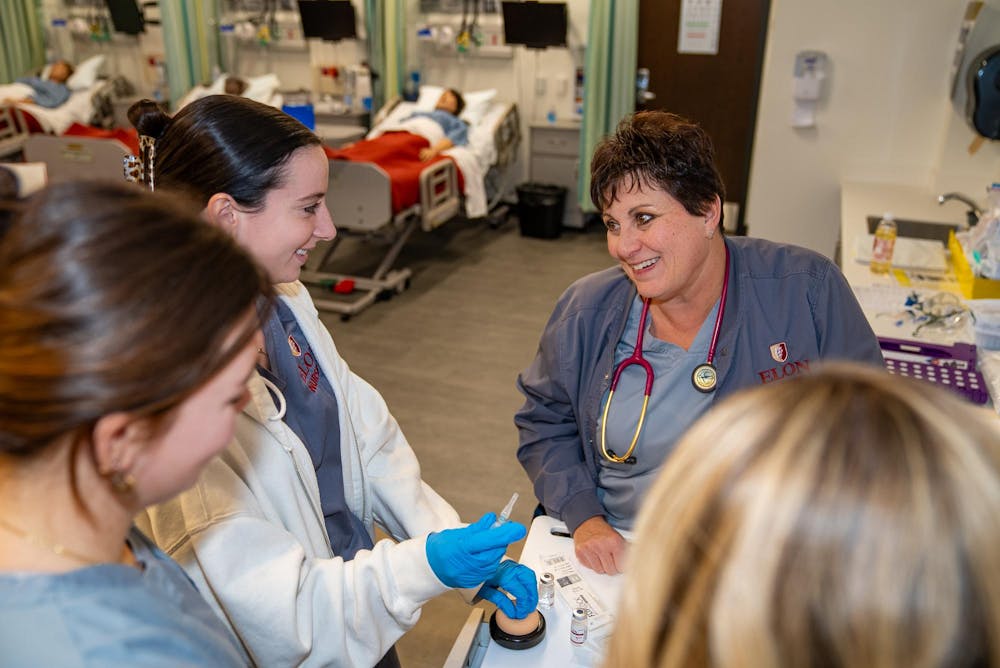
Junior Caroline McCormic (left) practices injections on fake skin with the guidance from Professor Jeanmarie Koonts in the Nursing Skills Lab at Francis Center.
Quay said that while the accreditation focuses on meeting the five standards, the NLN CNEA also looks at how the program will improve over time.
“It also shows that we have the dedication to putting processes in place where we are going to continually look to improve and strengthen the program that we have in regards to what it means for students,” Quay said.
Nursing students who receive degrees from accredited programs have more options when they enter the workforce. Most graduate nursing programs in the country require students to come from an accredited program, including the University of North Carolina’s School of Nursing.
Korn said she had faith that the program would receive accreditation by the time she was graduating. But, now that she knows the program is accredited, she has more control over her career after graduation.
“I get to make the decision now, and I have a lot more freedom,” Korn said.
According to Quay, the NLN CNEA was impressed with the ways the program includes diversity, equity and inclusion in its courses. She said the program requires nursing students to take classes that focus on equity and inclusivity in healthcare. One course specifically, called NRS 2000: Healthcare Relationships I: Disparity, Diversity, Equity and Inclusion, counts as an advanced equity requirement and is taken by nursing students during their first or second year at Elon.
Korn took the course during the second semester of her freshman year. She said it set her up to think about equity and inclusion in the healthcare field both in and out of the classroom.
“It was kind of our first taste of nursing,” Korn said. “I think it made me be able to kind of have that all in the back of my mind while I learned more stuff, and then also while I was going into hospitals and actually seeing it for myself.”
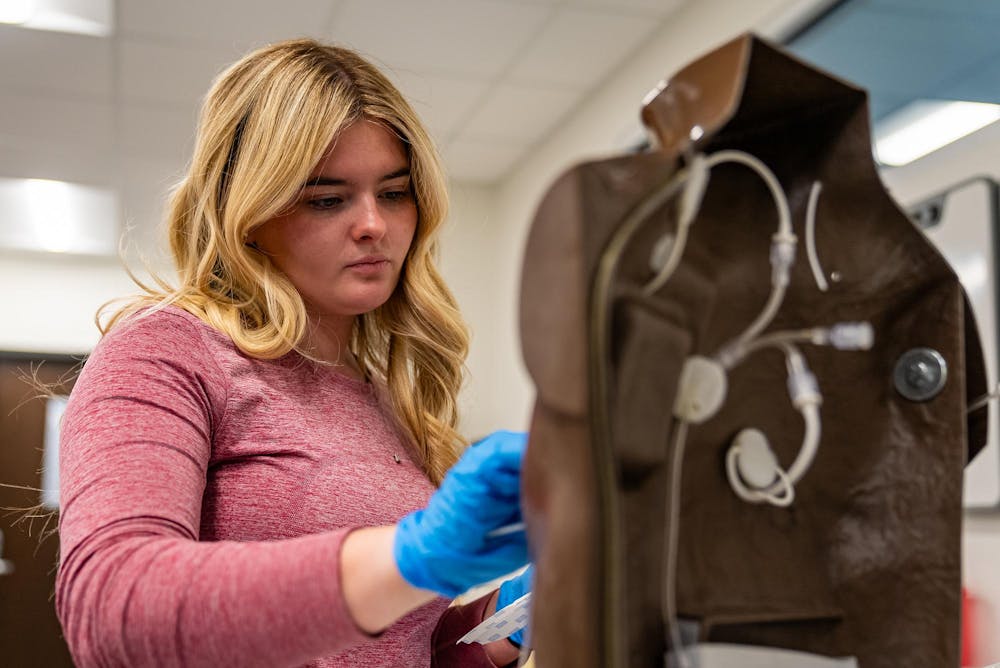
The accreditation body also applauded the program for its Winter Term study abroad course, according to Quay. The course, which travels to Cuba, focuses on showing students the differences between healthcare in the U.S. and healthcare in Cuba but also the limitations of each country’s systems.
The course ran for the first time this past January, with Korn being one of the inaugural students on the trip.
“I wouldn’t trade that experience for anything,” Korn said. “I learned so much. It was so interesting to see how different two places can be and two healthcare systems can be.”
Now that the program has received accreditation, Quay said the nursing program’s focus is now on how the curriculum will change to reflect the rapidly evolving healthcare system. As a member of Area Health Education Centers, a consortium of nursing education programs and clinical partners, Quay said she and other nursing program leaders meet on a quarterly basis to discuss what some of the needs are in the local areas and for nursing education and practice.
The first class for the nursing program started in 2021, and will graduate this May with accredited nursing program degrees.
“We’re really starting to talk about longer term,” Quay said. “What’s our vision in terms of ensuring that our curriculum is current and staying up to date with what we’re seeing in healthcare.”