

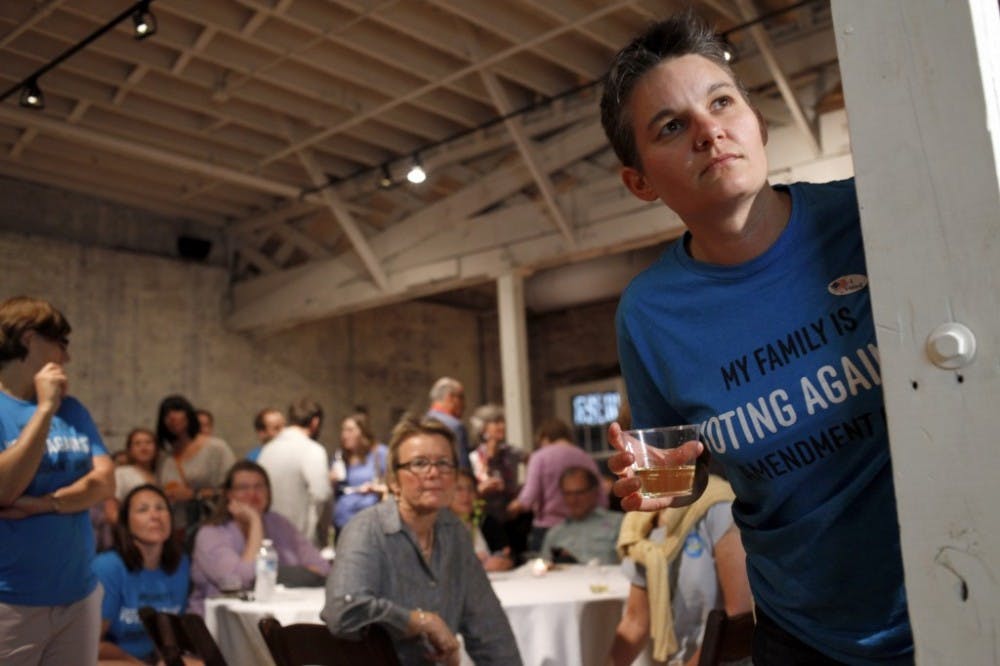
By midnight May 9, the results were finalized: Amendment One passed in the North Carolina primary elections with 61 percent of the vote. The strong amount of support for the amendment elicited strong reactions from all who had vied for or against its passage.
The amendment legally defines marriage as a union between one man and one woman and does not afford legal rights to any other form of partnership, heterosexual or homosexual. The issue drove many residents to vote in the primaries after weeks of campaigning both in support and opposition of the amendment.
Elon University’s LGBTQ office held a debriefing on the results the evening of May 9, and the room was filled with emotion, said Emily Kane, an education and advocacy chair for Spectrum, Elon's queer-straight alliance.
“There was a lot of anger and a lot of sadness and a lot of crying,” she said. “A lot of people were just kind of tired. We put a lot into this fight, and to not win it is hard.”
Many students and community members outside the LGBTQ community were disheartened by the results, as well.
“Students are upset, and rightfully so,” said Darien Flowers, executive president of the Student Government Association. “That our fellow citizens decided to make it legal to take civil rights and liberties away from a group of their fellow North Carolinians is saddening.”
But some students were pleased with the outcome and the definition of marriage now enshrined in the North Carolina Constitution.
“I was proud of the state of North Carolina for looking past the propaganda and doing their research and recognizing that the state needed an amendment,” said freshman Austin Faur, who publicly defended his viewpoint on marriage at an SGA Senate meeting two weeks ago. That night, the SGA passed a resolution stating the amendment contradicted Elon’s discrimination policy.
The greater community of North Carolina ought to recognize the amendment as discriminatory as well, Flowers said, recalling a statement made by Newark Mayor Cory Booker in response to New Jersey Governor Chris Christie’s proposal of a similar amendment.
“Booker said the government should never put to a popular vote the civil rights of a minority group,” he said. “When you do that, you effectively tell a minority group that their wellbeing or their rights to express themselves are left up to the majority.”
The passage of the amendment raised Flowers’ concern for the future of the state.
“It’s organized and systematic disenfranchisement,” he said. “With this kind of precedent, what’s the next thing? I’m fearful that you’re going to have more and more legislation introduced that limits civil rights of people in this state.”
But some opponents of Amendment One assumed a more optimistic outlook.
“I don’t see (the passage) as a loss,” said Clinton Edmonson, an Elon graduate who followed the results online from Los Angeles. “Laws like Amendment One are achieving the exact opposite of what they aim to prevent. All these people (who voted for the amendment) really strengthened a cause they didn’t have a chance to beat in the first place.”
Faur, who has recently been the victim of several verbal attacks regarding his stance on the amendment, agreed the results intensified the opposite sentiment. But he is not deterred from his beliefs.
“My friends are supportive and recognize that everyone who voted for (the amendment) is being attacked,” Faur said. “The future will be interesting. There may be lawsuits or something like that, but a similar amendment has been passed in 30 other states, and I think people forget that.”
But Kane said she believes the numbers can be overcome. The LGBTQ office might hold a meeting in the fall to discuss moving forward against the amendment.
“We are definitely not giving up,” she said.