

Generation gaps are not a foreign concept. Many adults question the effect of digital technologyon the younger generation, a new survey shows.
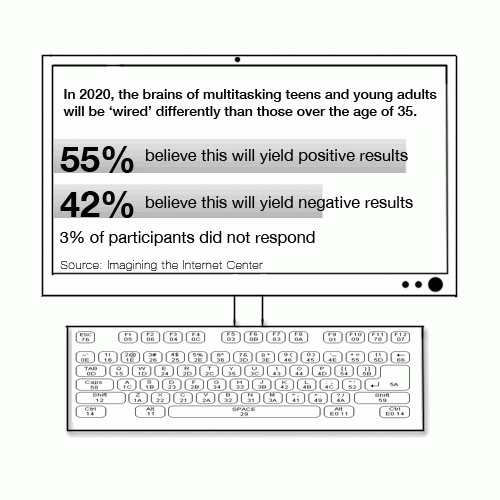
Janna Anderson, associate professor of communications and director of Elon University’s Imagining the Internet Center, and Lee Rainie, director of the Pew Research Center’s Internet & American Life Project, conducted a survey that explored the increasing prevalence of digital technology and its potential consequences come 2020.
More than 1,000 Internet experts and users provided predictions about the overall consequences of hyper-connectivity. Participants were initially asked to agree with one of two hypothetical scenarios that presented the positive and negative consequences associated with increased technological experience. Participants were later allowed to submit a personal opinion in response to the two scenarios.
In the study released Feburary, the responses, then submitted by leaders in various technology-centric industries and university programs, ranged from positive to negative, but most often suggested ambivalence.
In the hyper-connected community of Elon, most students are all too familiar with the practice of multitasking. An ever-increasing amount of digital and social media poses a constant threat to distraction.
“Twitter and Facebook are probably the biggest distractions for me while I’m working on schoolwork,” said Jacquie Adams, who responded to the survey in Anderson’s Future of the Internet course. Student responses were not published in the study.
“If I need a break, I’ll check Facebook and easily waste up to 30 minutes on it. I think I’ve gotten so used to being connected to everything all the time, I almost feel like I have to check Facebook constantly.”
Other students find such distractions manageable and even beneficial. Sophomore Joe Bruno, who also completed the survey, said he multitasks constantly, both on and offline.
“I’m constantly plugged in and wouldn’t want it any other way,” Bruno said. “Multitasking has become so incorporated into my life. Digital technology immensely affects my concentration when faced with schoolwork, but I don’t see this as a problem. I don’t buy into the argument that people cannot effectively multitask.”
Nevertheless, how students and young adults choose to divide their time, rather than if they chose to do so, is more indicative of digital efficiency, Anderson said. An underlying concern that the younger generation often use the Internet and other digital tools to pursue superficial interests can be found in many survey responses.
Yet, Amy Hogan, assistant professor of psychology who teaches a course titled Psychology and the Internet, acknowledges our limited knowledge with respect to the web.
“It is important to keep in mind that the Internet is rather in its infancy,” Hogan said. “We really don’t know its long-term benefits. There are studies that suggest that being connected all the time can affect concentration and focus, but there are also studies that indicate that (the Internet) is rewiring our brains to have greater visual and spatial intelligence and to deal with all sorts of information at one time.”
Survey participants disagreed on the pervasiveness of digital technology and its ability to foster change in cognitive and behavioral patterns. The survey results showed the true feasibility of multitasking is contested, as are its consequences.
“Some people try to say that (multitasking) doesn’t exist, but it has been proven that people can juggle tasks,” Anderson said. “Some people may be more capable (of multitasking) than others, but these are skills that can be learned.”
But the innateness of these skills for the younger generation is debatable, she said.
“Some (survey respondents) said that older people assume that every young person is a digital native,” Anderson said. “(But others argue that) all (young people) have different skills based on how much they have immersed themselves in (technology)...and want young people to realize how much more power they hold when they use digital tools the right way.”
In some ways, the digital capability of the younger generation rests in the hands of the older generation, Hogan said.
“We do have the responsibility to teach children digital fluency, and that includes when and how to use digital technology effectively,” Hogan said. “It’s also important (to teach them) what information is important online, because there is so much out there.”
But ultimately, the reality of either hypothetical situation proposed in the study will be determined by the self-control and the prudence of a generation largely accustomed to constant communication and instant gratification, Anderson said.
“A lot of it comes down to the whole idea of self-discipline and time management,” Anderson said.
Editor's note: This article was corrected to clarify that Bruno and Adams were not participants in the official study.