

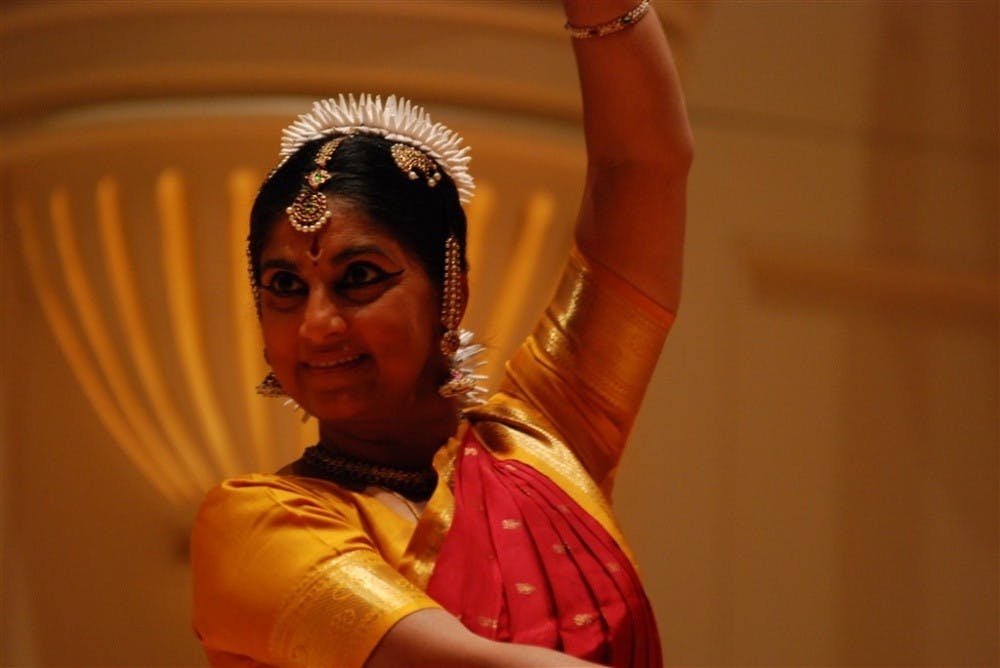
Hovering inches above the ground, Anuradha Murali reverently touched the wooden floor of Whitley Auditorium. Bringing her fingers to her closed eyes, she uttered a quiet prayer of thanks to the earth upon which she was about to perform. An Indian melody began to play, and Murali took the first step of her dance.
Murali, artistic director of Mrudani School of Performing Arts, performed Monday night as part of Elon's International Education Week. She was born in Bangalore, Karnataka, India and earned a Ph.D. in microbiology and immunology and currently works on cancer research at the Medical University of South Carolina. Raised in the United States for most of her life, she was trained in the art of Indian dance at a young age.
The dance Murali performed was Bharata Natyam, a type of classical South Indian dance. The dance is designed to be a form of worship to the god, whom the devadasi, or dancer, is reenacting.
In the mid-20th century, this form of worship came under heavy fire by the British in colonial India.
"Dancers knew they needed to portray worship," Murali said. "But the British looked at it and didn't see worship."
In 1947, British colonists initiated the Devadasi Act, which prohibited women from all forms of dancing. The act was largely ignored.
While it is now legal for both men and women to perform Bharata Natyam in India, it still remains controversial amongst certain members of the Indian community.
"Many families do not want their daughters dancing, because men are looking at (them)," Murali said.
Murali's performance consisted of a series of dances, each one invoking a different god.
The first was to the elephant-headed god Ganesha, who always receives the first dance because he is known as the one who removes all obstacles, Murali said. Without using words, Murali praised the god of beginnings and then paid homage to the original choreographer of the dance.
She proceeded with a series of dances to the gods Rama and Murugan before concluding her performance with an improvised dance depicting Krishna, the mischievous god.