

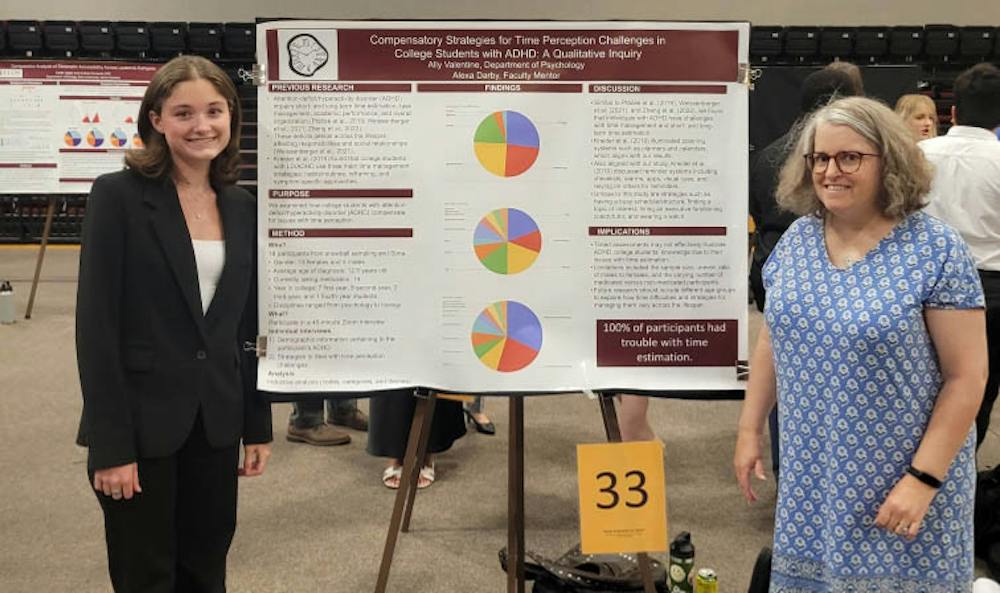
Research examining how college students with ADHD cope with time blindness has earned Elon University senior Ally Valentine national recognition through the Phi Kappa Phi Pioneer award.
Valentine, a psychology major, was selected for the award over the summer. She said she initially applied without expecting to receive the honor and was surprised when she received an email notifying her of her selection.
“I was really shocked,” Valentine said. “It felt really, really good and reassuring.”
The award recognizes academic achievement, research and leadership and provides funding that Valentine plans to use toward her research. She said some of the money will help cover registration for a conference where she will present her research in November. The remaining funds will support her current study, potentially helping provide incentives for participants.
In a statement to Elon News Network, April Post, advisor for Phi Kappa Phi, said the organization is the nation's oldest multidisciplinary honor society and is dedicated to academic excellence and service. Juniors invited to membership must rank in the top 7.5% of their class while seniors must rank in the top 10%.
Valentine began researching ADHD in college students with psychology professor Alexa Darby in spring 2025. Their research focuses on time blindness and the different coping mechanisms students with ADHD use to manage difficulties with their perception of time.
“We are thrilled that Ally has been selected for this award and grateful for mentors like Dr. Darby who encourage their students to pursue their research interests,” Post said.
Through Elon’s Summer Undergraduate Research Experience program, Valentine helped conduct the research and prepare a paper that is currently under review at a journal.
The research found that students with ADHD use different strategies to cope with time blindness, showing that there is not one solution that works for everyone.
“It’s not like a one-size-fits-all sort of thing,” Valentine said.
Valentine is now working with Darby on another study examining the social implications of ADHD on college students. The study looks at whether learning about the social effects of ADHD changes how students understand and attribute their own symptoms.
Valentine said Darby has been an important mentor throughout her research experience. She said Darby encouraged her to pursue research after learning about her interest in ADHD and neurodivergence.
“She’s been incredibly helpful, but she also gives me a lot of independence in the process," Valentine said.
Darby has also helped Valentine develop skills in research methods and connect with other faculty members to strengthen her quantitative data analysis skills.
After graduating from Elon, Valentine plans to work as a research assistant in an ADHD research lab before pursuing a doctorate in clinical psychology. She hopes to continue conducting research before eventually moving into a more clinical role.
For now, Valentine said the Pioneer Award is helping her take the next step in that path which gives her the opportunity to continue researching ADHD and share her work with other researchers.
“I’m headed in the right direction,” Valentine said.