

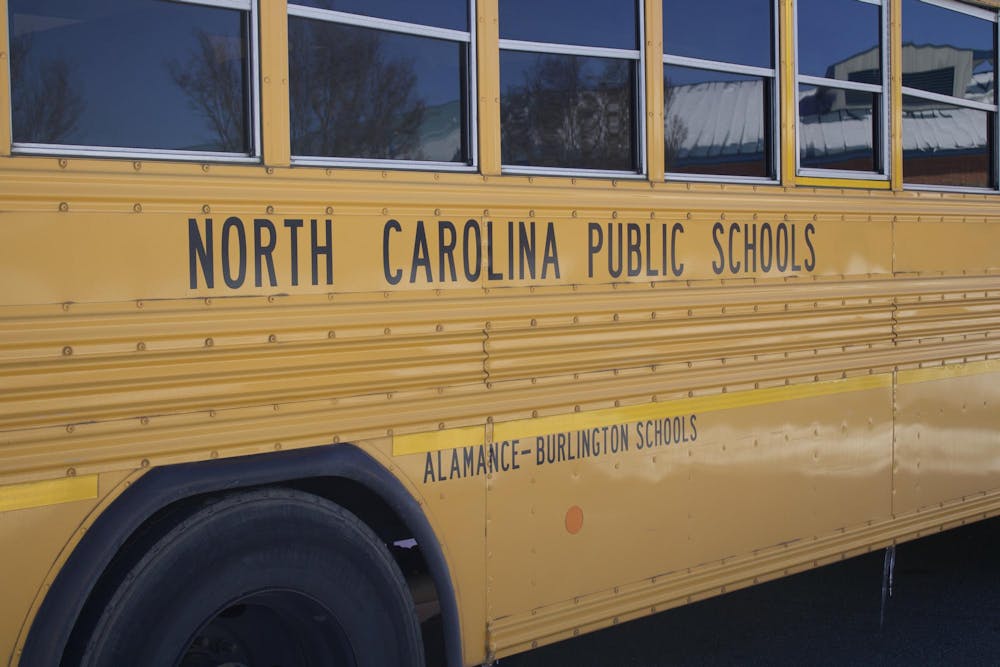
North Carolina teachers will receive an average salary increase under the state’s newly approved budget, a move education leaders say is a step toward strengthening the profession but not a complete solution to the state’s ongoing teacher shortage.
The teacher pay increases are included in Senate Bill 257, the state budget signed into law by Gov. Josh Stein. The budget provides an average 8% salary increase for teachers, with the largest raises going to educators in the early years of their careers.
For Tony Messer, assistant superintendent of finance for the Alamance-Burlington School System, the raises are welcome news but should be viewed in a broader context.
“The majority of the larger raises go to the lesser experienced teachers,” Messer said. “Teachers that have anywhere from one to eight years of experience will see the biggest increases.”
Although an average 8% raise appears substantial, Messer said teachers did not receive a salary increase the previous year, making the overall gain less dramatic over time.
“If you take that over the two-year span, that comes out to be about 4% per year, which is barely above inflation,” Messer said.
Teacher pay has remained a major topic of discussion in North Carolina in recent years as lawmakers, educators and school districts have debated how to improve recruitment and retention.
According to the North Carolina Association of Educators, the state's average teacher salary ranked 43rd nationally. The most recent rankings are at $58,292, nearly $14,000 below the national average of $72,030. North Carolina also trailed each of its neighboring states in average teacher pay, reinforcing concerns among education advocates that long-term investment will be necessary to improve recruitment and retention.
Messer said the state’s decision to direct larger raises toward educators with fewer years of experience reflects an effort to strengthen the new teacher pipeline.
“Anytime teachers get a raise like that, it’s important to highlight," Messer said. "But it's also important to keep it in perspective.”
For ABSS, the legislation will have little direct impact on the district's finances because teacher salaries are primarily funded by the state. While the district provides a local salary supplement, the additional increase approved in the budget will largely be paid through state funding.
“The majority of the pay increase will be coming from the state of North Carolina, not from ABSS,” Messer said.
Emily Lynn Atkins, chief communications officer for ABSS, said the budget sends a positive message to educators while many teachers are away from their classrooms during summer break.
“I imagine that they're very excited to see a raise at the state level, knowing that the state government is behind them in some way, trying to make progress,” Atkins said.
Atkins echoed Messer’s view that continued investment will be necessary if North Carolina hopes to make lasting improvements in teacher recruitment and retention.
Because every public school district in North Carolina will receive the same state-funded salary increases, Messer said the raises alone are unlikely to give ABSS an advantage when competing with neighboring districts to hire teachers.
Instead, he hopes the additional pay encourages more students to pursue education careers before they begin applying for jobs.
“Hopefully it will recruit those that are going to college to be interested in becoming teachers, and hopefully the teacher pipeline will start to increase where districts aren't fighting over teachers,” Messer said.
Messer described the legislation as an encouraging first step rather than a long-term fix.
“In my opinion, it’s a start,” Messer said. “You can't go from zero to a hundred in one year. But if they keep this momentum and give raises again like this next year and the following year after that, then possibly.”
Messer said pay is only one factor influencing whether people choose to become teachers. He believes improving the way educators are valued by the public is equally important to rebuilding the profession.
“I think the overall public opinion and value of what the teaching position provides will go a long way as far as recruiting people into the teaching profession,” Messer said.
As school districts prepare for the upcoming academic year, ABSS leaders say the budget marks meaningful progress for North Carolina educators. But they also believe maintaining that progress will require a long-term commitment from state lawmakers to continue investing in teacher salaries and supporting the profession beyond a singular budget cycle.