

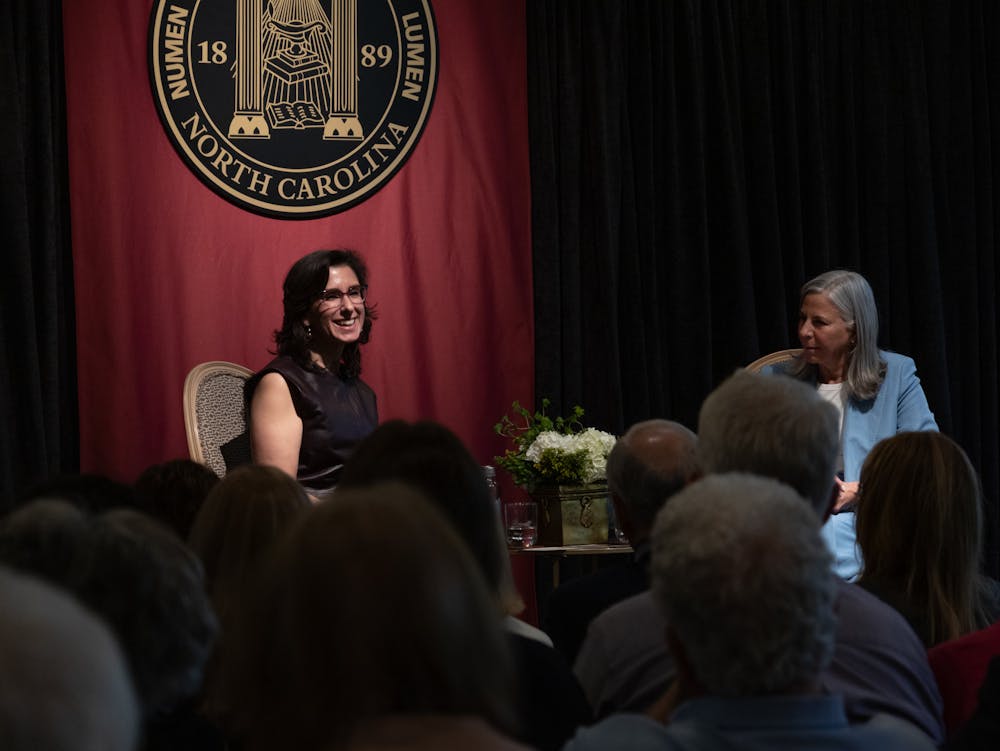
From being kicked out of her college newspaper to working as a New York Times investigative reporter and author, Jodi Kantor shared her wisdom and work with audiences at the Elon University School of Law’s Distinguished Leadership Lecture Series on May 6.
Kantor addressed audiences in The Proximity Hotel in Greensboro. Kantor has worked on many large investigative stories, including exposing the sexual harassment and abuse by Harvey Weinstein, and is now investigating the United States Supreme Court.
Kantor said journalists serve an important role in society because they can ask the questions it’s inappropriate for others to ask. She said in an interview with Elon News Network that she enjoys working on stories that expand past what people think reporters can expose, such as in the case of the Weinstein story.
“There are some secrets that need to be brought into public view so that we can know the truth, so that we can discuss them, so that we can have a better public debate,” Kantor said in an interview with Elon News Network. “The question of what Harvey Weinstein was really doing to women was one of those secrets. Now I'm working on stuff about the Supreme Court that I think is too hidden, that I think we'd have a healthier public debate about the Supreme Court if we knew more.”
Further, Kantor said that journalists are there to scrutinize the people in power, something she is doing in reporting on the Supreme Court. In her recent reporting, Kantor has been investigating the Supreme Court shadow docket, which allows the court to quickly pass short decisions without following its normal process.
Kantor’s reporting has included releasing 16 pages of internal memos of the case that she said was the start of how the shadow docket is used now.
“The fact that the justices are using the shadow docket, including in some very important recent decisions that have granted President Trump a lot of power. These rulings are technically temporary, but they are very consequential,” Kantor said. “Critics, I think, are really worried about the Supreme Court that, for a really substantial chunk of its work, has decided to bypass some of the time-tested steps in the judicial process and do things quickly and without transparency at a time when trust in the Supreme Court and trust in courts generally is imperiled.”
Kantor said the Supreme Court is hard to investigate because it is so secretive, but that secrecy also means the justices go without many rules dictating how they operate. She said that certain things go unknown about the Supreme Court and it can’t be treated like other branches of government when investigating.
“Journalists scrutinize power. It's very basic to our mission. However, courts really pride and need confidentiality,” Kantor said. “Every judge I've ever spoken to has said, ‘You know, the idea of my chambers turning into some sort of reality show is a nightmare.’ Confidentiality gives judges the freedom to change their minds, to be more independent, to be free of public pressure. So, where I've gotten to on this is that there are certain questions I'm not really asking.”
Investigating hard topics like those of the Weinstein story comes with emotional trauma, and Kantor said students often ask her about it.
“My partner on the Weinstein investigation was Megan Twohey, and when we speak to student audiences, we almost always get asked a variation of that question first, which is, ‘How did you bear the trauma of the Weinstein investigation?’” Kantor said in an interview with Elon News Network. “And we love to shock people with our answer. We say, ‘Of course, we shed tears in private. This is really horrible material, but the day you get to confront Harvey Weinstein is the best day at the office ever.’”
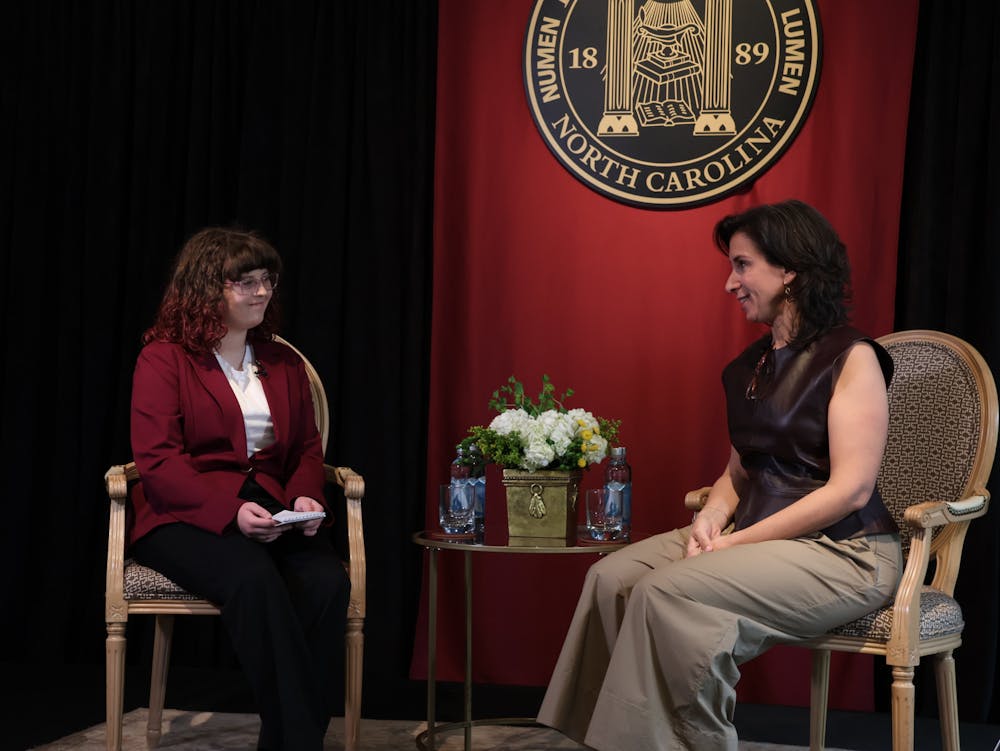
But Kantor said her career did not start as successfully as it is now, as she was kicked off her college’s newspaper. In her new book “How to Start,” released in April 2026, Kantor said she hoped to convey to students that they can still be successful even if their career doesn’t start the way they hoped.
“Even those of us who have been lucky to have some success and have some impact, often had starts that were real belly flops, and that did not conform to this idea that you need to have a perfect entry into the working world to succeed,” Kantor said in an interview with Elon News Network.
According to Kantor, the idea for her latest book came to her when she was asked to be the commencement speaker at her alma mater, Columbia University, during a time of turmoil, full of protests between Israel and Palestine, and funding issues. She said she talked with the students before writing her speech and the one thing they wanted her to address was how to start a career in the current state of the world.
“My friends from college were very protective of me, and they were like, ‘call in sick, don't go,”’ Kantor said during the event. “And there was something in me that was like, ‘Give me those kids for 15 minutes.’ As an alum and as a mom and as a citizen, I was just so upset at seeing a place that had been so transformational for me descend into this mire of negativity.”
Kantor said she wished that she had taken herself more seriously as a young journalist and realized there is a path to doing it as a career.
“There's a lot of bad news about going into journalism. It gets a bad rap,” Kantor said in an interview with Elon News Network. “Your relatives tell you not to do it, but it was just it was pretty much the same when I was in college in the 90s, and even though I devoured the news and periodicals and loved to read, I didn't think that journalism was something I could go into. I thought trying to become a journalist was like trying to become an actor. You know that even if you were talented, the chances of success were very, very, very small.”
Elon Law student and undergraduate alum, Isabel Craige, introduced Kantor before the event began. She said she got the phone call asking to introduce her while spending her spring break at the Supreme Court.
“When we were working on the biography that I was going to read, you really do see how much her work has impacted, especially young women, but women in the workplace,” Craige said. “So, being in the law school and going into the legal field, it is really important to hear these stories and making sure that young women like myself are being held in a good workplace that's going to be held accountable.”
Professor of Law Steve Friedland said as a professor of constitutional law that he found Kantor’s work on the Supreme Court informative.
“We don't in society really look at power as much as we should, and she really tries to bring truth to power and look at what's behind the curtain and show us what's going on the Supreme Court,” Friedland said. “What's going on with the justice system, particularly Harvey Weinstein and others who've committed heinous crimes, and what it's like for someone who really feels like this. Their job is to show people the truth.”
Kantor said she wanted students to know that even if things aren’t easy when you start out in a career, it isn’t the end and there is always a way to keep going.
“Even though things are not easy right now, you're not a statistic, you're a human being. You have agency,” Kantor said in an interview with Elon News Network. “You're not condemned to a certain fate, and if you have to struggle, because this is often a time of struggle in life, I think it's possible to struggle well in a way that will yield dividends for the future. So that's what my book is about. And I think the most important thing I can say is don't give up before you start, because then you're going to put personal satisfaction even further out of reach.”