

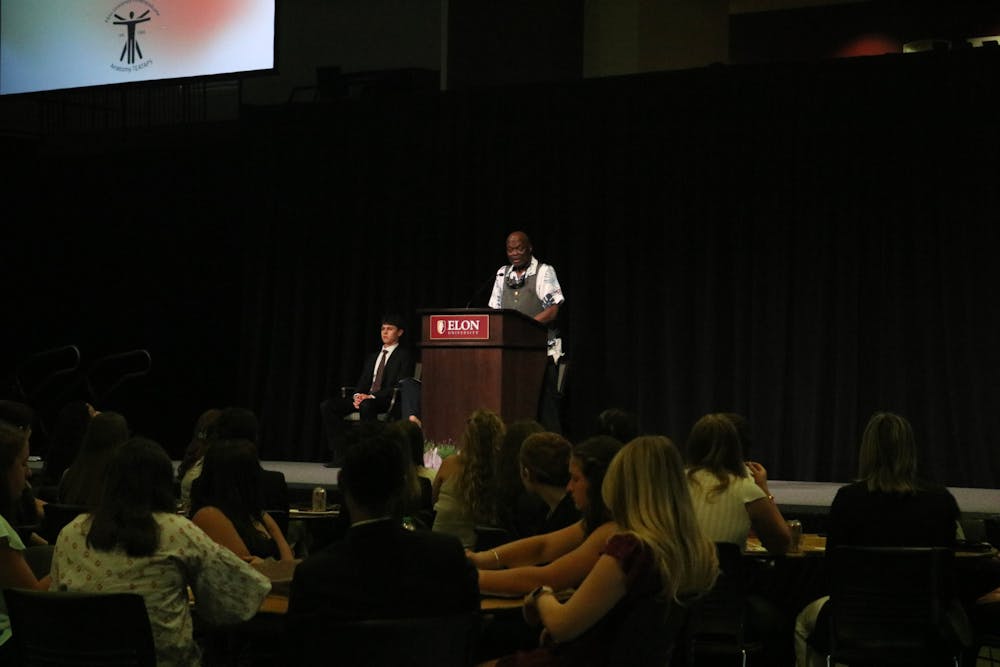
Under the glow of light in Alumni Gym, circular tables were arranged in rows. Each one held fragments of a larger story.
The Elon Anatomy Teaching Assistant Program Students and faculty gathered for the annual Human Donor Memorial on May 5, a ceremony on gratitude, reflection and remembrance for those known as “silent teachers.”
Elon sophomore Sage Grimpe said the meaning of the event wasn't something distant, but directly tied to her experience in the lab where those silent teachers are first encountered.
“It is so surreal,” Grimpe said. “Elon has donors, and we’re able to learn and have hands-on experience of dissection, which not many universities have. It’s such a special opportunity.”
The annual memorial honors individuals who choose to donate their bodies to science, which allows students to learn anatomy in a hands-on way. At Elon, that decision transforms donors into teachers— ones that never speak, yet shape every lesson.
Grimpe said it shifts how she thinks about the lab completely.
“I never really thought of it like someone is choosing to donate their body until I actually stepped into the lab,” she said. “Now I know someone who is donating their body to science. It’s been really eye-opening to see both perspectives. It’s such an incredible purpose.”
Around her were multiple other students who, before the ceremony, reflected on what they had learned together, speaking quietly to classmates.
The Anatomical Gift Program at Elon University, founded in 2017 under the leadership of Dianne Person, has grown into a cornerstone of anatomical education across the region. Since its integration in March of 2017, the program has welcomed 316 donors and registered more than 1,200 residents, a number that only continues to rise.
In a written statement to Elon News Network, Person said she has guided the program with a focus on dignity and care from life through death. Regardless of the reason, individuals who are 18 years of age or older, can make their own decisions and are supported by their families, are eligible to register through Elon’s first‑person consent program.
“The vision began with Janet Cope, professor of Physical Therapy Education,” Person wrote in the statement. “She wanted to establish a program to support physical therapy, physician assistants and undergraduate bioscience education. It has since expanded to include nursing programs, undergraduate anatomy in the College of Arts and Sciences and all graduate programs housed in the Gerald L. Francis Center.”
In Person’s statement to ENN, she added that at the heart of the program is an unwavering commitment to dignity, respect, and gratitude.
“Now in its ninth year, the Anatomical Gift Program fosters trust and empathy across North Carolina,” Person wrote. “Through outreach efforts spanning more than 65 counties, the program has introduced countless individuals and families to anatomical donation as a meaningful end‑of‑life choice.”
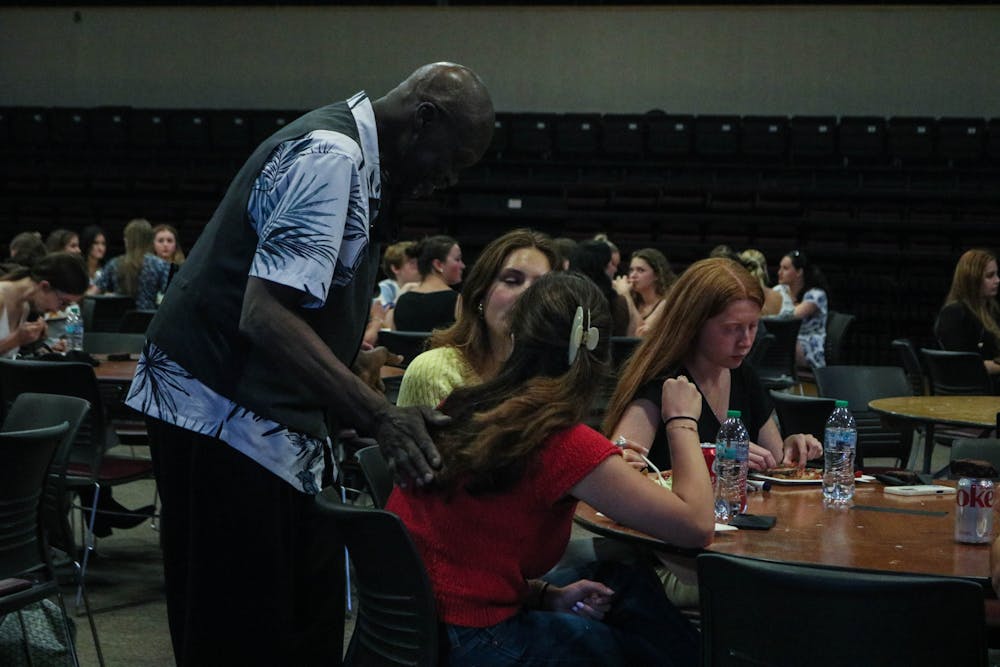
Associate Professor of Biology Matthew Clark talks to students at the Human Donor Memorial on May 5 in Alumni Gym.
Kim Burney, Elon graduate and clinical education coordinator for the School of Health Sciences, said the memorial is about recognition as much as it is about learning.
“The main goal is to focus on the silent teachers or our donors that help us to practice and learn every day,” Burney said. “It’s a way for us to honor them and give back.”
Burney has experienced the program from both sides first as a student and now as an educator. She said working with donors reshaped how she understands anatomy and strengthened her path in healthcare.
“It helped me a lot,” Burney said. “Learning about the human body and actually practicing on a real-life body furthered my career and helped me grow.”
She said the phrase “silent teachers” carries a specific weight in that context as it reflects both gratitude and responsibility.
“To me, it means someone is letting me learn from them by donating their body,” Burney said.
The ceremony is a recognition that education in anatomy is all built on trust, generosity and legacy.
For Grimpe, she said that perspective also changes how she approaches her coursework. She described a sense of gratitude that lingers beyond the lab.
“I think a lot of people need to be more grateful that we get this opportunity,” she said. “Not many universities have these resources. You only get one semester of anatomy, so take it seriously, learn from it, and take everything you can from it.”