

Six million Jewish people and five million non-Jewish people lost their lives during the Holocaust.
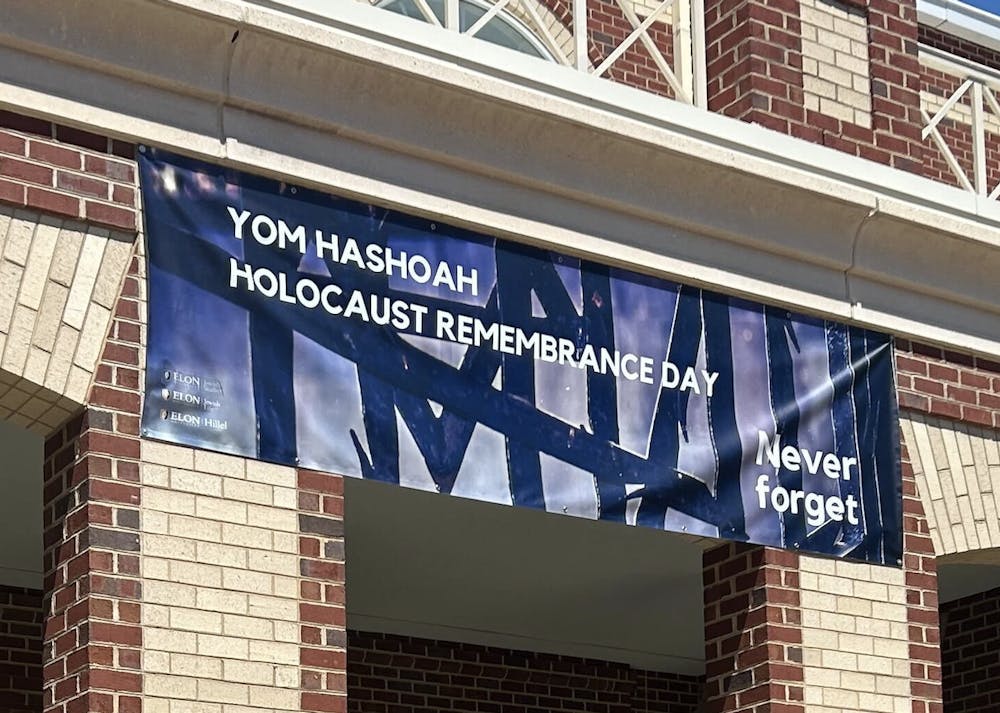
They were remembered at the annual Yom HaShoah ceremony in the Numen Lumen Pavilion Sacred Space on April 16. The ceremony was hosted by Elon’s Truitt Center for Religious and Spiritual Life and featured quotes, stories and prayers shared by students and faculty.
The theme for this year’s ceremony of remembrance was the forced migration that Jewish people faced during the Nazi regime in Europe.
Hundreds of thousands of Jewish people migrated from Germany and surrounding nations to other parts of the world like the United States, Palestine and Shanghai. Many of them faced barriers and rejection in the countries they sought refuge in.
Boaz Avraham-Katz, Hebrew professor and Jewish educator at Elon, said that remembering the Holocaust is still important to do, even three generations later.
"We felt that, since immigration is so much in the news, that we wanted to sort of shed a light on that, and it also makes it relevant,” Avraham-Katz said. “We are looking at the same way that it happened then, the way that it was so difficult to get in and isolationism, we are feeling that. We see that."
Students felt as though the event was still relevant because the Holocaust still affects Jewish people today. Zach Fellman, a freshman involved with Jewish life on campus, spoke at the event about immigration during the Holocaust.
“It means, for a lot of Jews, to commemorate and to honor the victims of those who came before us, and to realize that the Jewish population worldwide has still not recovered from the Holocaust,” Fellman said in an interview with Elon News Network. “Before the Holocaust, there were around 15.8 million. Today, there are 14.2, so 81 years out, we still haven't fully recovered from the Holocaust. And everybody has a story.”
During the ceremony, speakers gave respect to the non-Jewish people who were targeted by the Nazis, including members of the LGBTQ+ community, Jehovah’s Witnesses, people with disabilities, Soviet prisoners of war, Polish citizens, socialists, communists, trade unionists and Freemasons.
Fellman said that it is also important to honor the Righteous Among the Nations, the non-Jewish people who risked their lives to save Jewish people during the Holocaust.
“Not only was the Holocaust the story of the Jews and the people that the Nazis targeted the wrong way, but also of the Righteous Among the Nations,” Fellman said. “People, ordinary citizens, gentiles, who risked everything to help save the Jews and to look for the humanity of the victim.”
The ceremony concluded with a performance by a cappella group Vital Signs, who sang “Sparks” by Coldplay, and a lighting of candles to remember the lives lost during the Holocaust.