

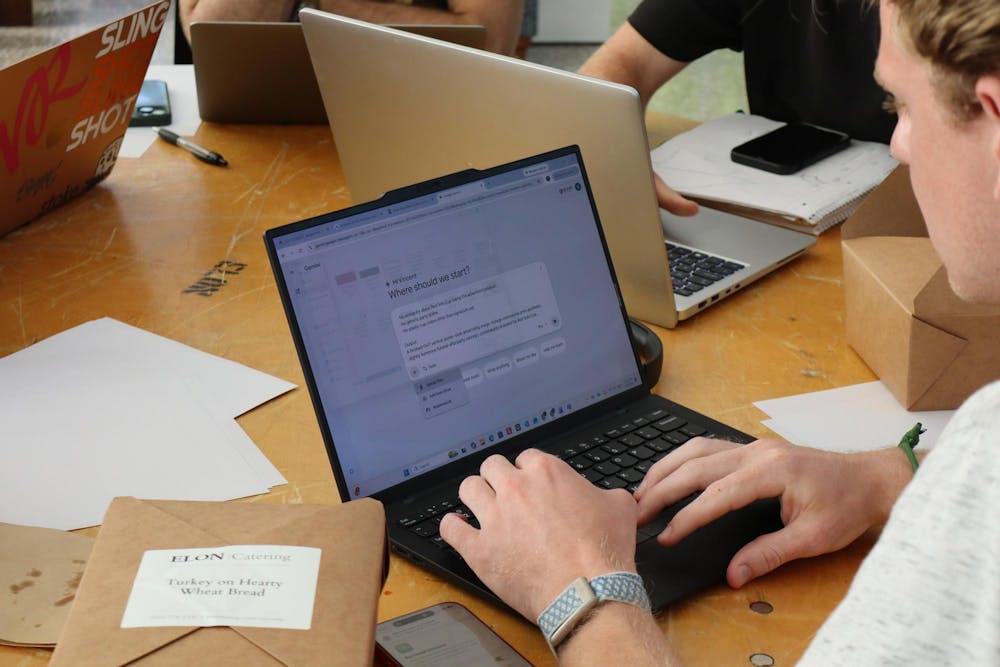
Elon University’s School of Communications and Love School of Business held the “Make Your Mark” artificial intelligence poster competition. The first of its kind on campus, the event drew the attention and ire of art and communications students. It featured a $650 prize pool and was held in three parts: a training session March 31, the competition April 2 and the award ceremony April 3. The outrage lasted the entire week. Has Elon entered an AI psychosis?
The Instagram post announcing the event has been flooded with only 19 likes and over 100 comments, the majority of which are criticizing the competition. Many of them follow a similar voice.
“Countless student organizations full of real artists, graphic designers and filmmakers and y’all chose to pour their tuition money into this b******t. Do better, Elon,” wrote Drew Reuschlein, an alumni Cinema/TV Arts and Music Production major.
The consensus is clear: The people do not want this. A plurality of entrants were there to prove a point. I went into the poorly-generated heart of controversy to see how the deal went down.
The Training Session
I walked into the Steers Pavilion at 5 p.m. March 31. By my estimate, there were about 13 people. For context, the first-place winner gets $200, second gets $150, third gets $100 and the judge’s favorite gets $100, as does the fan favorite. In total, it was a $650 prize pool.
The first thing I saw was a letter projected on the board from organizer Ben Hannam, chair of the department of communication design, addressing the controversy in the ambivalent room.
“I understand people may have concerns about including AI in a creative competition,” Hannam wrote. “It’s important to recognize that these concerns often come from a genuine desire to preserve originality, effort, and human creativity.”
Hannam made his point about the difference between an AI’s and a human’s approach to problem-solving. He explained that AI is good at following established pathways. He illustrated his point by showing an AI-generated image of a poster and reading the prompt that created it. He then proceeded to flip through the presentation slides.
One slide read “Each entry must include at least one hand-created element.”
It appeared there was a human factor after all. For a competition that led with the AI component, I was not expecting such a rule to exist. And apparently, there was a cash prize. So that’s where our tuition is going.
After the meeting concluded, I heard an attendee express their general displeasure with the event, so I flagged them down and asked them to expand on these feelings. As it so happens, I had just pulled aside the American Institute of Graphic Arts club president Delaney Guidi.
“I think one of the main frustrations is the amount of award money that’s being presented for this kind of a competition,” Guidi said. “We haven’t seen the same amount being put toward competitions that are on design merit alone.”
Elon University is championing the theft of real artists’ real works, and they don’t even know it.
Competition Day
I arrived a few minutes ahead of schedule and it appeared the headcount had increased. A handful of faces, familiar and not, converged at the tables set up in the Snow Family Grand Atrium. One of the draws was the boxed dinners the event provided, which most attendees immediately gravitated toward.
Hannam took the podium at around 5:05, introducing the “AI sandbox coordinator,” Sagun Giri.
“This competition is more than writing prompts. Not to have AI do all the work for you,” Giri said.
Following the short spiel from Giri, Hannam revealed the secret prompt. “The object is a red Solo cup, and the prompt is ‘make me buy it,’” said Hannam.
A large chunk of the attendees dispersed once the competition was officially underway. Caught up with a competitor, Annie Gosen, a double major in communications design and cinema/television arts. We spoke about her thoughts on the implementation of AI in this competition and how she planned to use it for her own entry.
“I try to use it as little as possible, especially when designing for any comm design class,” Gosen said. “I wouldn’t say it’s my strategy, it’s just what I do.”
Gosen explained to me that in a tool like Adobe Illustrator, removing the background from an image could technically be categorized as using an AI tool. She then said that the way the competition was marketed was somewhat misleading. The point was not to use AI to make a poster entirely, only to supplement parts of the process, according to her professor.
Then, Gosen revealed to me perhaps the sweetest irony of this whole contest. The poster made to advertise the contest was not AI-generated. What else needs to be said?
The Awards Ceremony
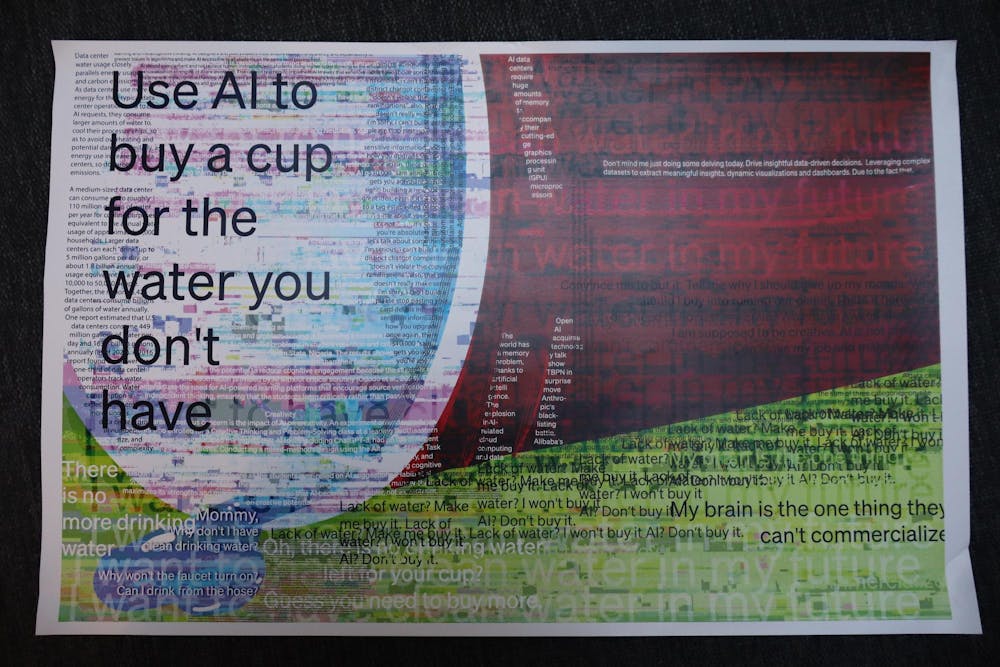
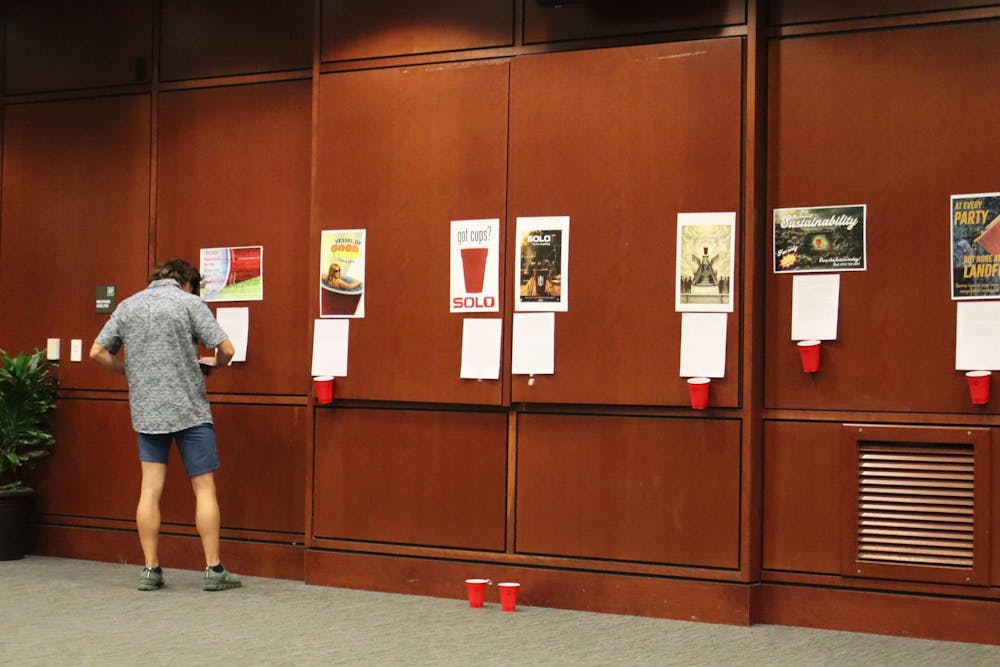
I arrived around 30 minutes after I intended to due to the confusing naming convention of LaRose Digital Theatre, sharing its name with the LaRose Commons, which is clear across campus and where I went first. What immediately caught my eye was the poster of one Tyler Wakelin, a student who made their entry entirely free of AI in protest of the whole affair. I had plans to speak with them before the event, but it would now have to wait until its close.
A strange atmosphere pervaded the room. In keeping with its AI theme, the moment felt decidedly lifeless. Many participants didn’t bother to show up, including some who even ended up winning.
The award ceremony proceeded with the announcement of the winners, starting from third all the way to first and then the announcement of the judge’s favorite. Third Place went to Emma Larsen, second to Delaney Guidi and first to Trey Holmes.
Once the ceremony concluded, I pulled Wakelin aside to dive deeper into their thoughts on the competition and to learn more about their method of protest, an AI-free poster.
“My original idea was to chug water for two and a half hours straight as a sort of protest piece, showing the AI use of water,” Wakelin said. “I disagree with the ethics and environmental aspects of AI.”
Wakelin’s poster was covered in layers of text, much of which was pulled from scholarly and news sources and relating to these ethical and environmental concerns of AI usage.
Final Thoughts
Hanlon’s razor says to never attribute to malice what can otherwise be explained by incompetence. This is obviously such a case. This was not meant to undermine the work of Elon’s artist populations, but it did read as tone deaf, especially coming from the school that fosters the very skills they discounted for this event.
I imagine if the event had not placed the AI element front and center, the resulting discourse would have been far more positive. It is clear that many of the communications school’s students feel as if their talents are being neglected, if not ignored, in favor of a techier approach.
There really is no excuse when you consider the fact that the very same school that produced this competition is home to its own in-house marketing and PR agency, Live Oak Communications. Many other students like me, and I invite Elon to do better with their events, taking the skills and sensibilities of their own into consideration before moving forward with an event that might leave everyone with a bad taste in their mouth.