

CORRECTION: A previous version of this article stated that the six principles to shape AI was also created by the Pew Research Center. It was only created by Elon President Connie Book and the team at the Imagining The Digital Future Center at Elon. Elon News Network regrets this error.
Elon sophomore Jesse Price was scrolling on Instagram when he saw something that caught his eye.
It was a promotion for the university’s first “Make Your Mark: AI Poster Competition,” which was hosted by Elon AI, the Elon School of Communications and the Martha and Spencer Love School of Business.
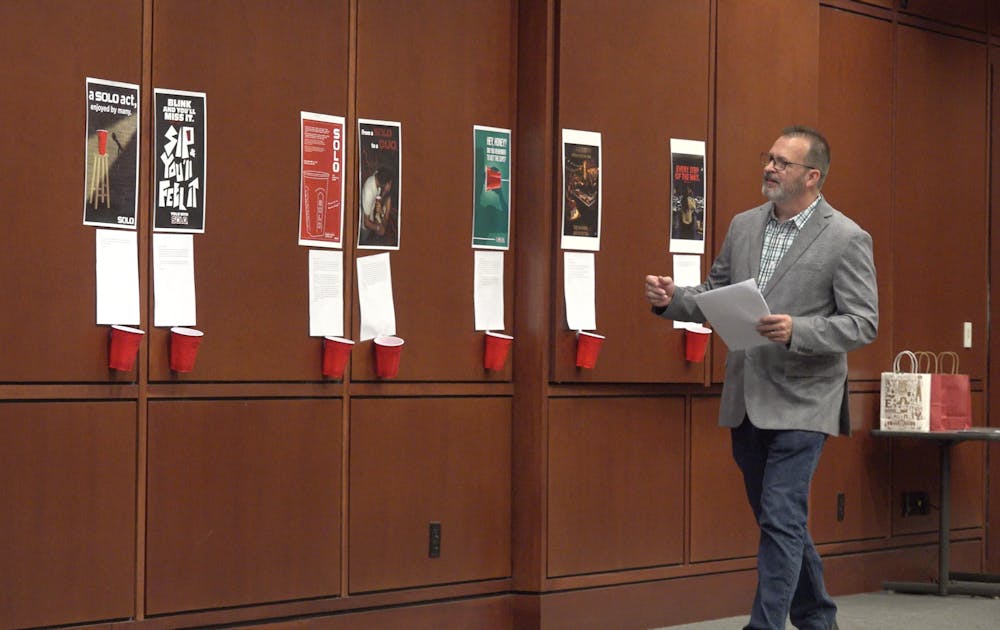
Students who participated in the competition received a prompt in Schar Hall on April 2 and had 2.5 hours to design an original poster.
Submissions combined AI-generated elements with non-AI or hand-crafted components. Participants then had to describe how AI helped their process.
Price said when he read the Instagram post, he was taken aback.
“When I saw all of my fellow students and friends posting and commenting and speaking up for what they believe is right, I decided to join in,” Price said. “I think that everybody should, because this is not the type of leadership we want from our education.”
As of April 7, the post has 117 comments, with every comment opposing the competition. Some comments are even hidden by Instagram because of foul language.
“Is anyone excited about this?” one comment asked. “Continuously disappointed in this institution.”
“Someone please go make a poster without AI and win this,” another said.
Other people commented with disappointed GIFs and tomato emojis.
Ben Hannam, associate professor and chair of communication design at Elon, said that both Elon AI and the School of Communications looked for ways to collaborate with one another.
“We had discussed how we could start that process, and thought that a poster competition sounded like a fun thing to do, so that’s where we began the conversation,” Hannam said.
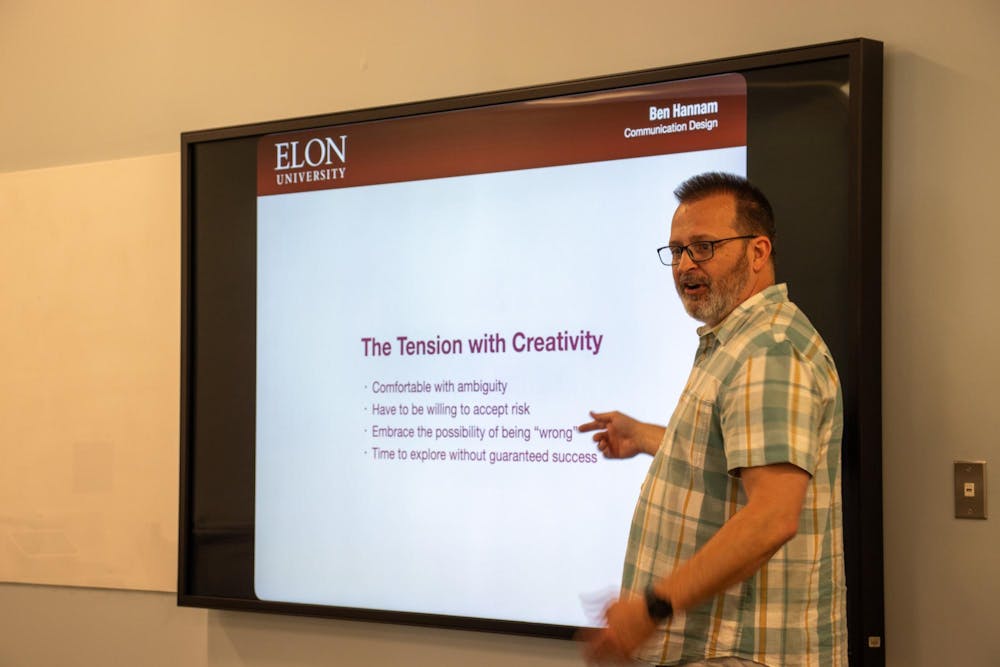
The competition included both an originally-made element and an AI-generated component. Hannam said that it is important to use AI tools to accompany handmade art because creativity and intentionality of communication come from people.
“I use AI tools, and they’re great for some things, and then they’re not,” Hannam said. “It’s not great for other things. Kind of exploring the boundaries of that helps us make better informed decisions about when it’s appropriate and when it’s not appropriate — I think that’s kind of part of the discussion that we’re trying to flesh out.”
The cash prizes were split between the School of Communications and the Love School of Business. Hannam said that April can be a grumpy month at Elon, when many students come back from Spring Break and reflect on all the work they need to do.
“We wanted to get people to participate, and we felt like the way to do that was to say, ‘Hey, you just went to spring break. Here’s a place where you could participate, very small, low-touch point two-and-a-half-hour type of competition, and you can win some prizes, and the prizes don’t suck,’” Hannam said.
Many students on the initial Instagram post commented about how the $650 in cash prizes could’ve been used for something else.
Hannam said that half the prize money came from the Communication Design budget, which is given by the School of Communications. He said that this budget covers the American Institute of Graphic Arts Hub for Graphic Design pizza events, faculty research and supporting classes that need materials for projects.
“Those are the kind of things that that budget is used for, is just kind of things that would directly affect our faculty or our students in a positive way,” Hannam said.
Lee Rainie, Director of the Imagining the Digital Future Center at Elon, said that one of Elon’s approaches to AI has been to tell faculty members to have their own AI approach. Elon President Connie Book and the team at the Imagining The Digital Future Center at Elon created six principles to shape AI policies in higher education.
“We encouraged institutions around the world to think about that, and a lot of them sort of embrace those principles,” Rainie said.
While AI expands on campus, Rainie said it’s being used in classwork, assignments and as a teaching tool.
“People are studying how AI performs, and there are ways in which there are lots of conversations about the ethical use of AI in teaching and learning, as well as the things not to do,” Rainie said.
Rainie said that some professors talk about AI and find ways to use it and not use it in assignments. He also said that there are some professors who don’t use it in classes at all. Finally, he stated that some professors also want their classes to explore AI and use it.
“Exploration is probably not a bad place to start on any subject, particularly one that’s a mystery or something that’s not fully known, and then the conversation sort of can go whatever direction it wants to go,” Rainie said.
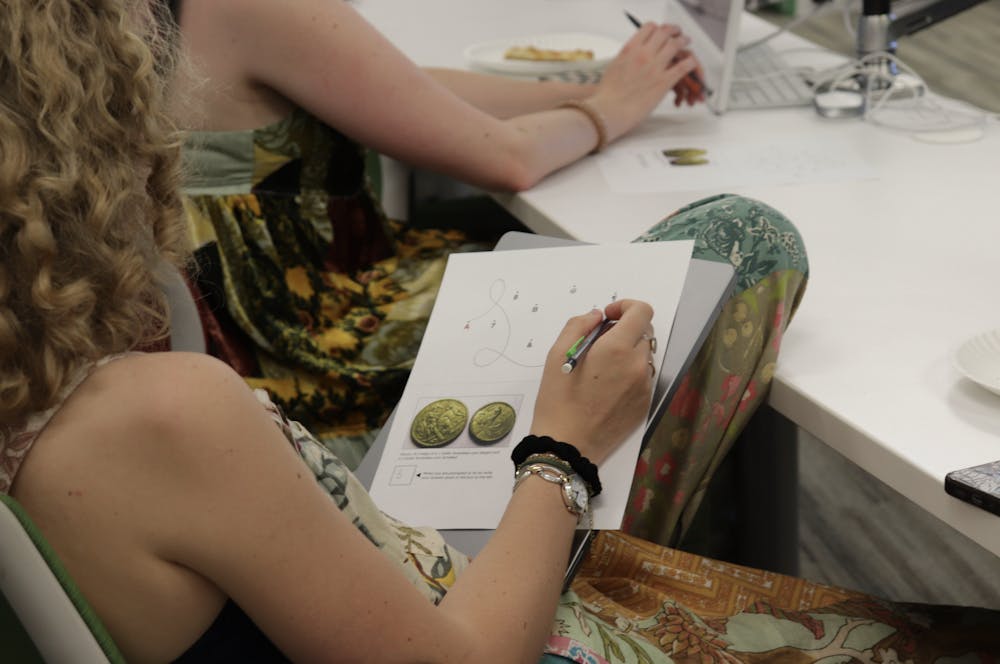
The competition included three separate events: a pre-event workshop where students could learn to use AI along with creativity, the actual 2.5-hour competition with the red Solo cup prompt and an award ceremony.
Elon senior and communication design major Emma Larsen attended the pre-event workshop and said an event like the poster competition is important because it represents diverse design elements.
“What makes this competition really interesting is that you are actually required to use a physical element in your work,” Larsen said. “So, it’s more about combining the use of AI and human-made design work, which is really exciting.”
Larsen stated that it is potentially scary that AI could take jobs from designers, but it’s important that people can use AI effectively in the job market.
“I think especially in this day and age, it’s really important to show that you actually have it as a skill, and that it doesn’t actually replace you, because it wouldn’t make something as good as what you could produce if you worked with it,” Larsen said.
The final part of the competition was the award ceremony, where awards were given to first, second and third place winners, along with the judge’s choice and fan favorite.
The judge’s choice award was given to Elon freshman Lorenzo Ribadeneira. His poster showed a red Solo cup with a barbecue inside it. Stick-figure people are inside the cup, holding chips and wearing party hats. The caption on the poster states, “THE CUP THAT BRINGS THE PARTY.”
The judges complimented his work, which Hannam read to the crowd.
“The Make Your Mark challenge was about more than just using AI to create a design; Instead, it pushed participants to make the intangible tangible with their own creativity, leading the way,” Hannam read. “And that’s what Lorenzo did so beautifully.”
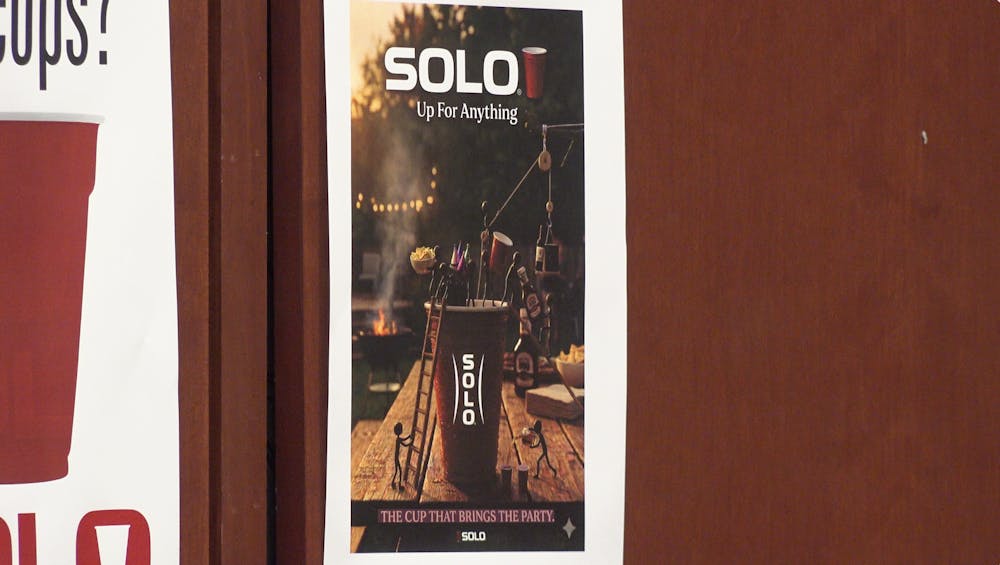
The three judges, professors Smaraki Mohanty, Lana Waschka and Michele Lashley, in their praises to Ribadeneira, also noted that he took the time to understand the prompt to consider what the impact of the words and the images needed to be.
“The way Lorenzo incorporated AI into his design process was exactly how we should be using it,” Hannam read. “He didn’t offload his creativity to it. Instead, he used it to elevate his thinking and ideation, as he explained, he had to keep going back and iterating until the design reached a point where he was satisfied with it.”
Ribadeneira is an entrepreneurship and innovation major. He said that he thought the competition was a good use of the practice of his AI skills, as he uses AI every day.
“Every poster in here does not look in any way similar to one of the other ones,” Ribadeneira said. “It was a great way to showcase your skills within AI, but also combining it with your creativity.
Ribadeneira, who owns a wakeboarding clothing company called Stoke, said that he has thought more critically because of the competition about how AI can improve his business.
“I feel like I learned that I can design things with AI,” he said. “That was never really like something that I got into much with my own clothing company. But now, after seeing that, I am able to be creative while using AI and making designs. Maybe I can implement that too.”