

Every day, millions of Americans drink water laced with chemicals that never fully leave the environment. Per- and polyfluoroalkyl substances, known as PFAS, or “forever chemicals,” these compounds are linked to cancer and other serious health risks. They are nearly impossible to remove with conventional water treatment methods.
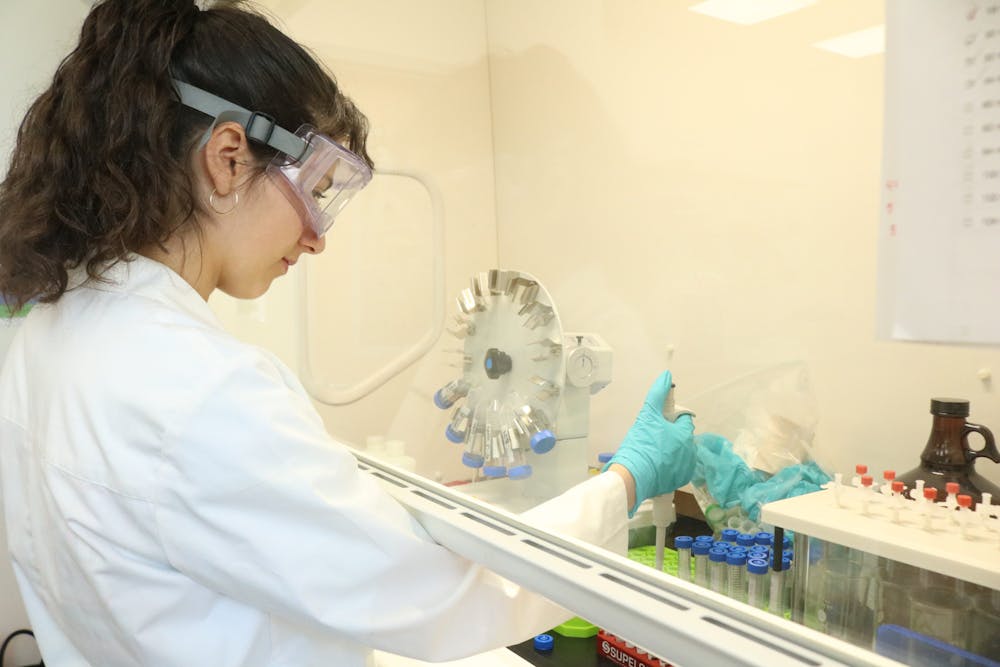
Sophie Remisio, a junior majoring in environmental engineering, is working toward a solution. She is developing a reusable filter designed to capture and safely dispose of PFAS.
“I always wanted to make a difference,” Remisio said. “When I learned environmental engineering existed, I realized it was the perfect way to create solutions for environmental problems.”
Her research focuses on using modified carbon nanotubes. She is testing ways to create a reusable filter that could dramatically reduce the presence of PFAS in drinking water.
“With this model, when the filter is fully saturated, you can pour a solution over it to remove the PFAS, then reuse the filter,” Remisio said.
She first became aware of PFAS through news reports about their presence in consumer products. Her concern deepened when she learned the chemicals had contaminated water around the world.
“I had read about PFAS casually through the news,” Remisio said. “There’s this stuff in products that I use that’s bad for me, and I realized it’s not just a consumer issue, but it’s a water issue.”
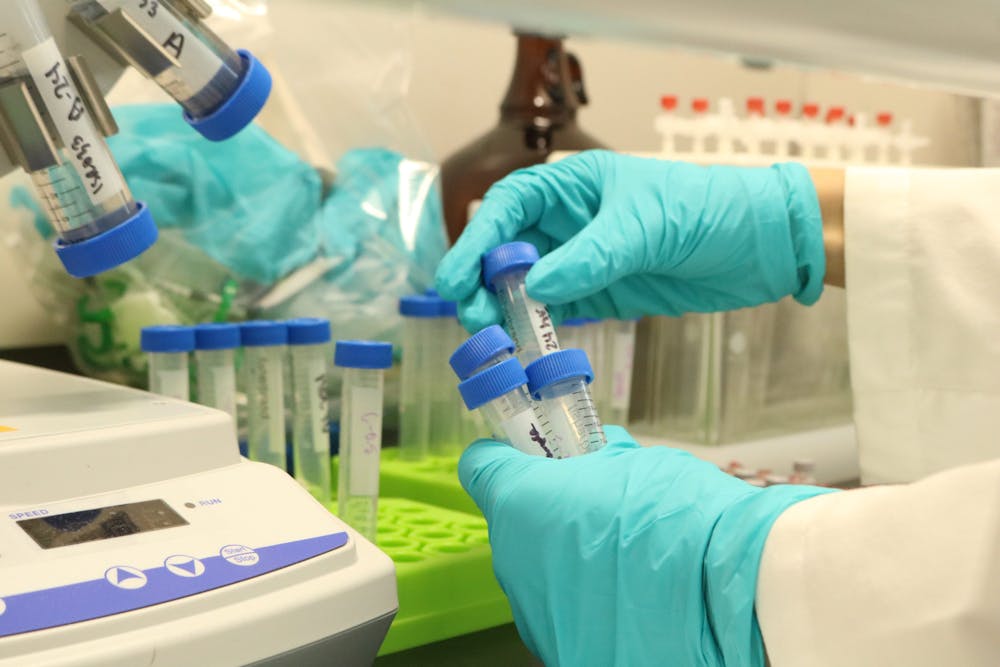
Junior Sophie Remisio looks at the labels of PFAS samples April 6 in McMichael Science Center.
Before discovering environmental engineering, Remisio had considered environmental education as a major. She has always been passionate about the environment but wasn’t sure how to make an impact until she found a major that combined science, engineering and environmental solutions.
“I always thought engineering was just like building bridges, and then I learned that it’s a lot more than that,” Remisio said. “I liked the pairing of environmental and engineering because I’m able to create solutions for environmental problems, and that felt like the right niche for me.”
Her research took off during an internship at the Duke University Center for WaSH-AID. She initially worked on stormwater treatment before moving into PFAS projects, learning directly from experts in the field.
Remisio said she learned a lot from a research professor in the department of electrical and computer engineering at Duke University.
“She taught me a lot, and I realized I was really passionate about it, not just as a consumer, but as an engineer,” Remisio said.
She said research is as much about patience as it is about scientific discovery.
“A day in the lab can take several hours to run an experiment because you have to label everything individually and handle PFAS very carefully,” Remisio said.
Despite the challenges, Remisio remains motivated by the potential impact of her work.
“I remind myself of the importance of the work I’m doing,” Remisio said. “It’s easy to get caught in the monotony, but I’m doing this to hopefully make a difference in the world.”
Her mentor, Will Pluer, an engineering professor at Elon, has guided her since her first year.
Pluer said that she knew junior-level concepts before even coming to college.
“She was engaged and excited from the start,” Pluer said.
Remisio began by assisting with ongoing research before moving to independent projects that aligned with her own interests.
Pluer’s mentorship style is hands-off, allowing Remisio to develop her own research flow.
“We check in every couple of weeks,” Pluer said. “When we meet, she downloads everything she’s been working on. We troubleshoot snags, but mostly we focus on the big concepts and the science behind the data she’s seeing.”
He also praised her resilience during setbacks.
“We’ve hit times when the filter didn’t remove any PFAS or when a method we thought was working actually wasn’t,” Pluer said. “She never takes it personally. She just puts more time in and keeps the project moving forward.”
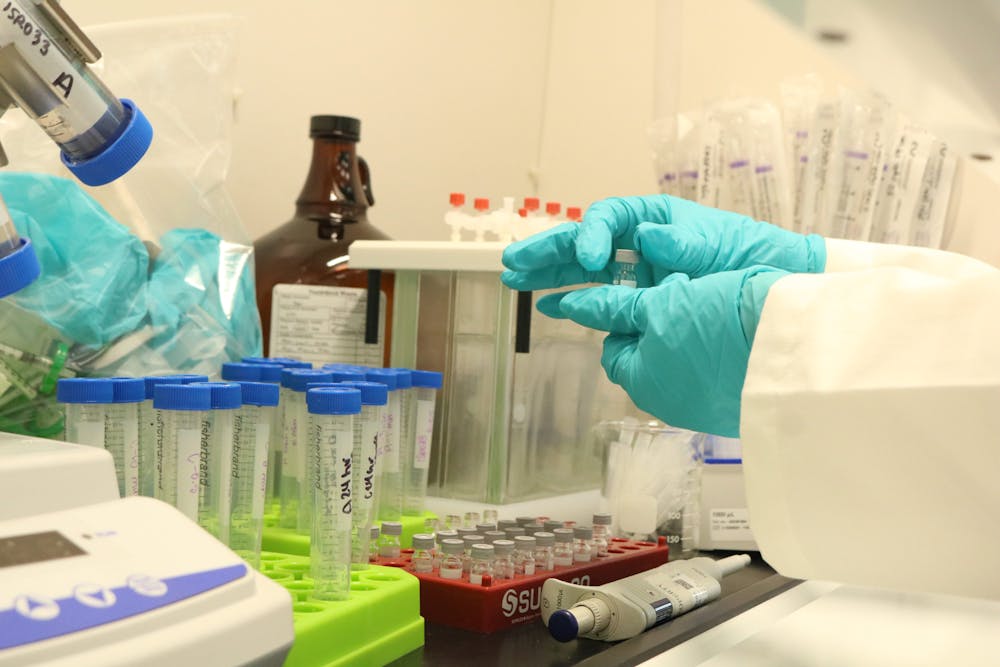
Junior Sophie Remisio closes PFAS samples April 6 in McMichael Science Center.
Remisio emphasized the intersection of engineering, public health and policy.
“When you create a solution, you need to have the right policy in place to actually execute it,” Remisio said.
She emphasized that there are things people can do to help their own health such as move away from nonstick pans. However, PFAS on a large scale won’t be gone anytime soon.
“But the main thing that needs to shift is policy. Large-scale contamination won’t be fixed without systemic change.”
Looking ahead, Remisio said she hopes to continue working in water engineering, specifically addressing PFAS and other persistent contaminants.
“PFAS aren’t going anywhere,” Remisio said. “I’m grateful for the experience I’m getting now because I know it will be part of my career in the years to come.”