

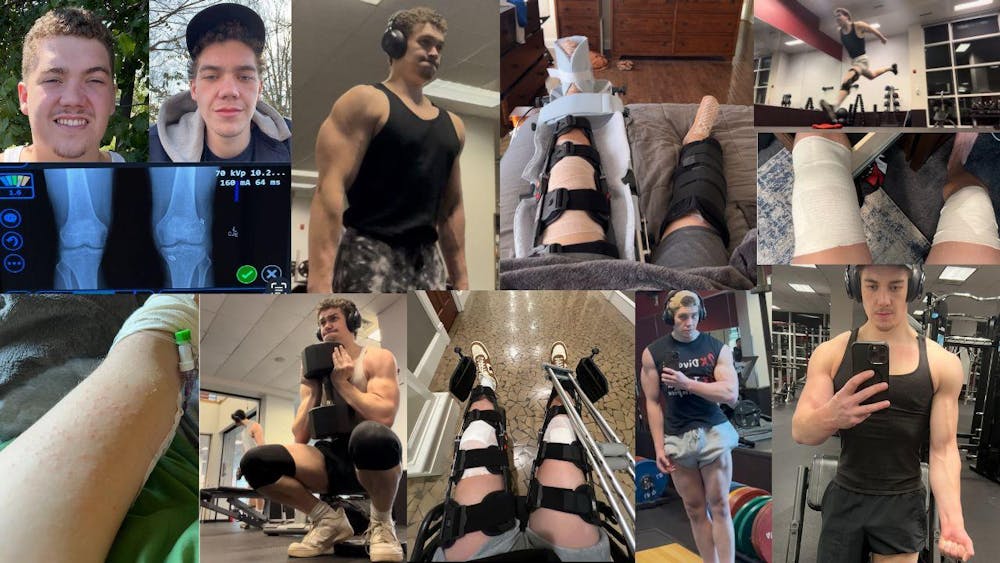
Elon University junior Jackson Weber was wrestling with a friend when he tore his ACL in Nov. 2023, an injury that completely changed what he thought his college career would be like.
When Weber entered Elon University, students could find him on the football field and basketball courts stunting for the Elon cheerleading team. The first time he tore his ACL in his sophomore year, he had decided to just take Winter Term off. Going into Spring Term, he expected to make a full recovery.
However, in summer 2024, while coaching the International Gymnastics Camps during his last month of ACL rehab, Weber tore the quad tendon that was used to graft his initial ACL injury. In the fall, he went back home to New Jersey for surgery, where the new graft’s tendons ruptured.
Weber didn’t walk for 39 days after his surgery. Quickly after he started using crutches, he noticed swelling and loss of motion in his knees, which the doctors at the hospital emergency room found to be an infection. Soon, Weber was hospital bed-bound as he developed sepsis, a life-threatening reaction to infection.
“I felt like I had been pulled out of my life,” Weber said. “I felt like I lost everything that I had here at Elon, which is a lot. I lost the cheer team. I lost my a capella group. I lost my ability to go to the gym. I lost my ability to walk. I lost my ability to eat. I lost my appearance that I grew accustomed to. That was devastating because I’m not the best with change, but you deal with what you have to.”
Elon University physician and medical director Terry Le noted that sepsis starts as a localized infection, like a urinary tract infection, skin infection, and/or common cold. These infections may cause the body to “go into overdrive” and begin a total systemic infection to other parts of the body, damaging organs.
According to Novant Center for Public Policy Solutions, sepsis takes a life every two minutes in the United States. The Center for Disease Control lists that at least 1.7 million adults in the U.S. develop sepsis and at least 350,000 die from the infection every year. Surgery, medicine and procedures that maintain blood flow are proven treatments.
Congress has introduced a bill in the Senate, the “Securing Enhanced Programs, Systems and Initiatives for Sepsis Act,” or SEPSIS Act. Sponsor of the bill, Sen. Charles Schumer (D-NY), included needing to lower rates of sepsis, provide education on best practices in addressing sepsis in hospitals and improve data collection on pediatric sepsis.
“Anyone can develop sepsis from a simple infection,” Le said in a statement. “Some illnesses that students encounter are viral and require primarily supportive, over-the-counter care, but other illnesses, such as bacterial infections, may require antibiotics. Sepsis can occur if antibiotics are not completed in their entirety because patients are feeling better and stop the medicines prematurely.”
The journey to recovery from sepsis wasn’t an easy one for Weber, who couldn’t hold back any food or drinks for a week because of his reactions to the antibiotics he was on. Before leaving the hospital, he was told that he’d need a peripherally inserted central catheter (PICC), which fed from his bicep to near his heart so the blood being pumped would mix with his antibiotics, circulating them throughout his body.
“I was super sick with the PICC line,” Weber said. “I would have to do infusions three times a day. You would flush with saline, the antibiotic and you flush with saline again. I did that for about a month and a half, a six-week course after I got out the hospital.”
Struggling to maintain both his health and schoolwork, Weber took another semester off, putting him a year behind when he thought he’d graduate from college. However, the hardest struggle for him was not being able to return to his active lifestyle, relying on the support of his friends to get him through his fight with sepsis.
“Being surrounded by a bunch of motivated people, I think that gave me more drive to push through what I was dealing with in my situation,” Weber said. “The experience, it gave me a lot of perspective. It changed me in a positive way. Obviously, I wish it didn't happen, but at the same time, it did a lot of good things for me.”
The mental health struggles associated with the initial tear and fear from not succeeding in his other commitments is what held Weber back from coming back the second time around to Elon. Being able to return to the gym and fitness was a driving factor for him once he came back. Weber continues to do ACL rehabilitation on a weekly basis, while taking the lessons he learned through his injury into his daily life and academics as an exercise science student.
“College students are at a crossroads in their life, exploring different aspects of health as both a user of the healthcare system and also just seeking information about their health,” Le said. “From a healthcare provider standpoint, it is a great privilege and opportunity for me to care for students and to provide information to give students more agency over their condition, treatment and healthcare journey.”
Through the infection and PICC line, Weber lost over 40 pounds from not being able to eat and do much physically. Once he got back to the gym, he bulked up to be 90 pounds heavier in six months, something that was reassuring for him after being in a calorie deficit.
Weber isn’t letting his injury stop him from doing what he wants to do physically, but staying cautious by using his brace and avoiding anything that could cause another tear. He remembered that there were times he wanted to give up, but that wasn’t the life he wanted to live.
“It was the first time I’d ever seen that much progress over a duration,” Weber said. “I think that gave me a lot of confidence in myself, that if you set a plan in motion and there’s merit to the plan, you’re gonna get done what you intend to get done. I did that.”