

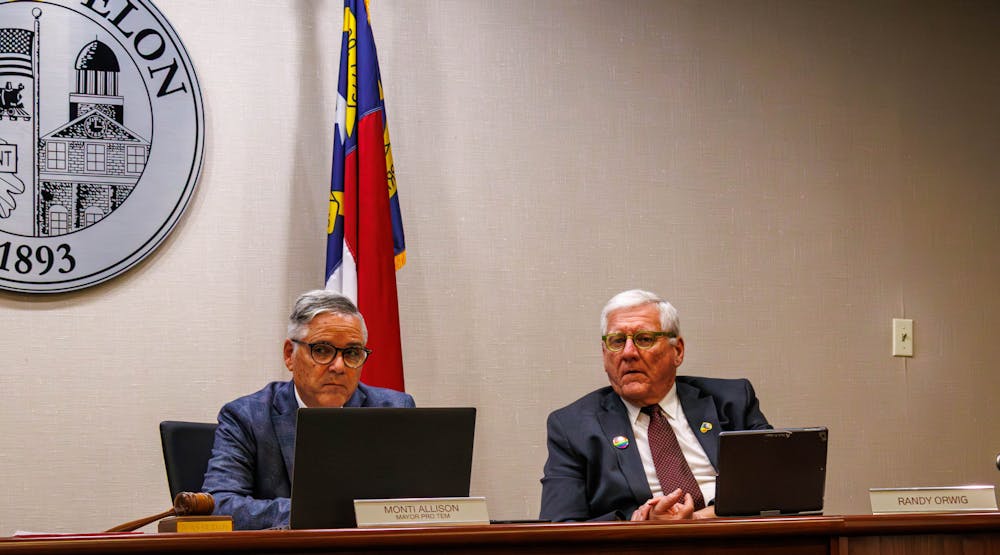
The Elon Town Council discussed pedestrian safety, new ordinance plans and council decorum in their meeting March 10.
Public Comments:
Elon University senior Bo Grant raised concerns about the lack of sidewalks on West Haggard, noting people walk along roads between Arts West and the nearby shops.
“You have students walking down there every night with no sidewalk,” Grant said.
Town manager Richard Roedner said in the reports section of the evening that the town has previously sought grant funding for the project in the past but has failed to get one for such a project. He said it remains an investment the town hopes to make for the safety of pedestrians in the area.
Ordinances
Town of Elon Mayor Emily Sharpe asked attendees to engage with the council’s discussion on the comprehensive plan, which will shape the town’s future land management ordinance.
“As we start to have public meetings related to the comprehensive plan, it is a really great time for people to really get involved and engaged,” Sharpe said. “ This is the development of our future land management ordinance.”
The LMO includes regulations around RVs on properties. Sharpe said she is concerned about residents using RVs as permanent residences without proper sewage and water controls. She recognized that there are recreational owners who maintain their vehicles responsibly.
During the meeting, council member Randy Orwig said he came prepared to argue with Sharpe on the subject. He said upon review of the agenda and the ordinance, he was concerned about how restrictive it would be when implemented.
Sharpe proposed two identical public meetings in late April for RV owners to learn about the potential ordinance. Orwig motioned to table the ordinance until the meetings take place, which the council approved.
Orwig expressed concern again when the subject of special events permits arose.
Town Clerk Kathleen Patterson presented updates to the ordinance, which now include clearer definitions of what qualifies as a special event and a staff review task force to establish parameters. Neighbourhood parties were removed from the policy and will continue to be handled by police under the noise ordinance.
As a former pastor of the church, Orwig said he took issue with permit requirements for church events, questioning how private property gatherings impact streets. Patterson said infrastructure impact is the driving factor.
“Ultimately, it has to do with safety,” Patterson said.
Enforcement of large unofficial gatherings, specifically with fraternity parties, also drew discussion. Elon Police Chief Kelly Blackwelder said that without parking violations or evident criminal activity, officers have little recourse beyond giving tickets. Roedner added that complaints typically come days after an event, limiting the town’s ability to act.
Orwig said he remained unsatisfied with the ordinance by the discussion’s end.
New Business
Recreation and Parks Director Kim Brown asked the town council to approve the addition of the Elon skatepark project to the parking regulation.
“We have shrunk down the design of the skate park, so it is a little cheaper,” Brown said.
Reports
Council member Steve Exum reiterated previous concerns about incorporating solar energy into the town’s construction planning process, presenting a comparison of electric bills from the summer of 2024 and a year later in 2025.
“These can be fiscally responsible, long-term cost-saving infrastructure decisions,” Exum said.
Sharpe said she wanted to address respect between council members, referring to the issues Exum brought up, drawing a parallel to the council’s prior rejection of paid parking, a decision she supported but did not continue to push after the vote.
“I didn’t then go and send 10 essays and 52 emails about why I think paid parking should be a priority because as a council you all stated your opinion,” Sharpe said.
The council had previously agreed that while solar energy merited future consideration, it was not a part of the current capital improvement plan. Exum said as a new council member he was unfamiliar with the protocols for bringing such issues forward, a claim Sharpe disputed.
Orwig interjected, to ask if the mayor and council members wanted to motion for a debate on the subject. While the mayor said no, the discussion continued.
The LabCorp building was a sudden sale that Orwig said was not brought to their immediate attention. He said a potential deal with LabCorp to implement solar panels into their building process will fall through in several months.
“This is from a timely perspective, not some kind of usurping of the priorities or anything else,” Orwig said.“It is that something came up that made a difference. If you want to separate that from what happened at LabCorp, I would completely disagree with you.”
After roughly 25 minutes, Roedner concluded the unofficial debate, clarifying that any additions to the agenda, including solar energy, must be approved collectively by a committee, not raised by individual council members.