

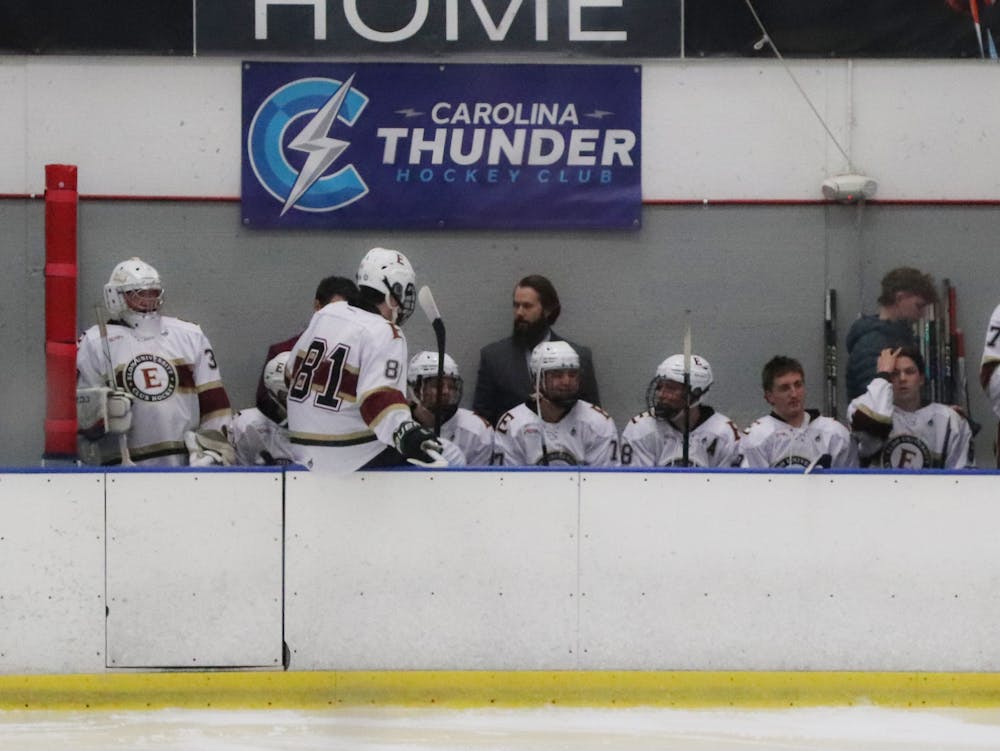
Elon University men’s club hockey head coach Travis Harris didn’t promise the team championships. He promised them accountability.
“I laid it all out,” Harris said. “I told them what my expectations were, what the plans were for the program. Some kids ended up not coming back. The ones who did helped me build this into what it is today.”
What it is today looks dramatically different from what he inherited at his first team meeting in May.
The Phoenix won two out of 10 games in the 2024-2025 season — the year before Harris arrived. Players were missing practices and games. The program had burned through its budget a month and a half before the season ended, according to Harris, who said that Elon essentially handed the team a final opportunity to prove it could survive. He took on the job, receiving pay from funds raised by the team. Elon University does not pay Harris directly.
“I honestly thought it would be a full rebuild,” Harris said. “Just get the kids to buy in, build this year and see where we were at the end.”
Instead, Elon delivered the most successful season in the program’s 15-year history, earning the No. 3 seed in the Atlantic Coast Conference M2 Elite playoffs and securing the program’s first-ever trip to Division II hockey nationals.
For Harris, the turnaround didn’t start with systems or strategy. It started with culture.
“Hockey’s all about accountability,” Harris said. “If you’re missing practices, missing games, you’re going to get benched. I’m not here to be your friend. I’m here to get you where I think you should be.”
That mindset is rooted in his own story.
Born in Southern California, about 30 minutes outside Anaheim, Harris started playing hockey at 7 years old. A year later, he moved to Houghton, Michigan, the birthplace of professional hockey.
Money was tight in a single-parent household, so Harris would work during the school year to afford tournament hockey in the spring and summer.
After high school, he enlisted in the U.S. Navy. He served five-and-a-half years as a gas turbine systems electrician before being medically retired in 2014 as a second-class petty officer. He said his military experiences shaped his approach to coaching.
“The values they drill into you, you don’t quit,” Harris said. “You keep pushing for the end goal. As long as you’re dedicated and you put in the time, you’ll see that your time wasn’t wasted.”
After back surgery in 2013 and several years away from the game, a coworker convinced him to lace up again in an adult league. That return reignited something bigger.
Harris began coaching youth travel hockey in North Carolina, focusing heavily on player development. His philosophy is simple: strengthen the individual, and the team will follow.
“You’re only as strong as your weakest link,” he said. “Every drill has a purpose. If you’re not doing it the way it’s designed, you’re wasting your time.”
In 2019, Harris founded the Carolina Hurricanes Warriors, a USA Hockey-affiliated program for disabled veterans. He took on the opportunity while also working a full-time job, adding 40 to 50 hours a week to an already busy schedule.
As a veteran himself, Harris said it was important for him to give his community the chance to play. John Rodgers, a player on the Warriors, said he sees overlap between the military and hockey.
“In hockey, games are won and lost because of teamwork,” Rodgers said. “Stack the two together and you have something more intimate and fraternal.”
Backed by donors, a Warriors program that began with 11 players has grown to more than 150 across the state.
“I just like to see the enjoyment people get out of playing,” Harris said. “Seeing the players’ faces after every win, after every practice, that’s what keeps me going.”
That same energy now defines Elon hockey.
Elon’s best season in program history has sparked interest across campus, according to senior co-captain Sam Chairman. Players who once viewed the program casually started showing up consistently, boosted by Harris’ significant efforts in recruiting.
Elon only practices once a week, but Harris said he created a group chat to talk to players outside of practice, where hockey chatter is nonstop.
Senior co-captain Wells Masterson, who has played on the team for four years, said it’s the closest and most energetic team he’s been part of at Elon.
“This is by far the tightest locker room we’ve ever had,” Masterson said. “Everyone is super close, and you can see that on the ice.”
Harris credits his assistant coaches, other adult hockey enthusiasts, for helping stabilize the program. He also points to a deeper mission beyond wins and losses, referencing a quote by Richard Branson: “Train people well enough that they can leave, but treat them well enough they don’t want to.”
Harris said that for college players, it means preparing them for life after graduation. An Ohio State survey found “lessons children learn in sports can have a positive impact on their lives long after they grow up.”
“Team sports are a huge confidence builder,” Harris said. “The kids who play sports usually have a more successful life. We want to keep providing that for these players, and help them grow off the ice.”
He said his long-term vision for Elon is ambitious: consistent national contention, expanded recruiting and establishing a women’s team.
Five-year plan?
“Ice rink on campus,” he said with a laugh.
For now, Harris said the focus is on steady growth. He took over a program on the brink and turned it into a contender in a single season. Elon will compete in its first AAU college hockey national championship on March 6 in Jacksonville, Florida.
But to Harris, it isn’t the records that matter most. It’s the sound of a locker room that — for the first time in years — expects to win.