

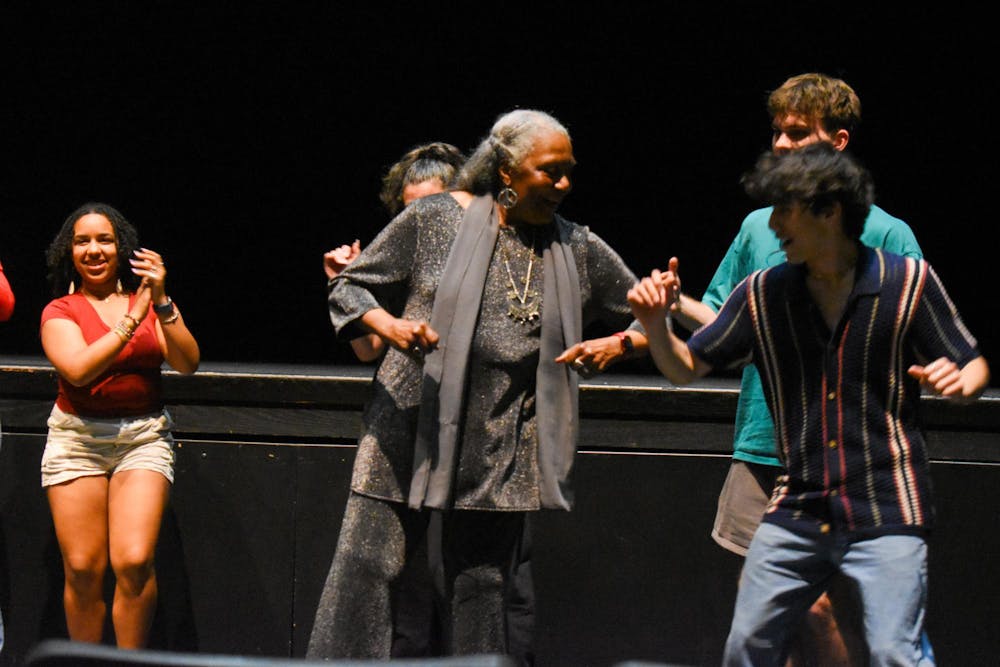
The Elon community found rhythm in McCrary Theatre as they gathered to hear Brenda Dixon-Gottschild discuss and perform her research on the Africanist presence in American dance.
The self-proclaimed “anti-racist” told the audience that while she was reading from her notes, the event would not be a traditional academic presentation.
“I’m performing my research rather than researching performance,” Dixon-Gottschild said.
She opened the evening with a libation, sprinkling water onto the ground as a way of remembering and honoring the women before us. The audience called out names of mothers, women important to them, and repeated the word “asé” [ash-ay].
Dixon-Gottschild performed pieces by former Poet Laureates such as Kendrick Lamar, Joy Harjo, and Tracey K Smith, to express the importance of expanding knowledge through literature. Reading gave her the power to spread messages and emotions throughout the crowd.
“I express my discontent with the ravages of discrimination against my dancing body, my black body, my female body,” Dixon-Gottschild said.
The activist’s performances did not stop with expressive readings. As a dancer, Dixon-Gottschild encouraged the audience to join her in movement and expression.
Zoia Cisneros, a choreographer for Elon University’s spring dance concert, which ran March 6 to 8, said she had hopes of being Dixon-Gottschild’s student when she lived in Philadelphia 20 years ago. Though she was unable to do so as a new mother, she found herself in McCrary getting to dance with her idol. She said Dixon-Gottschild asking her to create a rhythm with students and other community members was something she found special and necessary.
“This is divine timing,” Cisneros said. “There’s not any configuration. It’s not going to be the same again. We are the people here, present, and that’s the time and I had to be there.”
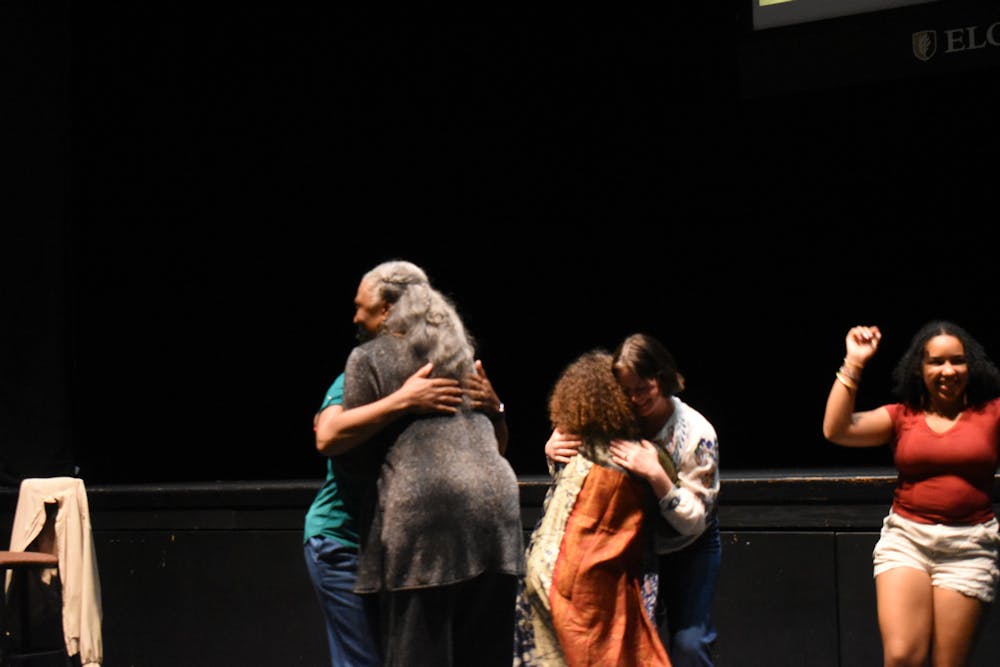
Elon freshman Benta Owino has been a dancer since she was three-years-old. Like Cisneros, she went down to dance with Dixon-Gottschild and her peers.
Owino referred to Elon University as a predominantly white institution, or PWI. In a Sagepub article, this is defined as schools with their white student body population exceeding 50%. It also describes a place that is known historically as a white institution.
“As a black dancer, I grew up in a mainly white dance environment and here at a PWI, it’s really important to have people come here and feel seen as a dancer and to diversify your outlooks and the community,” Owino said.
Owino said that it is important to create a space for black dancers in a predominantly white environment to be represented.
For Cisneros, the talk highlighted the spiritual connection between dance, ancestry, and identity.
“We’re human,” Cisneros said while crying. “We’re women. We’re letting our womb speak, and in the womb we hold many in our DNA. We hold our ancestors and they’re speaking to us.”
Cisnero said her reflection on ancestry came from the appreciation Dixon-Gottschild shared of past black dancers and ancestors.
Dixon-Gottschild said throughout the event that she was “reclaiming her time.” She said that time isn’t just what we see on a clock; it’s the sense that, as a society, we have to act together and create platforms to support communities.
“I'm spreading my wings, and this black bird flies ready to embody my activism, to let my body do the thinking and my mind to do the dancing, to be an activist without being a hater,” Dixon-Gottschild said.