

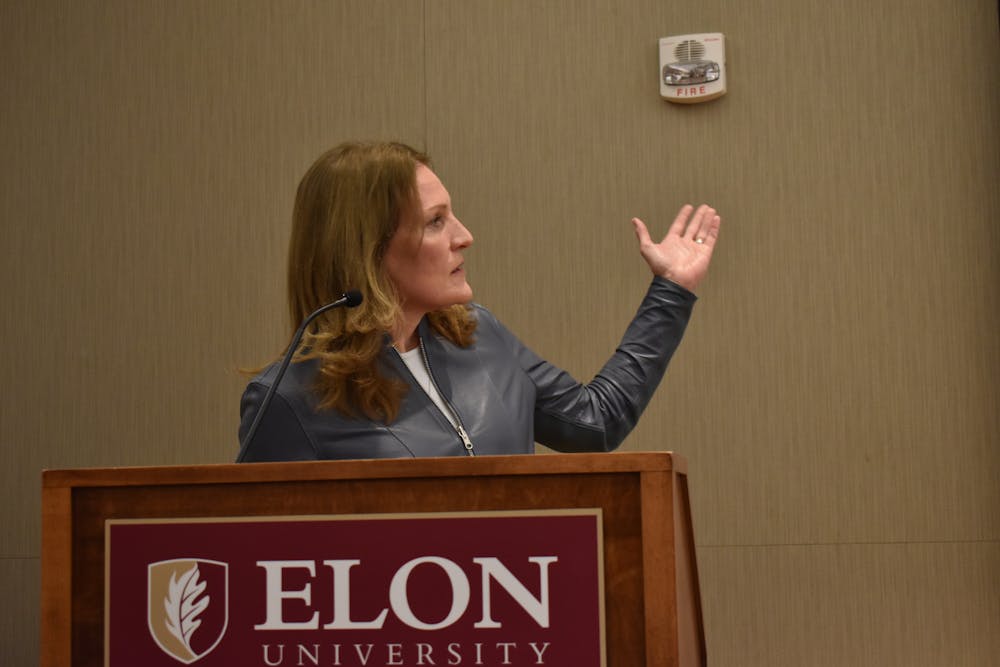
The Elon community gathered in Numen Lumen’s McBride Gathering Space room to hear Cynthia Miller-Idris speak about the influence of misogyny on domestic violence and violent extremism.
The lecture honored the memory of Lauren Dunne Astley, who was murdered by her boyfriend in July 2011, before she was able to begin her college journey at Elon University.
The Astley family has remained very involved in the Elon community since her passing. Her father, Malcolm Astley, opened the lecture with a speech to remember his daughter. He called for attendees to build their self-worth and encouraged them to “keep on sparkling.”
That focus on prevention and early intervention framed the evening’s lecture by Miller-Idriss, author of “Man Up: Understanding Misogyny to Prevent Extremism.”
In 2017, a white supremacist group and counter protestors gathered for a rally in Charlottesville. The rally ended with 19 injured and a woman dead, after a man allegedly drove into the crowd. After the events of the Charlottesville Unite the Right rally, Miller-Idriss focused her attention on advising tech companies on youth media culture.
Miller-Idriss founded the Polarization & Extremism Research & Innovation Lab, PERIL, at American University. A team of researchers from PERIL has been in North Carolina all week to train communities in recognizing manipulative online content and the emotions it incites.
“Education alone doesn’t prevent you from being manipulated,” Miller-Idriss said. “It’s a different kind of information literacy, literacy and a sort of skepticism.”
She said that college students are concerned about their peers, their family, and society as a whole.
“There are earlier ways to prevent and off-ramp people who are exhibiting signs we should be concerned about, including gender-based harms,” Miller-Idriss said in an interview with Elon News Network.
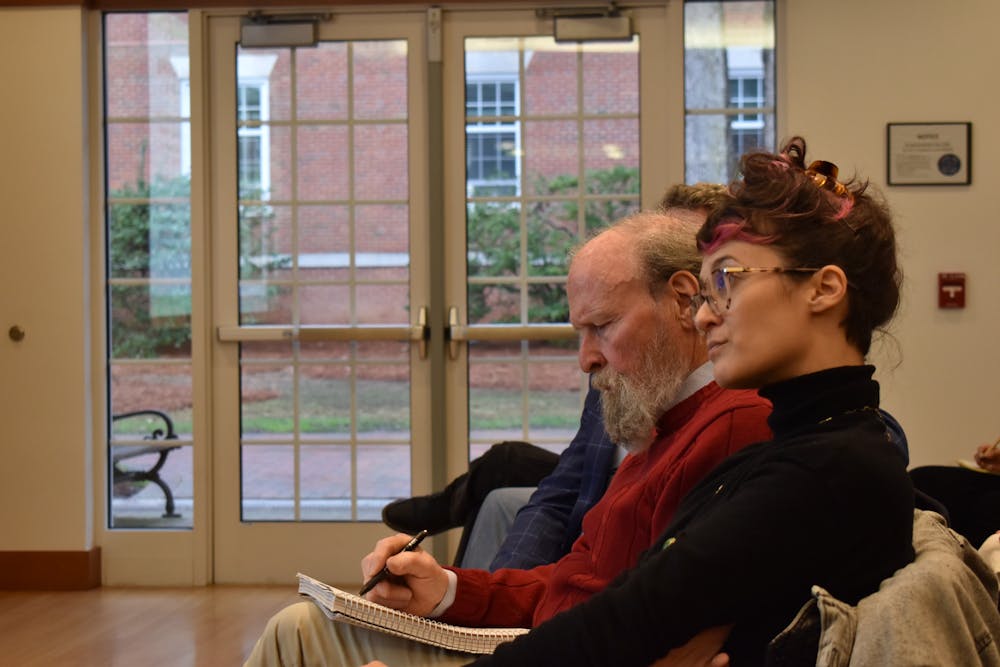
Malcolm Astley opens lecture with hope, telling crowd to embody his late daughter's vibrancy and "keep on sparkling."
Early intervention, she said, is especially effective amongst college students, who are able to share their learning experiences with younger generations, like their siblings. Manipulation in media is not a problem for a singular age demographic, though, everyone is susceptible.
“College students are great replicators of information for their family members,” Miller-Idriss said in an interview with Elon News Network.
It’s this same demographic that is most susceptible to manipulation, as they enter a vulnerable time of early adulthood.
Cheyenne Jacobs, a senior taking a sex, gender and power class, was invited to introduce the lecturer. She said discussions surrounding misogyny on campus were lacking, and bringing Miller-Idriss was the first time the campus had acknowledged this social issue.
“It’s always brushed off and insulted,” Jacobs said.
To Miller-Idriss, addressing misogyny and online manipulation begins with communicating and educating peers. That message resonated with students like Jacobs, who said conversations about misogyny remain limited on campus, particularly with Greek life.
“I feel like this school should be implementing more tactics,” Jacobs said, “Not just the mandatory ‘no hazing’ but talking to these large groups that are setting the standard of what’s normal on this campus. It really stems a lot from educating Greek life.”
During the Q&A portion of the lecture, students extended the discussion beyond campus. One mentioned the recent incident in which President Donald Trump and the USA Olympic men’s hockey team laughed at the women’s team, disregarding their success, highlighting the prevalence and normalcy of misogyny in sports and politics.
“There might be a room of 10 men,” Miller-Idriss said. “Only one man makes the sexist joke. Three might laugh. Five say nothing. And one says something.”
In an interview with Elon News Network, Miller-Idress said that college students were less worried about their own susceptibility to manipulation and more concerned about society as a whole. She said that it can feel hopeless if someone thinks society is doomed.
“But if you think society is made up of all of us, and I can have an impact here on the girls and boys club that I volunteer in, or in my job at the ice cream parlor where I have a couple high school students there, you can actually have a pretty big impact by having those conversations,” Miller-Idriss said.
Abby Gravely contributed to the reporting of this story.