

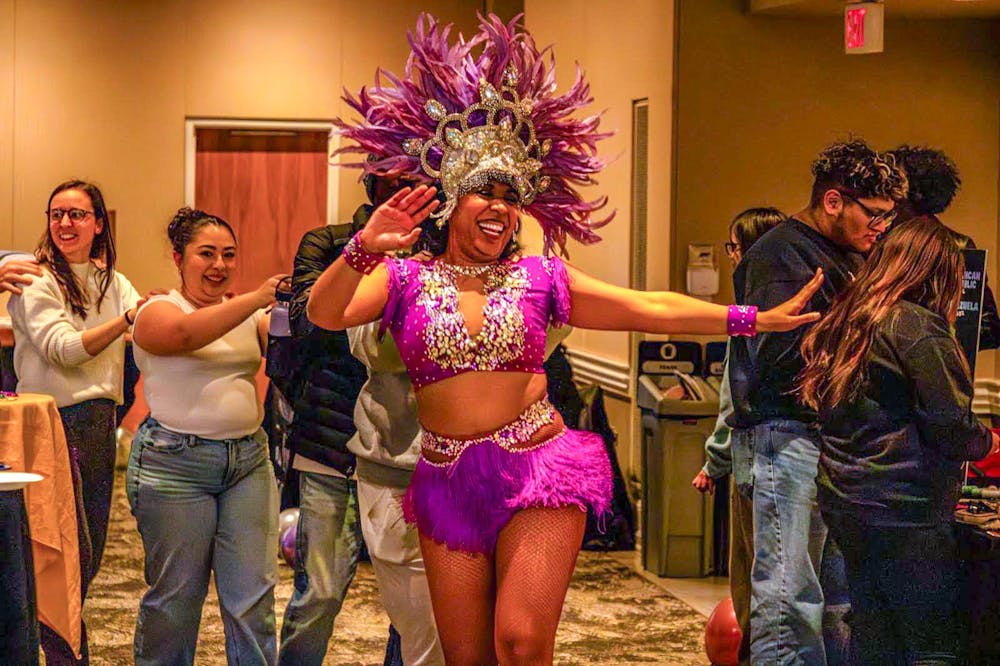
Mckinnon Hall was decorated in gold, green and red on Feb. 25 as students came together for Elon’s Carnaval celebration, a festival celebrated across Latin America before Lent begins. The event featured food, crafts and performances from Elon’s drum line and traditional Afro-Brazilian dance.
El Centro student coordinator and Elon senior, Nicole Castillo, said that Carnaval is celebrated across Latin America in ways many people may not realize, showing the festival’s deep cultural and religious roots.
“It is celebrated all over Latin America, and that is something that not a lot of people know,” Castillo said. “Different countries celebrate it completely differently. It’s not the same as in Brazil, as in Ecuador, as in Bolivia.”
Hosted by the CREDE and El Centro, the event featured dancing, food, crafts and informational displays on how different countries celebrate Carnaval. While Brazil is the country often most associated with the festival, organizers said they wanted to broaden that perception.
The event was held during Black History Month to emphasize the African and Afro-Latin influences embedded in the celebration.
“This year, we decided to do it a little bit differently and showcase Carnaval in other countries in Latin America,” Castillo said. “The reason why we're doing it right now is because there's a lot of cultural mixing due to colonization, cultures and religions mixed in South America.”
Carnaval is rooted in Christianity and takes place before Lent, 40 days of reflection and sacrifice leading up to Easter. It is traditionally a time of celebration before many Christians give up certain habits or luxuries for Lent.
“We want to share the message that Carnaval is created by Christianity and different cultures combined,” Castillo said. “It's mostly seen in Brazil, but a lot of countries celebrate it, and it has a lot of cultural mix.”
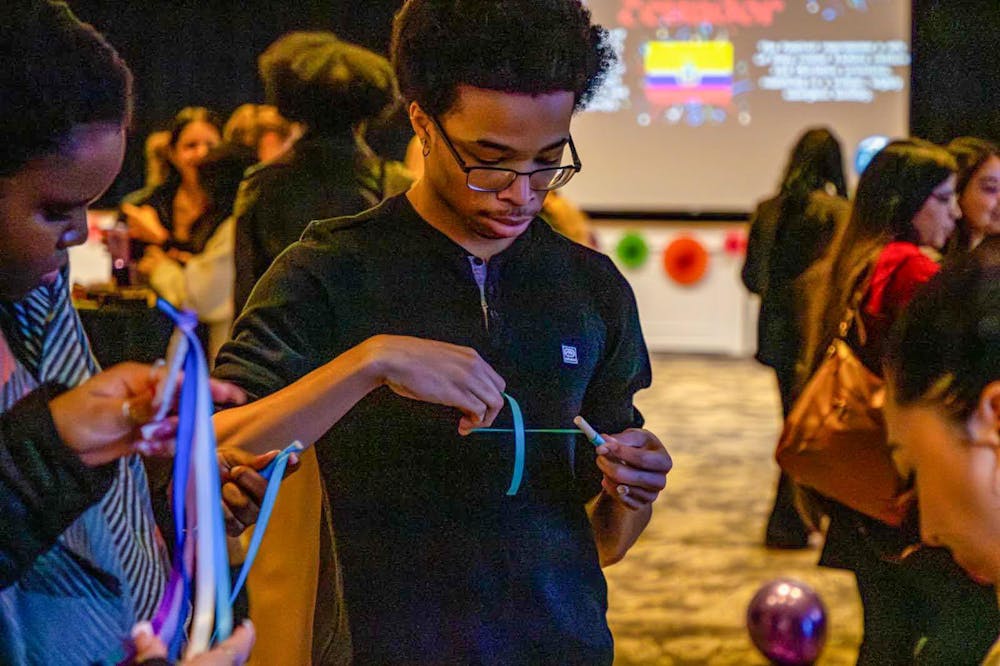
Stations representing different countries let students engage with a variety of cultural traditions. At one table, students created masks inspired by Brazil. At another, they made crafts reflecting Bolivian customs. Posters detailed how each country celebrates differently.
The event also featured performances by the North Carolina Brazilian Arts Project, which specializes in Afro-Brazilian art forms. Assistant Director of the project, Courtney Feliz, said she wanted to share both the joy and history behind the traditions.
“We wanted to show people the joy of Brazil, a little bit of the history of Brazil, a little bit of the roots of samba,” Feliz said. “Carnival is one little piece of what we see, and I’m very grateful we got the opportunity to showcase that.”
Feliz said she chose the music to make the experience interactive and accessible. Their dance had traditional samba rhythms along with a fusion selection and added a conga line to encourage audience participation.
“I was thinking about what would make people get excited and actually start moving and dancing with us,” Feliz said. “How can we make it fun, engaging, and bring people out to experience it a little differently with us?”
Feliz emphasized the importance of showing respect for cultural expression.
“This is a cultural art form, and we want to make sure we’re treating it with the utmost respect for African Brazilian culture and the roots of where it came from,” she said. “I hope more people explore it and try it.”
Travis Espinoza, a visitor who is thinking about attending Elon University for graduate school, attended the event after being encouraged by close friends. Espinoza said that the celebration was memorable for its energy and engagement.
“I think what stood out to me the most was either the performances or the tabling,” Espinoza said. “Every table had a different activity. I was able to make myself a little key chain and got to learn more about different countries.”
He said the interactive components made the experience more meaningful, allowing him to participate rather than simply observe.
“It made me feel very much like I was a part of something,” Espinoza said. “Even though it’s not part of my culture, it was really nice just to get a feel of someone else’s culture.”