

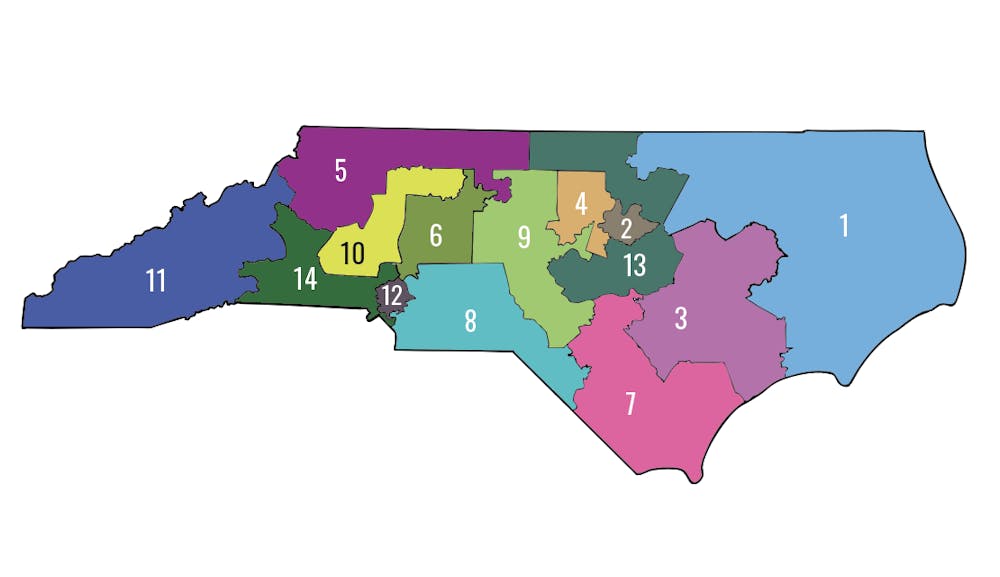
The North Carolina state legislature approved a new congressional map. This change comes after the Trump administration has been pressuring Republican states to change their congressional maps to ensure Republicans continue to control Congress after the 2026 midterm elections.
In a post on X, formerly known as Twitter, North Carolina senate leader Phil Berger said, “The NCGA is ready to help Republicans secure Congress and move Donald Trump’s agenda forward.”
North Carolina is not the first state to change its map. In August, Texas Republicans altered their congressional map, making Republicans more likely to win five additional seats. In response, California Gov. Gavin Newsom requested his state legislature to change their congressional map to favor Democrats in 2026. In September, Missouri also changed its congressional map to ensure the GOP would gain an additional House seat. Multiple other states are also considering changing their congressional map.
“I’ve got bad news for Gavin Newsom and the radical left,” Rep. Brenden Jones said during the House’s session on Oct. 22. “North Carolina will not stand by while they tried to undermine the will of our voters and stacked the decks in Washington.”
Usually, states will not change their congressional maps until after a census, which happens once a decade. With Republicans trying to maintain power in Congress with a six seat majority, the plans to redistrict would allow them to pick up more seats in 2026.
The North Carolina House of Representatives voted 66-48 in favor of the new map on Oct. 22. This will affect voters in the 1st and 3rd congressional districts. Rep. Don Davis, a Democrat, is the representative for the 1st district, which he won in 2024 by less than two points. The new map would make it more likely for Republicans to gain one seat in next year’s midterm elections.
In a press release posted on his X account, Davis called the decision to change the congressional map one of the darkest moments in North Carolina history.
“Our state has prioritized passing a new congressional map that affects only our region, with the intention of predetermining the outcome of an election 377 days away,” Davis said in the post.
Davis’ office did not respond to Elon News Network’s request for comment.
Anderson Clayton, chair of the North Carolina Democrats, claimed the new map would dilute and disenfranchise Black voters in the northeastern part of North Carolina. According to Census Reporter, 39% of voters in the 1st district are Black. Even though the area of the 1st district has changed over time due to redistricing, the 1st district has had a Black representative every year since 1992.
“If you ask the average person whether or not the government is effective, they would probably tell you no,” Clayton said. “And it doesn’t help to have that happen when you see congressional maps redrawn every two years. This is the fourth time we’ve redrawn maps in five years in North Carolina, and what that means is that people feel alienated from who represents them in Congress or at a state legislative level and it means they are less connected to government.”
Rep. Rodney Pierce denounced the bill during the House’s session on Oct. 22 and said it fractures the 1st district’s primarily rural community.
“This bill redraws Congressional District 1 in a way that doesn’t just shift boundaries, it fractures communities. It pulls together counties that have little in common in geography, economy and daily life,” Pierce said. “When you do that, you dilute the voice of people who have long toiled together toward a common good.”
The North Carolina GOP did not respond to Elon News Network’s request for an interview.
In Texas, voting rights advocates sued to overturn the new map. In North Carolina the new map is facing similar legal challenges. According to the Public Radio for Eastern North Carolina, a preexisting lawsuit was amended to include a challenge to the newly drawn districts. The lawsuit, Williams v. Hall, focused on the alleged violation of the 14th and 15th Amendments and Section 2 of the Voting Rights Act. The lawsuit claims that the violations affected Black voters in the Triad area. Arguments for the lawsuit have already been made in court, but no verdict has been decided.
Clayton said the North Carolina Democrats have a long term plan to address gerrymandering in North Carolina which included reclaiming the state supreme court in 2028.
“What I do think, though, that people need to understand is that the short lived victories that they will have, will be the long term gains of the North Carolina Democratic Party,” Clayton said. “And I say that because we have been on a three step plan to take back the North Carolina State Supreme Court and also eradicate partisan and racial gerrymandering.”