

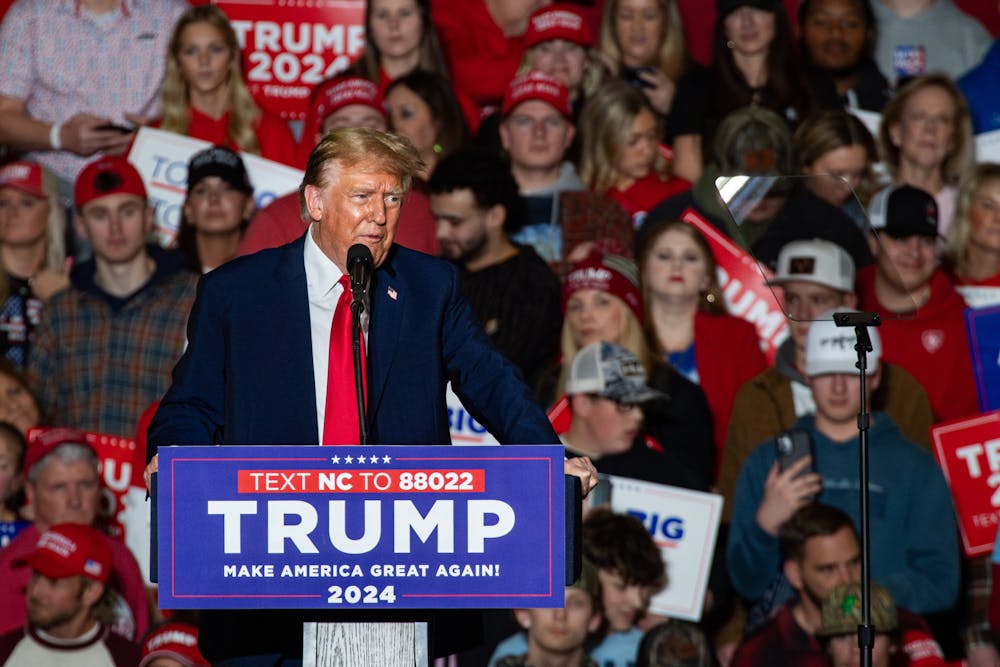
The Elon University Poll published its third report this month showcasing a steady decrease in Trump’s approval rating in North Carolina over time.
This most recent poll found that 39% of North Carolinian adults surveyed currently approve of the job President Donald Trump has done so far.
The Elon Poll published in February 2025 found that Trump had an approval rating of 45% amongst North Carolinians, which dropped to an approval rating of 41% amongst North Carolinians in April 2025.
This most recent Elon Poll surveyed a sample of 800 North Carolinian adults.
Director of the Elon Poll Jason Husser said one of the factors contributing to Trump’s decrease in approval ratings is Independents breaking away from Trump.
”Trump has tended to do much better when he is the outsider, bringing a challenge to a group of people who he thinks are doing wrong for America, sort of he's still the savior against a particular enemy,” Husser said. “Once he is the insider, particularly when he has the level of control of Congress that he has right now, it makes it a little bit harder for him to effectively frame himself as the person fighting the system among people who were marginally attached to him to begin with.”
The most recent Elon poll also found that a majority of respondents believe that inflation, the job market and the current state of the economy have all gotten worse since Trump took office.
Respondents also are concerned about how federal spending cuts will affect healthcare, with 63% saying they were very or somewhat concerned.
“If we do see more and more anecdotes and people feeling health care pinch related to the recent Trump administration changes, I think that could be a real challenge for Republicans in 2026,” Husser said.
Trump’s approval rating was split between party lines, however 56% of those surveyed who identify as Independent disapproved of Trump’s performance.
On a national scale a recent poll from YouGov, the organization the Elon Poll partnered with to conduct field works, found that 55% of Americans currently disapprove of the job Trump has done so far while 40% approve.
The most recent Elon poll also found that a majority of respondents believe that inflation, the job market and the current state of the economy have all gotten worse since Trump took office.
Respondents also are concerned about how federal spending cuts will affect healthcare, with 63% saying they were very or somewhat concerned.
“If we do see more and more anecdotes and people feeling health care pinch related to the recent Trump administration changes, I think that could be a real challenge for Republicans in 2026,” Husser said.
The Elon Poll also found that 42% of respondents approve of the job North Carolina Gov. Josh Stein has done since being in office. This shows a 2% drop in approval rating since March 2025. There has been an increase in North Carolinians who disapprove of Stein’s performance, increasing from 17% to 24% in March 2025.
“He's vetoed a number of pieces of legislation that Republicans really wanted to see,” Husser said.
Stein vetoed 14 pieces of legislation during this past legislative session.
As North Carolina gears up for a Senate race between Democrat and former governor Roy Cooper and former Republican National Committee chairman Michael Whatley, the most recent Elon Poll found that only 26% of North Carolinians had heard a great deal or some about Whatley.
However, 40% of those who were surveyed had a very or somewhat favorable impression of Whatley.
“Roy Cooper is arguably the best well known North Carolina politician,” Husser said. “Once the Republican campaign apparatus kicks in, Whatley could really gain a lot of ground quickly, and so that's something I really want to emphasize.”
Cooper has never lost an election in his political career.
For Cooper, 75% of North Carolinians had heard a great deal or some about the former governor. The poll found that 50% of those who were surveyed had a very and somewhat favorable impression of Cooler.
The North Carolina Senate race is projected to set funding records, potentially becoming the first billion-dollar Senate race.