

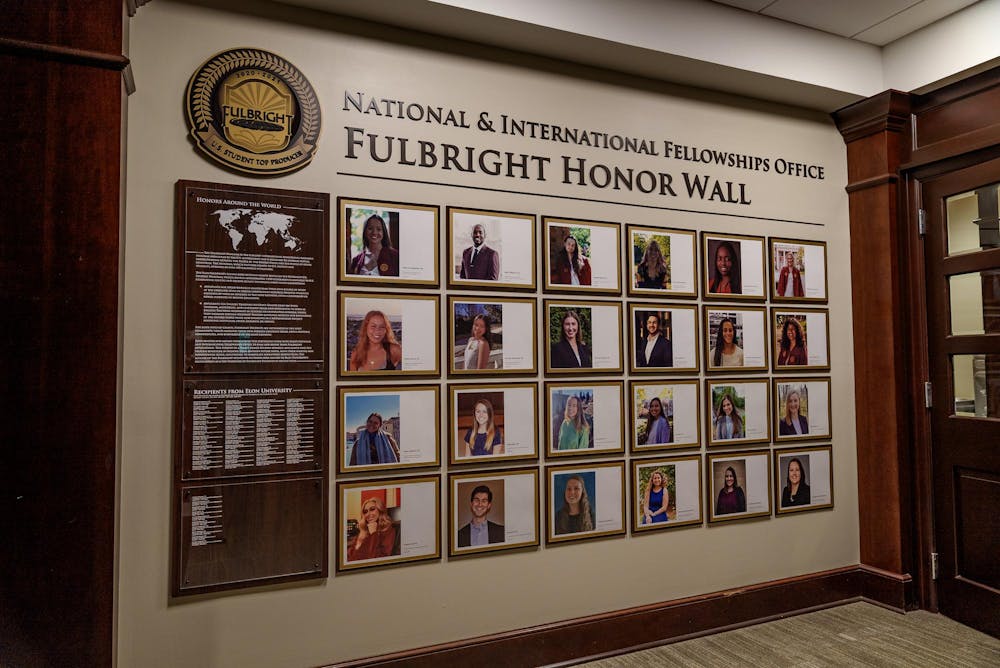
There were no Fulbright finalist announcements and clear information at Elon University’s annual celebration for students applying to fellowships, creating a tense atmosphere for the first time in years. It was a harsh reality for Nicole Galante, the assistant director of national and international fellowships.
“Since the inauguration, it has been kind of turbulent in the fellowships world,” Galante said. “So many of the awards we work with are government-funded, like Fulbright, and in the midst of all of this uncertainty and changing in the government, students have been a casualty.”
The Fulbright U.S. Student Program provides grants for research, graduate study and teaching English abroad in more than 140 countries, according to the Fulbright website.
Typically, Fulbright results come out between mid-March and mid-April. But this year, the results were almost two months late, with the first ones announced on May 7, according to Galante. This delay has left many of the 14 Elon semifinalists in a difficult position, unsure if they will ever receive a decision. As of May 16, more than half the semi-finalists at Elon have heard back, Galante said. According to the Fulbright website, applications continue to be reviewed as of May 31.
“They didn’t know if they would ever hear about a Fulbright result, let alone find out they got the grant,” Galante said. “It’s one thing not to get a grant, but it’s another thing to just never know.”
The delay is part of a trend. Fulbright, a U.S. government-funded international education program in over 140 countries, is caught in a federal funding freeze tied to budget conflicts under the new administration’s spending priorities. Similar programs like the Gilman International Scholarship Program, also experienced funding cuts. Galante said Fulbright’s staff was reduced from 15 to just two active employees during critical months when notifications and information were being delayed.
For some students, the uncertainty has been overwhelming. Britt Mobley ’24, an Elon alum and former student body president, is currently teaching English in the Czech Republic with the Fulbright grant and said he saw the effects firsthand. Countries without Fulbright Commissions are countries that don’t have a dedicated local organization to manage the Fulbright Program. Instead, the U.S. Embassy in the countries handles the program’s administration.
“Countries without commissions, primarily in Central and South America, Southeast Asia or Africa, are run through the U.S. Embassy, and a lot of those English teachers either have not been paid, have had to go home or are just kind of stuck,” Mobley said.
Mobley’s experience in Europe was more stable. The Czech Republic’s Fulbright Commission, funded by both the U.S. and Czech governments, kept its program running without issues.
“We were given the confidence that we have our money,” Mobley said. “But this situation reveals a larger problem. The United States has, in history, taken very isolationist points, and it has never turned out to be good. We are better because we exchange and we are partners.”
For Mobley, the situation has also forced a change in how he approaches his work.
“At first, I was just focused on teaching English, making sure they learned the material,” Mobley said. “But now, I’m thinking about the connections I’m building, the lives I’m impacting. That’s what Fulbright should be about.”
Elon senior Sadie Smith, a semifinalist for a Fulbright English teaching assistantship in Bulgaria, described feelinglost in the silence.
“I have heard absolutely nothing from anyone at Fulbright — zero, like, absolutely no email, anything about anything,” Smith said. “Everything has been extremely uncertain.”
Smith said the help she received from Elon University while waiting for answers has meant a lot to her.
“Elon is genuinely so supportive,” Smith said. “Throughout this application process, I was super impressed with all the work they do and those people and how supportive and helpful they were throughout.”
Galante said the lack of clear communication made an already stressful situation worse.
“Fulbright was saying that the delays were because host countries had not yet finished their selection,” she said. “But we know that the host countries did finish their selection. The issue was that things were being held up on the U.S. side.”
Galante tried to keep students informed, but she said it was difficult without reliable updates. Despite the confusion, many students remain committed to international exchange.
“Fulbright is at its heart about cross-cultural exchange, and thankfully, our students are committed to these things, whether or not the government says they are valuable,” Galante said.
But the uncertainty has taken a toll. Smith, who once saw Fulbright as a possibility, has had to rethink her plans.
“I was always looking at other options,” she said. “But once all of this started happening, it was just like, ‘OK, Fulbright’ — I’m going to pretend like it’s not an option.”
Galante emphasized that Fulbright’s real value is in the connections it builds.
“Fulbright was started after World War II with the idea that if more people from around the world started talking to each other, the likelihood of serious conflict would be much less,” Galante said.
But for students such as Smith and Mobley, this year’s uncertainty has highlighted a larger issue with the U.S. government’s support for international education and diplomacy.
“It’s disappointing,” Smith said. “The lack of care, it’s very clear where this administration’s values lie.”
As the situation evolves, Galante said she is still committed to helping her students.
“I promise I will do my part to make this world a more decent place for your sake, because you all make this a world I want to be part of in the first place,” Galante wrote in a LinkedIn post from early May.