

Updated as of 5:21 p.m. May 6 to include statement from Jason Kirk, Andrew Monteith and Brett Cooper.
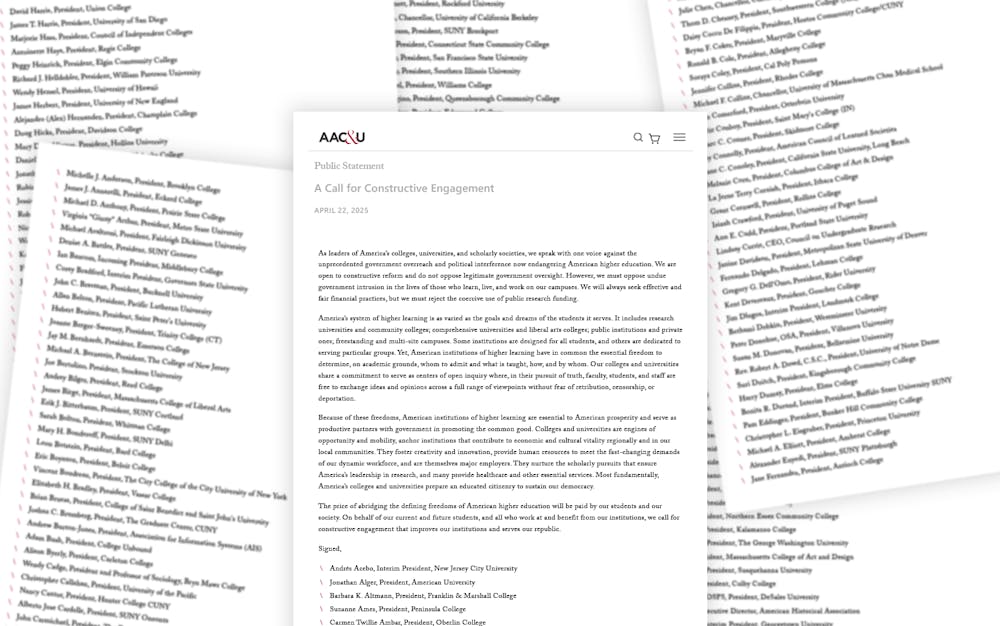
The American Association of Colleges and Universities released “A Call for Constructive Engagement” on April 22. This was released by university presidents across the U.S. in response to the “unprecedented government overreach and political interference now endangering American higher education.”
The statement calls for “constructive engagement that improves our institutions and serves our republic.”
The mission of the AACU is to advance the “democratic purposes of higher education by promoting equity, innovation and excellence in liberal education,” according to its website.
As of noon May 5, 612 university and college presidents have signed on — Elon University has not. Eric Townsend, university spokesperson, provided a statement on the university’s behalf. While Elon has not signed onto the letter, Townsend wrote that higher education still stands together as a sector to work through current “challenging federal policies.”
“Elon University has reviewed the AAC&U letter and appreciates that this message supports and complements the ongoing efforts of many higher education leaders to collectively convey the importance and value of higher education,” Townsend wrote. “Many university and college leaders are working through appropriate legal challenges in partnership with higher education professional associations.”
Randy Williams, vice president and associate provost for inclusive excellence, also did not respond to Elon News Network’s immediate request for comment. Williams is also a member of the board of directors of the AACU.
Jason Kirk, Elon political science professor, said even without Elon signing onto the letter, the message of the letter and diversity of the schools included stood out to him.
“I think that was also really affirming to see this isn’t just the Ivy’s and the elite schools,” Kirk said. “The statement specifically talks about the real diversity of higher ed in the U.S., including community colleges and liberal arts colleges, which is where Elon began as a liberal arts college.”
Schools are responding in different ways to federal pressure to change practices within institutions in exchange for federal funding. Harvard University was the first university to reject what the university president described as “unprecedented demands,” including eliminating diversity, equity and inclusion programs.
Andrew Monteith, Elon professor of religious studies, said it makes sense for Harvard, the wealthiest university in the world, to be able to fight this battle. Harvard has a $53.2 billion endowment, and Elon’s endowment stood at $367 million in fall 2024.
“They are absolutely trying to dictate what is or is not acceptable,” Monteith said. “Course content, it’s a wild overreach for the office of the president. Harvard has the money to fight that in court. We’re doing OK, but we’re not Harvard.”
Brett Cooper ’05 said when he first saw the AACU statement he immediately scrolled to the bottom to search for Elon and President Connie Book’s name. When he didn’t see either listed his first reaction was disappointment, he said.
“I was just disappointed given where the attacks that we were seeing against colleges and academic freedom right now,” Cooper said. “Reading what the statement was like, it felt very much in line with where I would want Elon to be.”
Cooper said after seeing the range of schools that were included on the list he was more frustrated to not find Elon included. Eight out of Elon’s 15 peer institutions signed onto the statement.
“Seeing them on this list, and seeing Elon apparently not selectively deciding we didn’t want to stick our neck out there — it was disappointing,” Cooper said.
Monteith said at Elon he feels the role faculty members play is different from the role of administrators, as a university president is someone who has to answer to many more individuals — including students, parents, faculty and the Board of Trustees.
“I don’t know that faculty and Connie Book have to play the same roles,” Monteith said. “I feel that my own job requires me to one, to not be silenced just because the government wants us to stop talking about things that’s a foundational principle of academic freedom.”
Kirk said as someone working in higher education, he is concerned about many ways that the federal government has been involved with issues within higher education. He said he is specifically concerned about his coworker who’s $250,000 federal grant from the National Endowment for the Humanities was revoked last month and cuts within science, technology, engineering and math fields.
Kirk participated in Elon’s Day of Action “teach-in” event hosted by Elon’s chapter of American Association of University Professors. During his session, he read from the books “On Tyranny” and “On Freedom” by Timothy Snyder. He said one section he read focused on authoritarian governments, focusing on Europe.
“The lesson for that particular entry is, do not obey and advance,” Kirk said. “Because when you do, you essentially teach the powerful how far they can push.
Kirk said he did not know what decisions went into different universities’ decisions to sign or not this statement — but thought the message of the statement was important to be shared with the public.
“I do think that collective statements and more importantly collective action by university leaders is just essential in this critical moment facing American higher ed,” Kirk said. “But institutional autonomy is also an important academic value and campuses face both similar and unique situations.”
Cooper said while he wasn’t sure what, if any, impact this statement would have on public policy — the message it is sending to have colleges unite together is something people notice.
“An attack on one schools academic independence and attack on its students and professors is an attack on all of academia,” Cooper said.
Signatories from North Carolina college presidents include Wake Forest University, Davidson College, Duke University and Warren Wilson College.
“Our colleges and universities share a commitment to serve as centers of open inquiry where, in their pursuit of truth, faculty, students, and staff are free to exchange ideas and opinions across a full range of viewpoints without fear of retribution, censorship, or deportation,” leaders wrote in the statement.
The AACU is continuing to accept signatures from current leaders of colleges, universities and scholarly societies.
Monteith said as it’s not clear yet what action this statement will bring, if any, it makes it harder to know what the best course of action is — but as an individual he feels it is necessary for him to share his beliefs.
“I feel compelled to speak on issues that matter to me, which, right now, I think the government is behaving in essentially fascist, restrictive ways,” Monteith said. “And so I don’t mind saying that in public.”